


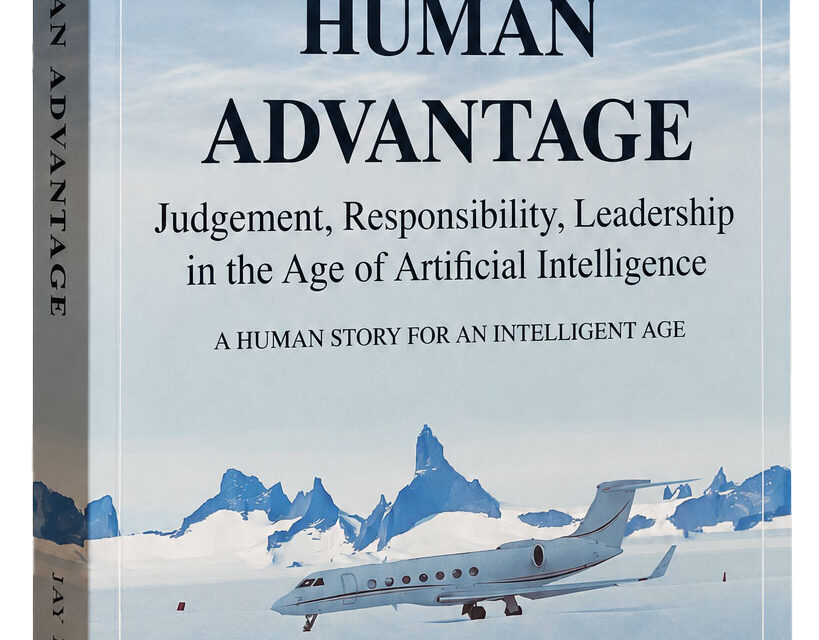
As artificial intelligence becomes increasingly autonomous, Durban author Jay Ramnundlall explores why human judgement, responsibility and leadership must remain at the centre of technological progress.
Artificial intelligence is transforming how we work, learn and make decisions. But as technology becomes more capable of acting independently, an important question emerges: who remains accountable when machines make decisions that affect human lives?
Durban author and technology entrepreneur Jay Ramnundlall tackles this question in his latest book, The Human Advantage: Judgement, Responsibility and Leadership in the Age of Artificial Intelligence.
Officially launched in Umhlanga in October 2026, following its introduction at the sold-out KZN AI Summit, the book examines the growing influence of autonomous AI and the responsibility humans have in shaping its future.
Drawing on more than four decades of experience in business, technology, entrepreneurship and education, Ramnundlall offers an African perspective on one of the most pressing conversations of our time.
The Human Advantage: Keeping People Accountable in an AI-Driven World
As artificial intelligence moves beyond generating information to making decisions and executing tasks, traditional ideas of responsibility are being challenged.
For Ramnundlall, who serves as CEO of the Alpvest Institute for FutureTech (AIFT), the greatest concern is not necessarily what AI can do, but what humans may stop doing as a result.
“The central message is simple: we may delegate intelligence, but we must not surrender judgement, responsibility or accountability. The greatest risk is not simply that AI will think for us. It is that we may gradually lose the habit of thinking for ourselves,” he explains.
Rather than presenting artificial intelligence as a threat to be feared, The Human Advantage encourages readers to consider how technology can enhance human capabilities without replacing independent thought.
The book also challenges business leaders, educators and policymakers to establish clearer boundaries around the use of AI.
How Artificial Intelligence Could Reshape Employment and Education
One of the book’s central themes is the future of employment.
While artificial intelligence promises greater productivity and efficiency, its growing ability to perform entry-level tasks raises concerns about how young professionals will develop essential workplace skills.
If AI handles the responsibilities traditionally assigned to junior employees, where will the next generation of industry experts gain practical experience?
Ramnundlall also examines the role of education in preparing future generations for an increasingly automated world.
“Education must develop three capabilities: the ability to think and solve problems independently; the ability to use AI effectively; and the ability to supervise, challenge and, when necessary, reject its outputs,” he says.
His argument places critical thinking, ethical judgement and human oversight at the centre of future skills development.
Responsible AI Leadership: Who Makes the Final Decision?
Beyond employment and education, The Human Advantage explores how organisations can introduce artificial intelligence without compromising accountability.
The book presents four practical frameworks designed to help leaders navigate responsible AI adoption:
-
Accountability Distance: Examines the separation between the person responsible for an outcome and the reasoning behind it.
-
The Agency Envelope: Establishes clear boundaries around what AI systems may know, recommend, decide and execute.
-
The Responsibility Threshold: Identifies when the consequences of a decision require direct human judgement.
-
Human-Accountable AI: Promotes systems where responsibility remains traceable and important decisions can be explained, questioned or stopped.
These frameworks encourage organisations to consider not only what artificial intelligence is capable of doing, but also what it should be permitted to do.
For business leaders, the message is clear: technological advancement should not come at the expense of transparency, ethical decision-making or accountability.
Africa’s Opportunity in the Age of Artificial Intelligence
While much of the global AI conversation focuses on technological development and economic competition, Ramnundlall highlights the opportunities for Africa.
From expanding access to education and professional expertise to supporting entrepreneurship, artificial intelligence could help address longstanding barriers to economic participation.
However, he argues that technological access alone is not enough.
“The similarity in themes highlights a question confronting leaders everywhere: as technology becomes more capable, what must people become better at? For Africa, that means developing judgement and accountability while widening access to education, experience and economic opportunity,” he explains.
His perspective also aligns with themes identified in the World Economic Forum’s Strategic Intelligence Outlook 2026, titled The Human Edge: How to Lead, Decide and Thrive in the Age of Technological Disruption.
Through The Human Advantage, Ramnundlall brings an African voice to this international discussion, encouraging the continent to approach AI adoption with both ambition and responsibility.
Why Human Judgement Remains Our Greatest Advantage
Ultimately, The Human Advantage is more than a book about artificial intelligence. It is an exploration of what it means to remain human in a world increasingly influenced by intelligent machines.
Ramnundlall believes discussions about AI should extend beyond technology companies and industry specialists.
Businesses, educators, employees, policymakers and communities all have a role in determining how artificial intelligence is developed, governed and used.
“The human advantage is not necessarily our ability to outperform machines intellectually. It is our responsibility to determine worthwhile objectives, exercise ethical judgement and remain answerable for decisions that affect other people,” he says.
As artificial intelligence continues to evolve, the book offers a timely reminder that technological intelligence and human responsibility are not interchangeable.
Where to Buy The Human Advantage by Jay Ramnundlall
The Human Advantage: Judgement, Responsibility and Leadership in the Age of Artificial Intelligence is available in two formats:
-
Softcover: R389, available from Big Bang Shop.
-
Digital flipbook: R289, available through Payhip.
Readers interested in learning more about artificial intelligence can also access a free AI beginner’s guide.
To join the conversation around responsible AI, leadership and the future of technology, connect with Jay Ramnundlall or the Alpvest Institute for FutureTech on LinkedIn.
