


Choose Kruger if you can give a safari at least three nights and want the full, wild scale of South Africa’s flagship park. Choose Pilanesberg if you have a weekend, you are driving from Johannesburg and you would rather avoid malaria tablets. Both have the Big Five, so the real difference is time, distance and the kind of trip you want. Sabi Sand and Madikwe fit in as a third and fourth option, and we cover them below.
TL;DR
- Kruger covers about 19,485 km², Pilanesberg about 572 km². One is a multi-day expedition, the other a compact, easy weekend.
- Pilanesberg is roughly 2.5 hours from Johannesburg and malaria-free. Kruger is 5 to 6 hours away and sits in a malaria-risk zone.
- Kruger’s daily conservation fee from 1 November 2026 is R140 per adult for South African citizens and residents, R296 for SADC nationals and R692 for international visitors.
- Sabi Sand is a private reserve with a different style of safari, bordering Kruger. It suits a splurge rather than a budget self-drive.
- Plan at least three nights wherever you go, or pick Pilanesberg for a quick escape.
Table of Contents
- Kruger and Pilanesberg at a glance
- Size and wildlife: what the numbers mean on the road
- Getting there from Johannesburg
- Malaria: the practical difference
- Costs: entrance fees and what you will actually spend
- How many days do you need?
- Best time of year
- What about Sabi Sand?
- And Madikwe?
- Which one should you choose?
- Perspective
- Plan your next escape with Joburgstyle
- FAQ
- Sources
Kruger and Pilanesberg at a glance
| Kruger National Park | Pilanesberg National Park | |
|---|---|---|
| Size | 19,485 km² | 572 km² |
| Distance from Johannesburg | 5 to 6 hours | About 2.5 hours |
| Malaria | Risk zone | Malaria-free |
| Big Five | Yes | Yes |
| Best for | A dedicated safari of three nights or more | A weekend from Johannesburg |
| Style | Vast, varied, self-drive or guided | Compact, easy to cover, self-drive friendly |
The size and distance figures come from a side-by-side comparison of the two parks, which also confirms that all Big Five species are present in both.
Size and wildlife: what the numbers mean on the road
Kruger is about 19,485 km², against about 572 km² for Pilanesberg, according to that same comparison. You could fit Pilanesberg into Kruger dozens of times. On the ground, this changes how a day feels.
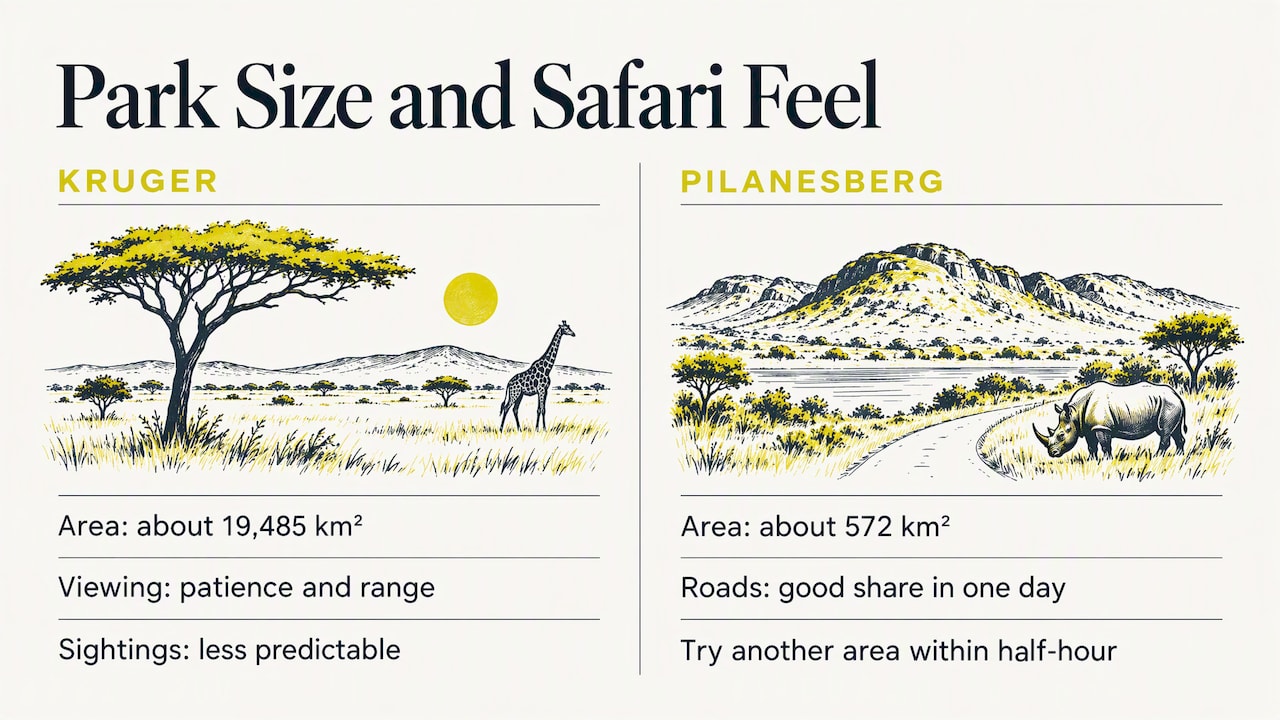
In Pilanesberg you can drive a good share of the roads in a day. If a sighting is thin in one area, you can try another within half an hour. That makes it forgiving for first-timers and for families with small children who tire of long drives.
Kruger rewards patience and range. Sightings are less predictable, and the landscape shifts as you travel between camps. The park is a flagship of South African National Parks, established in 1898 and spanning nearly two million hectares, and it also protects archaeological and cultural sites. You are choosing a place with real depth, not just a game drive.
Are there lions in Pilanesberg?
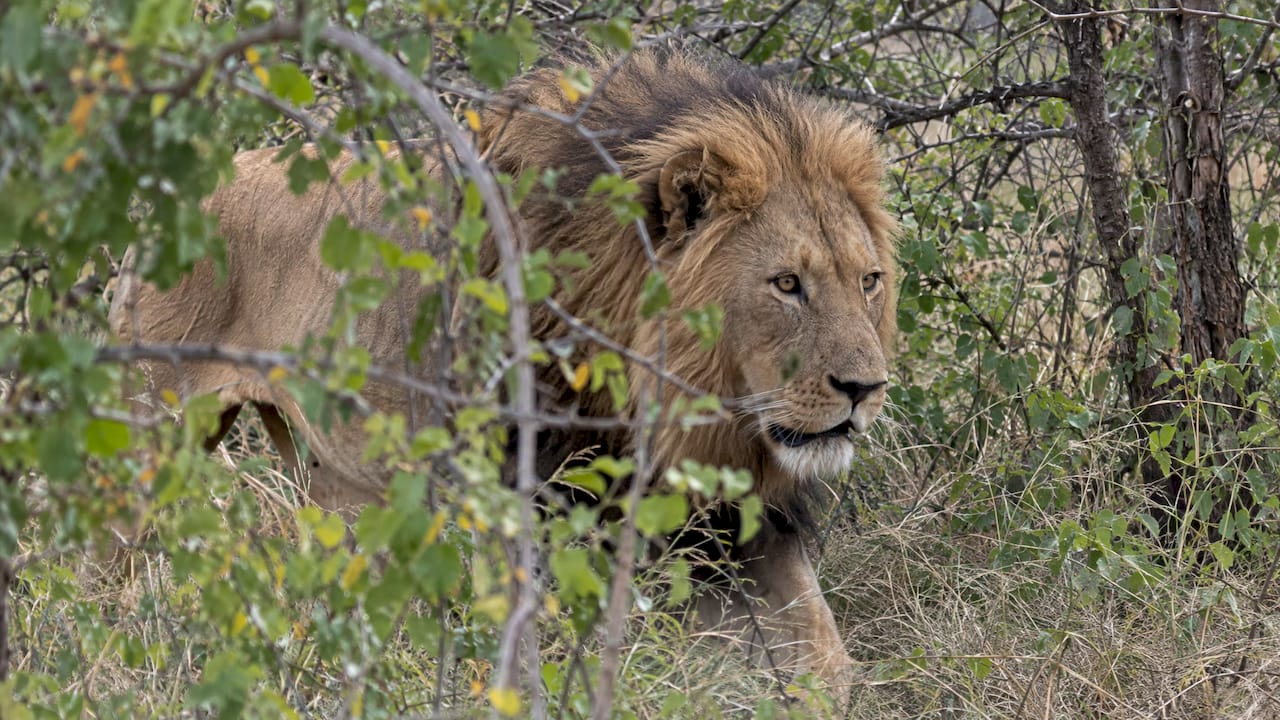
Yes. The Big Five (lion, leopard, elephant, buffalo and rhino) are all present in both parks, as the comparison above states. As in any wild park, seeing a specific animal is never guaranteed. Lions can be elusive in a compact reserve with dense bush, so ask at the gate or at your lodge where recent sightings were reported.
Getting there from Johannesburg
Pilanesberg is about 2.5 hours from Johannesburg. Kruger is 5 to 6 hours away, depending on which gate you use and the traffic. That gap decides most people’s choice.
With Pilanesberg, you can leave on a Friday afternoon, do a full Saturday on the roads and be home on Sunday. With Kruger, a weekend means long drives for very little time in the park. If you only have two days, the Kruger journey eats too much of the trip.
If you are weighing other short escapes too, our guide to weekend getaways from Johannesburg lists nine options within three hours.
Malaria: the practical difference
Pilanesberg is malaria-free, while Kruger is in a malaria-risk zone, per the comparison guide. For many travellers, especially those with babies, toddlers or pregnant family members, this is the deciding factor.
If you are heading to Kruger, speak to your doctor or a travel clinic well before you leave. Malaria risk and prophylaxis depend on your age, health, pregnancy status and the time of year, and only a medical professional can advise you. Do not guess or borrow someone else’s tablets.
Costs: entrance fees and what you will actually spend
Kruger’s published rates are clear. For 1 November 2026 to 31 October 2027, the daily conservation fees are:
| Visitor type | Adult (per day) | Child (per day) |
|---|---|---|
| South African citizen or resident | R140 | R70 |
| SADC national | R296 | R147 |
| International visitor | R692 | R345 |
To claim the South African rate you need proof: a South African ID, a South African driver’s licence or a South African passport, according to SANParks’ fee information. Carry it at the gate.
Pilanesberg fees are set by its own park authority and change from time to time. Check the park’s official website for the current daily rate before you leave, and budget for the fee per person plus your vehicle.
The fee is only a part of the bill. Think about:
- Fuel. Kruger’s distances mean more driving, and the drive from Johannesburg is more than twice as long.
- Accommodation. Staying inside Kruger, in the park’s own camps or lodges, adds up over several nights. Pilanesberg allows a day trip or an easy base nearby.
- Food and drinks. Pack a cooler for the road, and a picnic for the day, wherever the rules allow.
- Guided drives. Guided sunrise and sunset drives cost extra but improve your odds of good sightings.
Over a single weekend, Pilanesberg is usually the lighter option on your wallet because you save on fuel and nights. Over four or five days, Kruger’s per-day cost for South Africans is modest, and the value comes from how much you see.
How many days do you need?
Lonely Planet recommends a minimum of three nights for a safari. That is a sensible rule for Kruger, where the travel time and size make a one- or two-night visit feel rushed.
Here is a simple way to plan:
- One day: Pilanesberg only, as a long day out from Johannesburg if you start early.
- Two nights: Pilanesberg, with time for a morning and an afternoon drive on both days.
- Three to five nights: Kruger, in one region, so you spend your time looking for animals instead of crossing the park.
- Six nights or more: Kruger across two camps in different regions, or Kruger followed by a private reserve.
Best time of year
Season shapes what you see. As a general pattern, the drier months of the South African winter tend to be easier for game viewing, because the bush is thinner and animals gather around water. Summer is hotter and greener, with dense vegetation and afternoon storms, and it is also when many young animals are born and birds are at their best. Both parks can be rewarding at any time of year, so match the season to your priorities: clear sightings, comfortable temperatures or lush scenery. Check weather forecasts and the park’s current conditions before you leave, and book early for school holidays, when camps fill quickly.
Winter mornings can be cold in an open vehicle. Our safari packing list for South Africa covers what to wear for early starts and warm afternoons.
What about Sabi Sand?
Sabi Sand is a private nature reserve beside Kruger, and it works very differently from either national park. You usually stay at a lodge and join guided drives, instead of driving yourself through the reserve. Access is controlled: Sabi Sand enforces an internal curfew between 23:30 and 04:30, during which no unauthorised vehicles may travel through the reserve.
So in a Kruger vs Sabi Sand decision, think of it this way. Kruger is the wide, public, self-drive park with a range of budgets. Sabi Sand is the more exclusive, lodge-based option with a guide at the wheel. If your priority is a polished, all-inclusive stay, Sabi Sand is the one to price up. If you want freedom and a lower daily cost, Kruger fits better. Many travellers combine the two: a few nights in Kruger, then a short stay at a private reserve.
And Madikwe?
Madikwe is the other name that comes up next to Pilanesberg. Both lie in the North West province, in the same general direction from Johannesburg, so they suit the same kind of trip. For a Madikwe vs Pilanesberg decision, the question is mostly about style: Pilanesberg is the easy, accessible national park that you can do with your own car, while Madikwe tends to attract those looking for a quieter, lodge-style stay. Confirm current access rules, rates and booking requirements directly with the reserve before you commit.
Which one should you choose?
- A weekend from Johannesburg: Pilanesberg.
- Travelling with a baby or toddler, or avoiding malaria medication: Pilanesberg.
- First safari, nervous about self-driving: Pilanesberg, or a guided drive in Kruger.
- A proper safari holiday of three nights or more: Kruger.
- You want variety, space and the full sense of scale: Kruger.
- A special occasion with guided drives and a lodge stay: Sabi Sand.
If you are travelling with children, our piece on Kruger Station for families is a good place to start planning the Kruger side of the trip.
Perspective
We cover Johannesburg and its surrounds as people who live here, and we have a simple view of this choice: do not ask which park is better, ask which trip you actually have time for.
For most Joburgers, Pilanesberg is the park you can say yes to on a Thursday. It is close, it is easy, and it gets you out of the city and into the bush without a week of planning. Kruger is the one you save leave for. It is bigger than any weekend, and it deserves a few days and an early alarm.
Our approach at Joburgstyle is to point readers to places that give them a real experience, whether that is a quick escape from the city or a longer journey. We would rather you do one safari properly than rush two. Pick the one that matches your calendar, and then spend the time you do have looking, not driving.
Chad
Plan your next escape with Joburgstyle
We write about travel, hotels, game reserves, family outings and fine dining in and around Johannesburg, so you can plan the trip from one place. Whether you are choosing between a weekend in the bush and a longer holiday, our travel coverage is there to help you decide.

Browse the latest travel and lifestyle stories on Joburgstyle, and read our guides to Lion & Safari Park if you want a shorter wildlife outing near the city.
FAQ
Is Kruger or Pilanesberg better for a first safari?
It depends on your time. Pilanesberg is compact, about 2.5 hours from Johannesburg and malaria-free, which makes it an easy first safari. Kruger is much larger and needs three nights or more to do properly, but it gives you the fuller experience.
Is Kruger National Park in Mpumalanga or Gauteng?
Neither is exactly right for the whole park. It is not in Gauteng. Kruger lies in the north-east of South Africa, and the drive from Johannesburg takes about 5 to 6 hours, depending on the gate you choose.
Is Pilanesberg malaria-free?
Yes, Pilanesberg is described as malaria-free, while Kruger is in a malaria-risk zone. If you are going to Kruger, see your doctor or a travel clinic before you travel for advice that fits your health and the season.
How much does Kruger cost per day?
From 1 November 2026 to 31 October 2027, the daily conservation fee is R140 per adult and R70 per child for South African citizens and residents. SADC nationals pay R296 and R147, and international visitors pay R692 and R345. Bring your South African ID, driver’s licence or passport to claim the local rate.
Sources
- Kruger National Park, SANParks
- Rates and entry fees, Kruger National Park, SANParks
- Rates and entry fees, SANParks
- Kruger vs Pilanesberg, The South African Guide
- How to plan a South African safari, Lonely Planet
- Gate access, Sabi Sand
