

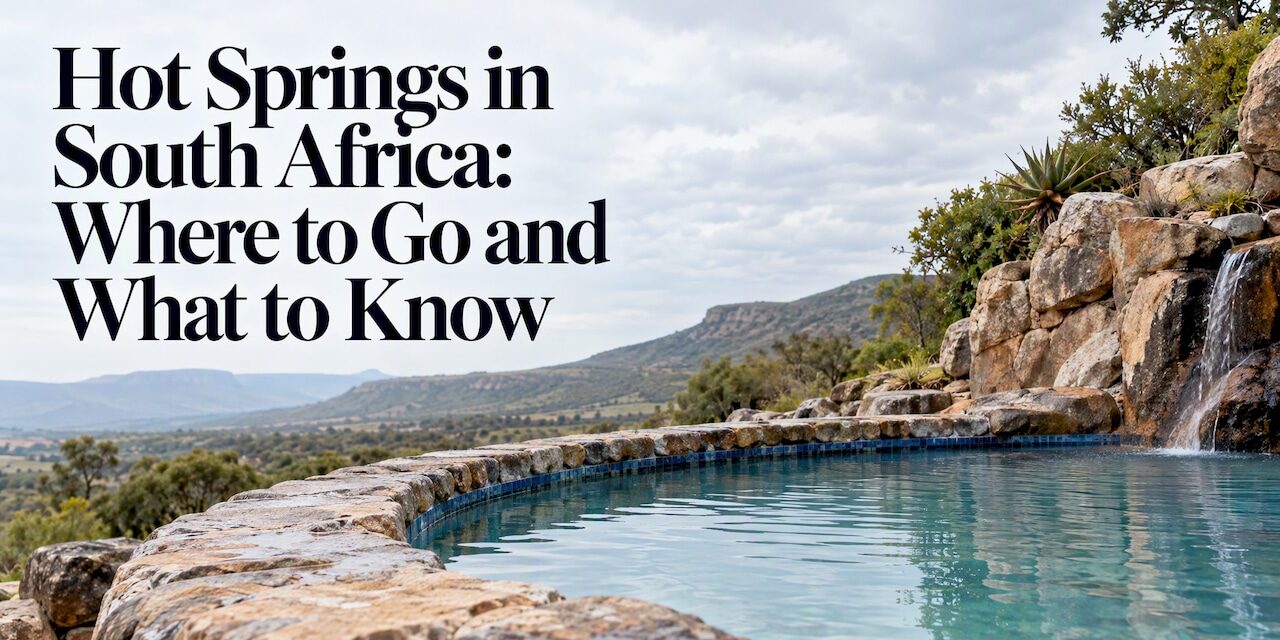
South Africa does have natural hot springs, and you can soak in them without leaving the country. They cluster in a band that runs from the Western Cape up through KwaZulu-Natal, the Free State and Gauteng to Limpopo. For most Joburgers the easiest option is Bela-Bela, a little over an hour’s drive north. Cape Town visitors have the Citrusdal and Cederberg springs. Further afield are quieter Karoo and Northern Cape spots. Below we explain where the water comes from, which places are worth a trip, and what to check before you book.
TL;DR
- Thermal springs are found mainly in a 400 km-wide band from Piketberg in the Western Cape to the Soutpansberg in Limpopo.
- From Johannesburg, Bela-Bela (formerly Warmbaths) is the practical choice: it lies on the main highway north, just over an hour from Gauteng.
- From Cape Town, the springs around Citrusdal and the Cederberg suit a weekend away.
- Most springs are modest, family-oriented resorts rather than luxury spas, so choose by what you want: a day pool, a private bath or a long stay.
- Always confirm current rates, day-visitor rules and water conditions with the resort before you drive.
Table of Contents
- Does South Africa have natural hot springs?
- The main hot spring destinations
- Hot springs near Johannesburg
- What does a hot spring visit cost?
- What to check before you go
- Perspective
- Make a weekend of it
- Other ways to extend the trip
- FAQ
- Sources
Does South Africa have natural hot springs?
Yes. Thermal springs in South Africa are predominantly found within a 400 km-wide band that stretches from Piketberg in the Western Cape, through KwaZulu-Natal, the Free State and Gauteng, to the Soutpansberg in Limpopo, according to a Water Research Commission report. That is the belt to think about when you plan a trip, and it explains why the best-known springs are spread so widely across the country.
The numbers are modest compared with volcanic countries. A 2015 paper for the World Geothermal Congress documented 87 thermal springs across South Africa, with temperatures ranging from 25°C to 67.5°C. So some are pleasantly warm, while others are properly hot at the source and are cooled or mixed before bathing.
Why the water is hot
South Africa has no active volcanoes to heat its water. According to the same Water Research Commission report, the water circulates from a recharge area into a deep fractured aquifer, 1,000 to 2,000 metres down, where it heats up and then returns to the surface along a fault zone. In other words, rain becomes a hot spring through geology, not volcanism. The country is tectonically stable, so researchers at the University of South Africa note that it has limited potential for very-high-temperature geothermal energy. That is also why you will not find geysers or steaming lagoons here, just mineral-rich pools and baths.
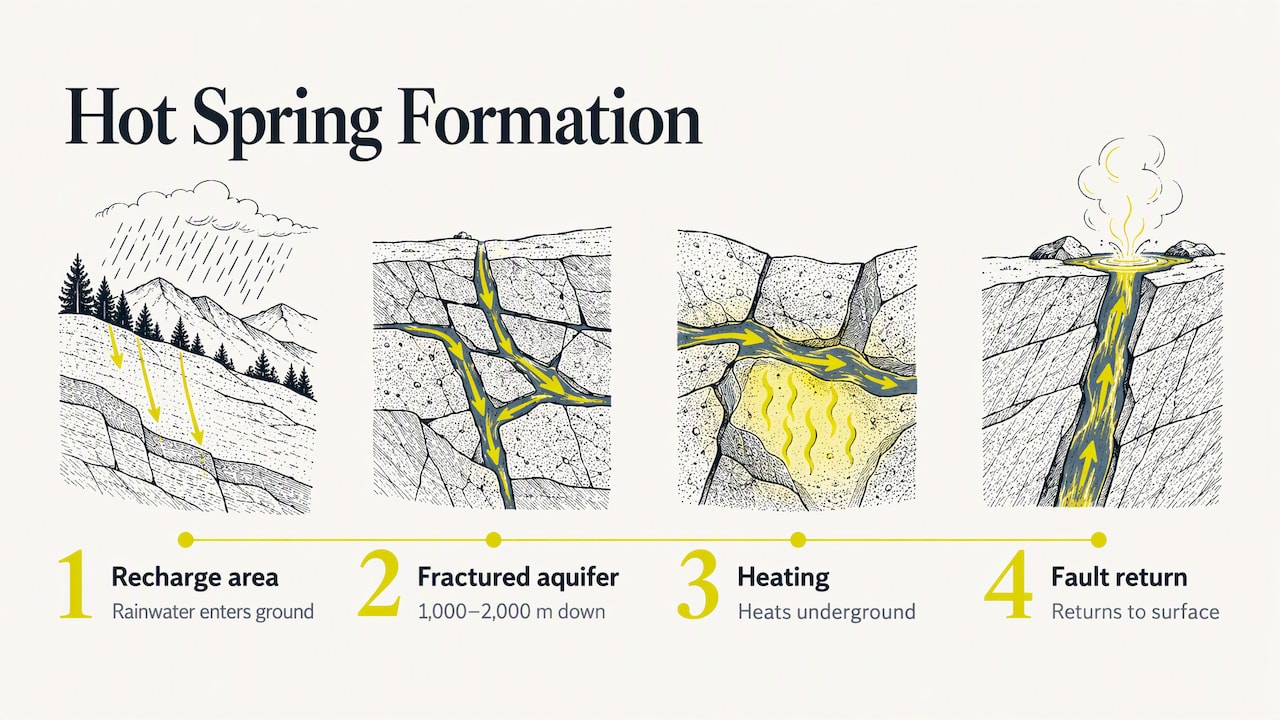
A practical consequence: most springs here are fed from fault lines, so you will often find them at the foot of mountains or along old geological breaks, in towns that grew up around the water.
The main hot spring destinations
The table below is a planning guide. It groups the places travellers most often search for by region and by what they are best suited to. It deliberately gives no prices, because rates, day-visitor policies and pool conditions change; the resort or municipality is the place to confirm them.
| Area | Province | Best for | Distance logic |
|---|---|---|---|
| Bela-Bela (Warmbaths) | Limpopo | Weekend away from Gauteng, family stays | Just over an hour from Gauteng |
| Citrusdal and the Cederberg | Western Cape | Private mineral baths, rock pools, scenery | Roughly a Cape Town road trip |
| Warmwaterberg | Western Cape (Klein Karoo) | Quiet, budget-minded stops | Off the Route 62 style of drive |
| Cradock | Eastern Cape (Karoo) | Stopover on a long road trip | En route between regions |
| Aliwal North | Eastern Cape | Overnight halt on the way to or from the Free State | Inland route |
| Tshipise | Limpopo (far north) | Long stay near the Zimbabwe border | Far from Gauteng |
| Riemvasmaak | Northern Cape | Remote desert-river escape | Near the Namibian border |
Bela-Bela, Limpopo
If you live in Johannesburg or Pretoria, this is where you will probably go first. The town’s name comes from the Northern Sotho term for boiling-boiling, and the natural hot mineral springs emerge at about 53°C, according to the Bela-Bela Municipality. The town was long known as Warmbaths, so you will see both names on older signs, brochures and maps.
It is easy to reach: Bela-Bela sits on the main highway from Gauteng to Limpopo and Zimbabwe, just over an hour’s drive from Gauteng. That makes a day trip realistic, and an overnight stay comfortable. The municipality adds that most Bela-Bela resorts offer conference, sport, accommodation, recreation and restaurant facilities, so you can pick between a family resort with a full programme and something smaller.
Because tourism is a major contributor to the local economy, according to the same municipality, the area is geared to visitors, and you will find a wide spread of accommodation and activities. The flip side is that school holidays and long weekends fill up quickly, so book ahead then.
Citrusdal and the Cederberg, Western Cape
This is the favourite for Cape Town travellers. The Baths, a privately owned resort near Citrusdal, is promoted as having hot mineral spring baths, Jacuzzis, and hot and cold pools, with natural rock pools in the valley. Private baths are the draw: you book a bath filled with spring water straight from the source and soak in your own space, which suits couples and people who dislike crowded pools.
The Cederberg setting matters as much as the water. Think fynbos, sandstone formations and cool winter evenings that make a hot soak feel earned. Winter and early spring are popular, but summer days can be very hot, so many guests use the cold pools then and save the hot baths for the evenings.
Warmwaterberg, Cradock and Aliwal North
These are the older Karoo-style spa towns. They are modest, family-priced places and not luxury spa resorts, so go expecting pools, braai areas, caravan sites and simple chalets rather than treatment menus. Their appeal is the stopover: if you are driving between the Cape and the interior, a hot soak breaks a long day on the road far better than another roadside coffee.
Warmwaterberg sits in the Klein Karoo of the Western Cape, Cradock in the Eastern Cape Karoo and Aliwal North on the Eastern Cape side of the Free State border. Check opening arrangements directly, since small operators change hours and maintenance schedules more often than big resorts.
Tshipise and Riemvasmaak
Tshipise, near Musina in far northern Limpopo, falls within the northern end of the thermal band that reaches the Soutpansberg. It is a long drive from Gauteng, so treat it as a holiday rather than a weekend.
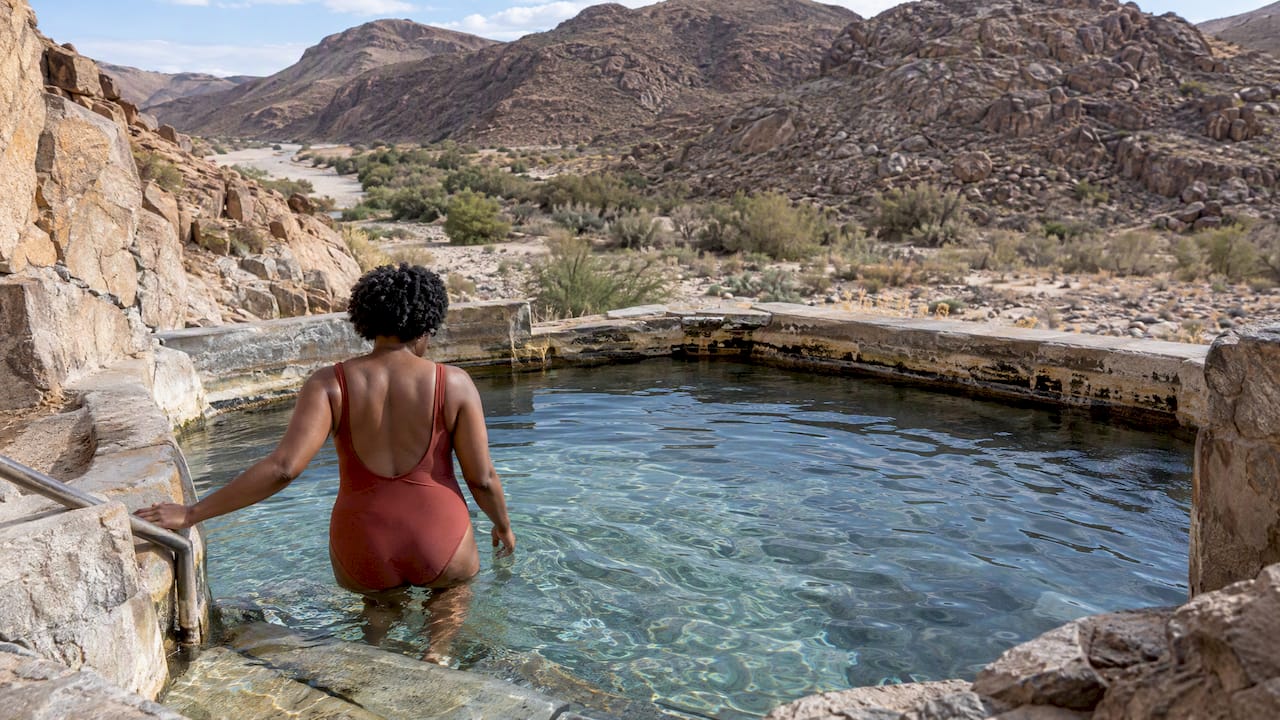
Riemvasmaak is a different kind of trip altogether. It lies close to the Namibian border, between the Orange River and the now dry Molopo River. Go for the remote desert landscape as much as the water, and plan fuel, supplies and road conditions carefully.
Hot springs near Johannesburg
If you want to be in the water by lunchtime, your options come down to two things: a trip to Bela-Bela, or a spa day in Gauteng. Tourism listings for the province include spa venues that use the word “hot springs” in their name, but the genuinely natural, mineral-fed experience is best sought out at the Limpopo resorts.
A sensible Johannesburg plan looks like this:
- Leave early. Bela-Bela is just over an hour from Gauteng, but the N1 can be slow on Friday afternoons and at the start of school holidays.
- Decide day visit or overnight. Some resorts sell day-visitor entry; others are guest-only. Phone before you set off.
- Pack for the heat. Hot water, dry bushveld air and the sun make for a dehydrating combination. Take water, a hat and a towel.
- Plan the rest of the weekend. With facilities such as sport and restaurants at many resorts, a day can fill up quickly without leaving the grounds.
Back in the city, after a soak, you can keep the weekend theme going with our one-day loop of things to do in Johannesburg, or head to a gallery or museum if the weather turns.
What does a hot spring visit cost?
We could not verify current entrance fees or accommodation rates for individual resorts, and we will not guess. Pricing across South African springs varies by type of operation:
- Municipal or small-town spas often charge a per-person day entry fee, usually lower for children.
- Private resorts price by stay: chalets, rooms or camping, sometimes with pool access included and sometimes not.
- Private baths, such as those at Cederberg-style resorts, are usually booked by the hour or session on top of any entry fee.
To get a real figure, check the resort’s own website or ring them, and ask the right questions: Is the day-visitor fee per person? Are public holidays charged differently? Are private baths extra? Is a booking required? If you are comparing package trips with a heated pool as a feature, the details matter, and this guide to what to look for in a holiday with a heated pool is worth reading before you commit.
What to check before you go
A hot spring trip goes wrong in predictable ways. These are the checks that save a weekend.
Is the water natural and still flowing?
A pool described as a “hot spring pool” may be fed by spring water, by a heater or by a mix. Ask whether the water comes from the source and whether the bath you are booking uses it. This matters most if the mineral experience is the reason for your trip.
How hot is it really?
Source temperatures can be high. Bela-Bela’s springs emerge at around 53°C, which is far too hot for bathing without cooling. Resorts mix or cool the water, and pools are kept at comfortable levels, but private baths can run hot. Start with short soaks and get out if you feel dizzy.
Health and safety
If you are pregnant, have heart or blood-pressure problems, or take medication that affects circulation, speak to your doctor before spending long in hot water. Keep children under close supervision in hot pools, and do not drink alcohol while soaking. Sun protection matters too, since many pools are outdoors: our piece on sunscreen and how well it really works is a useful reminder to reapply.
Day visitors or guests only?
Policies differ from resort to resort, and a closed gate is a long drive wasted. Confirm in advance, especially on public holidays.
Season and crowds
Winter weekends and school holidays are peak times at most springs. If you want quiet, go midweek.
Perspective
We write about Johannesburg, South Africa and Dubai every day, and the pattern we see is that readers want an easy reset more than a big expedition. Hot springs fit that perfectly: they are close, they are local and they cost little compared with a flight. The trap is expecting a five-star spa. Most of the country’s springs are honest, family-run places with a lot of character, and the visit is better when you treat it as a slow day out, much like the thinking behind our piece on lazy pool days and local culture.
Our advice is to pick one spring, not three. Go early, book the thing that matters to you (private bath, family chalet or just a day pass), and leave the afternoon empty. The water does the rest.
— Chad
Make a weekend of it
A soak is better with a plan around it. At Joburgstyle we cover travel, hotels, game reserves, family outings and fine dining across South Africa, so you can build the rest of the trip from one place. If you are mixing the springs with a slower coast break, start with our guide to slow travel activities on the KZN South Coast, or browse everything on the Joburgstyle homepage.

Other ways to extend the trip
If you are heading north, a stop in Bela-Bela can be combined with a game reserve or bushveld stay, since the resorts there already offer recreation and accommodation. In the Western Cape, the Citrusdal valley pairs well with Cederberg hiking and wine farms. Back in Joburgstyle’s home city, a Sunday after the trip can be quiet: the museums in Johannesburg and the city’s art galleries are easy ways to stay slow.
FAQ
Does South Africa have natural hot springs?
Yes. A 2015 World Geothermal Congress paper documented 87 thermal springs, with temperatures between 25°C and 67.5°C. Most lie in a band from the Western Cape through KwaZulu-Natal, the Free State and Gauteng to Limpopo.
Where are the most hot springs located?
The thermal springs follow a 400 km-wide band running from Piketberg in the Western Cape up to the Soutpansberg in Limpopo. Well-known visitor destinations include Bela-Bela in Limpopo and the Citrusdal and Cederberg area in the Western Cape.
Are there hot springs near Johannesburg?
The closest is Bela-Bela, which is just over an hour’s drive from Gauteng on the main highway north. Its springs emerge at roughly 53°C, and several resorts offer accommodation, restaurants and recreation facilities.
Are hot springs good for your skin?
People often enjoy mineral baths for relaxation, but we have not found solid evidence we can cite that they improve skin. If you have eczema, psoriasis or sensitive skin, ask a dermatologist before long soaks, and rinse and moisturise afterwards.
Sources
- Water Research Commission report on thermal springs in South Africa
- Evaluation of the Geothermal Energy Potential for South Africa, World Geothermal Congress 2015
- Bela-Bela Municipality
- What to look for in a holiday package with a heated pool
