
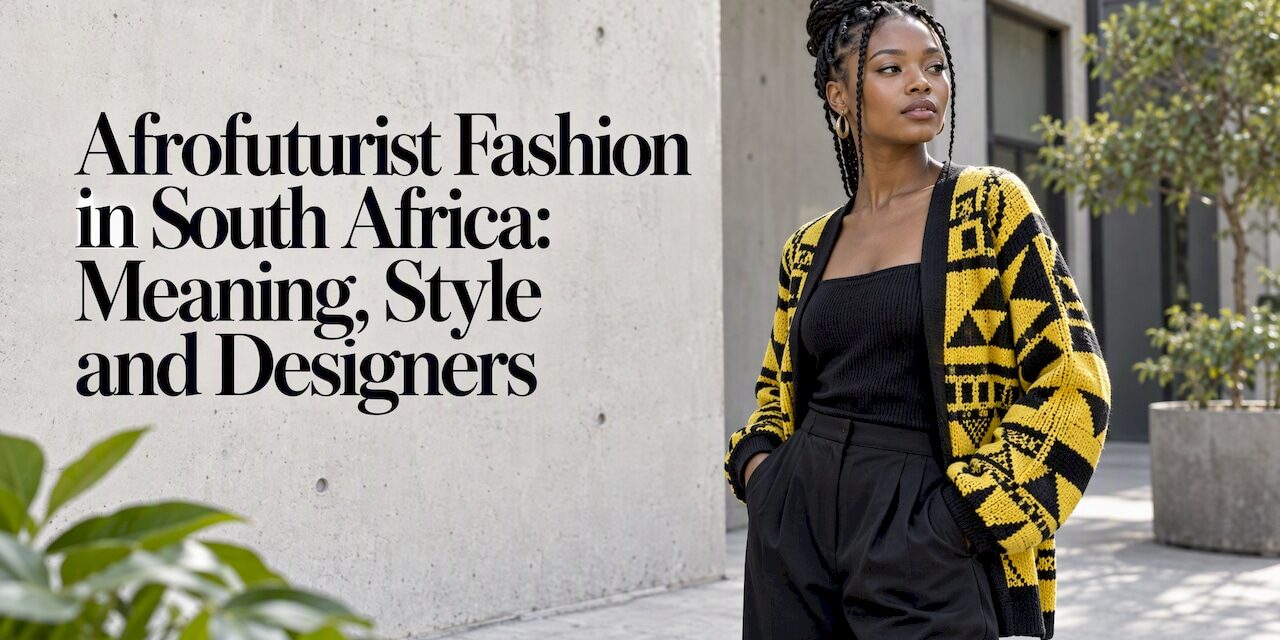
Afrofuturism fashion is clothing that imagines liberated futures for Black and African life, drawing on history, heritage and technology rather than on space-age costume alone. It is a way of thinking about dress before it is a look. In South Africa, that thinking shows up in Xhosa beadwork translated into knitwear, in Johannesburg collectives that remix the city’s past, and in the global visibility of films such as Black Panther.
This guide explains what the term means, what to look for, where it goes wrong, and which South African designers and ideas are worth your attention.
TL;DR
- Afrofuturism expresses Black identity, agency and freedom through art and activism that envisions liberated futures. Fashion is one of its clearest languages.
- It is not the same as silver fabric, flying saucers or an African print on a modern cut. Without a point of view about the future, it is simply styling.
- South African examples include MaXhosa’s Xhosa-rooted knitwear and Johannesburg collectives such as Khumbula and the Sartists, who remix local history with global influences.
- You can wear the idea well by starting with craft, story and silhouette, and by buying from designers who own their references.
Table of Contents
- What Afrofuturism means in fashion
- What Afrofuturist fashion looks like
- How to tell it apart from generic futuristic fashion or African print alone
- South African designers and the Afrofuturist conversation
- Johannesburg: hypersampling, menswear and the city as a studio
- How to wear the idea well
- Common misreadings
- Our perspective
- Follow the story with Joburgstyle
- FAQ
- Sources
What Afrofuturism means in fashion
The National Museum of African American History and Culture describes Afrofuturism as a way of expressing Black identity, agency and freedom through art, creative work and activism that imagines liberated futures for Black life. Fashion translates that into fabric, cut, texture and styling.
Three ideas sit underneath the term when it is applied to clothes:
- Agency. The wearer or designer decides what the future looks like, instead of inheriting someone else’s picture of progress.
- Memory. Heritage is treated as a resource, not a relic. Beadwork, pattern, dress codes and spiritual traditions carry information forward.
- Invention. New silhouettes, materials or technology are used to propose something that did not exist before.
When a garment has all three, it reads as Afrofuturist. When it has only the third, it is usually just futuristic fashion. When it has only the second, it may be wonderful traditional dress, but it is not necessarily making an argument about tomorrow.
A future that is not a straight line
A 2023 discussion published by the Brooklyn Museum around its fashion and Afrofuturism programming suggests that African fashion can imagine futures by recovering pre-colonial histories, mythologies and spiritual traditions, centring Africa and moving beyond recent trauma. The same discussion presents African futurity as potentially non-linear and circular, so that histories, heritages and belief systems stay active as tools for imagining what comes next.
That is a useful correction for anyone who thinks the future in fashion must look like metal and neon. In this reading, the past is not behind you. It is something you carry and reshape.
What Afrofuturist fashion looks like
There is no single uniform, and designers would resist one. Still, certain design ideas recur, and a South African example makes them concrete.
An academic interview published on Project MUSE with Laduma Ngxokolo of MaXhosa describes the label’s language as Xhosa beading and symbolic messaging, bold traditional colour combinations, pattern contrasts and contemporary silhouettes that bring African and Western sensibilities together. Ngxokolo explains that the aesthetic is founded on Xhosa people, traditions and histories, while the later name MaXhosa Africa acknowledges other African cultures.
From that and from the wider conversation, the recurring elements can be summarised as follows:
| Element | What it does | Where you might see it |
|---|---|---|
| Heritage pattern and symbol | Carries story and identity into the present | Beaded motifs reinterpreted as knit or print |
| Bold, deliberate colour | Signals confidence and cultural reference at once | Saturated palettes drawn from traditional combinations |
| Sculpted or exaggerated silhouette | Suggests a body in a new kind of world | Architectural shoulders, layered volumes, unexpected proportions |
| Craft with new materials | Joins hand skill to technology or reworked textiles | Hand finishing on engineered or upcycled fabrics |
| Styling as narrative | Treats an outfit as a statement, not a trend | Mixing archival pieces with contemporary tailoring |
Notice that none of these require a spaceship. The futurism is in the intention and the transformation.
How to tell it apart from generic futuristic fashion or African print alone
This is where most online lists go wrong. Search results for the topic are full of mood boards, stock imagery and shops that attach the label to anything metallic or printed. A more careful test is useful.
Contributors to the Brooklyn Museum discussion caution that pyramids, flying saucers and Sun Ra can reduce Afrofuturism to clichés, and argue for the freedom to define African futures beyond Global North assumptions. They also argue that African creatives should decide which futures and which sense of time the term describes.
Here is a quick checklist you can apply to any garment, collection or Instagram page:
- Does it have a source? Can the designer say which tradition, history or community the work comes from?
- Does it propose something new? Is there a change in form, material or context, or is it a straight reproduction?
- Who defines the future? Is the idea African-led, or is Africa being used as a backdrop for an imported idea of progress?
- Is the wearer a subject or a prop? Afrofuturism is about agency. A costume that makes the wearer an extra in someone else’s story misses the point.
An African print shirt is not Afrofuturist by default. If you are looking at prints in general, our guide to African print outfits and how to wear them in South Africa is a better starting point, and it can help you decide when a print is simply a good wardrobe piece and when it is part of a larger idea.
Defining futures on your own terms
Brands outside Africa are also asking what clothing will look like next. One industry piece on the future of clothes and what brands should test is a reminder that questions about materials, production and personalisation are now mainstream. The Afrofuturist answer differs in one key respect: it asks whose future, and who gets to write it, before it asks which technology to use.
South African designers and the Afrofuturist conversation
South Africa is not a footnote in this story. A South African scholarly article on Afrofuturism and decolonisation notes that the costume design of Black Panther drew inspiration from Laduma Ngxokolo’s MaXhosa knitwear, connecting local South African fashion to a globally visible Afrofuturist visual world. The same article argues that combining historical African culture with contemporary and futuristic forms can present African culture as dynamic rather than static.
That idea of a dynamic culture matters for the local industry. It is the opposite of the souvenir view of African dress, where heritage is frozen and sold. When a designer takes a Xhosa beading pattern and knits it into a modern cardigan, the culture is being used, extended and worn in everyday life.
To see how local labels are building on that energy beyond Gauteng, read our piece on KZN South Coast fashion labels making an impact on the global stage. For the business side, including why designers push for more shelf space, see what a South African fashion leader said about African fashion deserving more retail space.
Johannesburg: hypersampling, menswear and the city as a studio
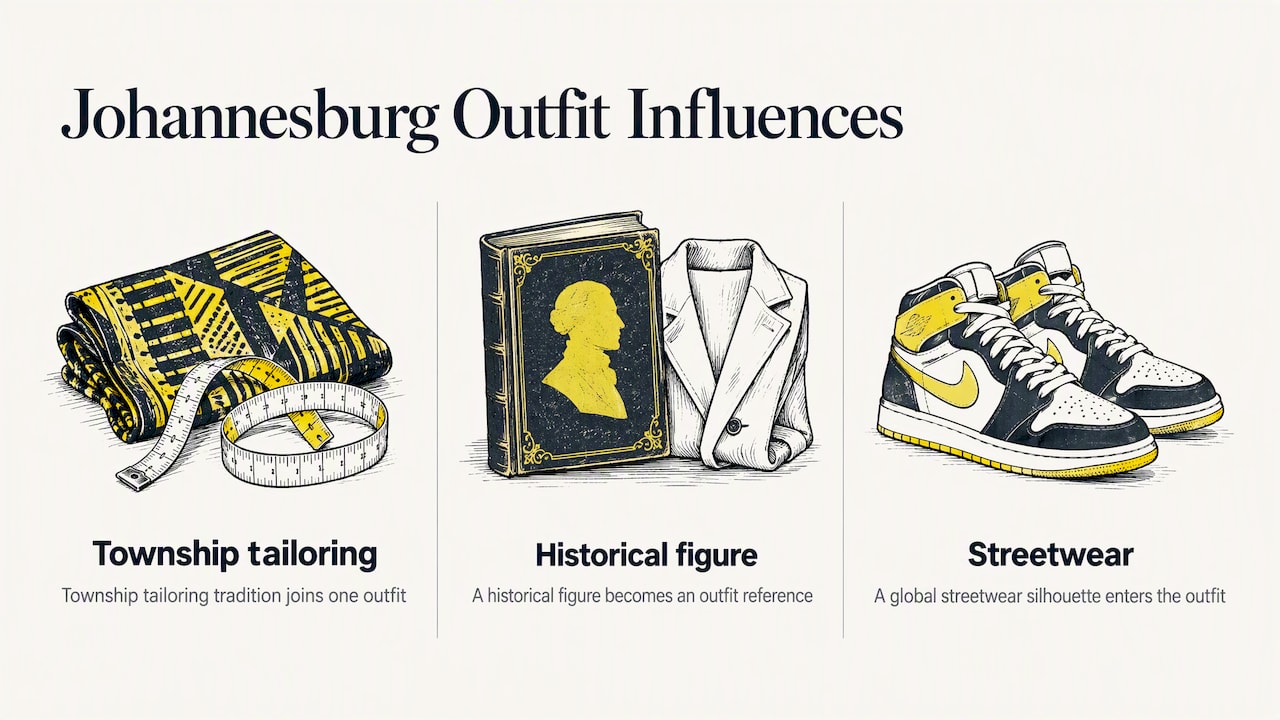
Johannesburg offers a distinct strand of the conversation. A 2015 article in a University of Pretoria journal describes the Johannesburg design collectives Khumbula and the Sartists as practising hypersampling: remixing, re-appropriating and fusing references from Southern and South African history with transnational and transhistorical influences.
In plain terms, that means a designer might put a township tailoring tradition, a reference to a historical figure and a global streetwear silhouette in the same outfit, and let the tension between them do the talking. It is the fashion equivalent of a producer sampling records from different decades and countries to make a new track.
The same article argues that these practitioners use fashion to negotiate black masculine identities and to disrupt power relations, expressing creative agency in the African metropolis. That is Afrofuturism at street level: not a gallery concept, but a way of dressing that quietly rejects inherited scripts about who a Black man in Johannesburg should be.
Identity and pressure are not only questions of style. Writing on reducing environmental pressure on the Black professional approaches the same terrain from the workplace side, and it is a reminder of why many people treat what they wear as a deliberate act and not decoration.
Where to see it in the city
We would be careful about promising a single address where Afrofuturist fashion is on permanent show, because most of it lives in collections, pop-ups, showcases and designer studios that change often. What you can do is build a route:
- Spend a day in the inner city and Maboneng, where galleries, design shops and street culture sit close together. Our one-day Johannesburg loop is a practical way to structure it.
- Follow local showcases and awards, which are a reliable way to meet emerging labels. We have covered the FIASA Awards and the Local Fashion Police finalists, both useful maps of who is working now.
- Look at established names for context. The story of David Tlale’s 20 years in the industry shows how a South African designer builds a lasting point of view.
- Check the current programme of galleries and art fairs. Events such as Art in the Garden in Parktown North put art, collecting and style in the same room. Always confirm the current dates on the organiser’s page.
How to wear the idea well
You do not need to dress like a film character. A few principles keep the result respectful and personal.
Start with craft and story
Choose one piece with a clear origin: a knitted cardigan with a heritage pattern, a hand-finished jacket, a garment whose designer can explain the reference. Ask where the motif comes from and who owns it. If the answer is vague, move on.
Play with proportion, not props
A strong shoulder, a long line, a surprising layer or an asymmetrical hem makes a future-facing silhouette without any costume. Keep the rest of the outfit simple so the idea has room.
Mix eras on purpose
The Johannesburg approach of hypersampling is a good model. Pair something inherited, such as a vintage jacket or a family piece, with something new. The contrast is the statement.
Be honest about the budget
Afrofuturist dressing is not only for runway buyers. Second-hand pieces, tailoring alterations and one well-chosen accessory are all legitimate. When you do buy, favour designers who credit their sources and produce locally where they can.
Think seasonally
If you want to see how these ideas sit within wider movements, our overview of global fashion trends for 2026 shows where bold colour, texture and heritage references are heading worldwide.
Common misreadings
The last section of most good discussions on this topic is a warning, and it is worth repeating here.
- Treating it as a costume genre. Silver, chrome and cosmic motifs can be part of the vocabulary, but when they are the whole vocabulary the result is a cliché.
- Flattening Africa into one culture. Ngxokolo’s own explanation of MaXhosa, rooted in Xhosa tradition before widening to other African cultures, shows how specific the references are. Specificity is respect.
- Assuming the future must be Western. The Brooklyn Museum contributors argue that African creatives should set the terms. A design that copies a foreign idea of progress and adds African decoration has not done that.
- Ignoring the people. Fashion that speaks of liberation while paying makers poorly or hiding their names contradicts its own message.
Our perspective
We watch South African fashion every week, and what stands out is how much of the most interesting work refuses a label. Designers tell us about family, neighbourhood, church, nightlife and craft long before they mention the future. That is exactly why we think the Afrofuturist idea fits here: the future is being built out of the specific, not the generic.
Our view is simple. Johannesburg does not need to borrow a futuristic costume to take part in this conversation. It already has designers sampling history, tailoring identity and putting local pattern on global stages. Our job is to show that work with context, to name the people behind it, and to connect it with readers in Johannesburg, across South Africa and in Dubai, where we also cover design and style.
If you take one thing from this article, let it be this: ask who defined the future in the garment you are looking at. When the answer is an African maker with a story, you are looking at the real thing.
— Chad
Follow the story with Joburgstyle
We cover emerging South African designers, showcases and cultural events alongside travel and lifestyle from Johannesburg to Dubai. For more fashion, art and culture reporting, start at the Joburgstyle home page or read how Dubai’s design district is shaping the region’s creative scene.
FAQ
Is Afrofuturism fashion the same as wearing African prints?
No. African prints can be part of an Afrofuturist outfit, but a print alone does not make it one. The idea needs a point of view about the future, rooted in African history and defined by African creatives. Our guide to wearing African print outfits covers the everyday side.
Which South African designers are linked to Afrofuturism?
Laduma Ngxokolo of MaXhosa is the most cited, partly because Black Panther’s costume design drew inspiration from his knitwear, according to a South African scholarly article. In Johannesburg, the collectives Khumbula and the Sartists have been written about for their hypersampling approach. Many designers do not use the label themselves, so treat it as a lens, not a membership.
Does Afrofuturist fashion have to look futuristic?
Not in a literal sense. The Brooklyn Museum discussion warns that space-age imagery can reduce the idea to clichés. What matters is that heritage, agency and invention come together, which can be as quiet as a knitted pattern on a modern cut.
How can I start wearing it without getting it wrong?
Begin with one well-made piece from a designer who can explain their references, and build the outfit around it with simple basics. Credit the maker when you post about it. Avoid costume pieces that borrow symbols you cannot explain.
Sources
- Afrofuturism, National Museum of African American History and Culture
- Afrotopia: Looking at Afrofuturism in Fashion, Brooklyn Museum
- On Tradition, Symbolism, and (South) African fashion, Project MUSE
- Afrofuturism and decolonisation: using Black Panther as a case study, SciELO South Africa
- Hypersampling black masculinities, University of Pretoria journals
