

Dubai lifestyle is outdoor, international and built around dining, events and ambition, and it costs more than most newcomers budget for. Johannesburg offers a very different rhythm: a creative, music-led, gallery-rich city where the weekend is shaped by neighbourhoods rather than skylines. We cover both cities from the ground, from our base in Johannesburg and our presence in Dubai, so this guide sets out how each one lives, what each one asks of you, and where to read more before you commit time or money.
Key Takeaways
- Dubai life is shaped by Islamic culture, hospitality traditions and a calendar of more than 1,000 sports, cultural and entertainment events a year, according to the city’s own Quality of Life Strategy.
- Dress is relaxed across most of the city, but conservative clothing is advised at religious and historical sites, and public displays of affection are discouraged.
- Dubai is easy to settle into, yet the social pressure to spend is real, so plan the budget before the brunches.
- Johannesburg’s lifestyle runs on live music, digital creativity, contemporary art and neighbourhood dining, with a very different pace and price point.
- Our Dubai and Johannesburg guides cover restaurants, brunch, dress codes, nightlife and family outings in practical detail.
Table of Contents
- What a Dubai day actually looks like
- Culture and customs that shape daily life
- Eating out is the social calendar
- Events, sport and the leisure calendar
- The cost of keeping up
- Life in Johannesburg: music, art and neighbourhoods
- Dubai and Johannesburg side by side
- Planning around both cities with JoburgStyle
- Our view on lifestyle journalism
- FAQ
- Sources
What a Dubai day actually looks like
The lifestyle people picture, skyscrapers, beaches, desert drives and long restaurant tables, is mostly an outdoor one. Mornings are the time for runs, golf and beach swims; the middle of the day moves indoors to malls, offices and cafés; evenings belong to terraces, waterfront promenades and late dinners. The season matters enormously. Summer heat pushes life indoors, while the cooler months fill every patio. If you are deciding when to go, our guide to the best time to visit Dubai for South Africans compares peak temperatures with the lower rates that come with them.
People who move there tend to rate the practicalities highly. In InterNations’ 2022 Expat City Ranking, which surveyed 11,970 expats of 177 nationalities, Dubai came first worldwide in the Expat Essentials Index. Two thirds of respondents found dealing with local authorities easy, 88% were happy with online government services and 95% were satisfied with car infrastructure. The same survey placed Dubai third for culinary variety and dining options, and fifth for culture and nightlife.
That tells you something about the city’s character: it is organised, car-friendly and service-led, and the leisure offer sits on top of that efficiency rather than competing with it.
Culture and customs that shape daily life
Dubai is a cosmopolitan city, but it is also an Emirati one, and the culture underneath is worth understanding before you arrive.
The Visit Dubai City Guide 2026 states that Islam is the official religion and plays a significant role in the culture. Emirati national dress includes the abaya and shayla for women and the kandoora and ghutrah for men. The same guide says all attire is generally acceptable, while conservative dress is advised at religious and historical sites. Adults aged 21 and over may drink in licensed venues, and excessive public displays of affection should be avoided.
Family and hospitality sit at the centre of Emirati social life. The UAE government’s platform describes how Emirati families still live together, bound by religious and tribal ties, and how the majlis, the traditional gathering space, began as informal meetings led by a sheikh to resolve community matters. A cultural training booklet for tour guides adds some etiquette detail: hosts traditionally offer guests food and shelter for three days and nights, a typical Emirati home has two majlis, one for men and one for women, and unrelated men and women usually greet without a handshake.
In practice, you do not need to memorise any of this. You need to be courteous, let a person of the opposite sex offer their hand first, accept a cup of coffee if one is offered and dress with awareness of where you are. Our Dubai dress code guide for South African visitors turns these principles into specific outfit decisions for malls, beaches, restaurants and mosques.
Eating out is the social calendar
In Dubai, dining is not an occasion, it is the default way to see friends. Menus run from Emirati and regional dishes to every major international cuisine, and the better venues book out well ahead on weekends. Brunch has become a institution of its own, with set prices, packages and a distinct etiquette about timing and drinks.
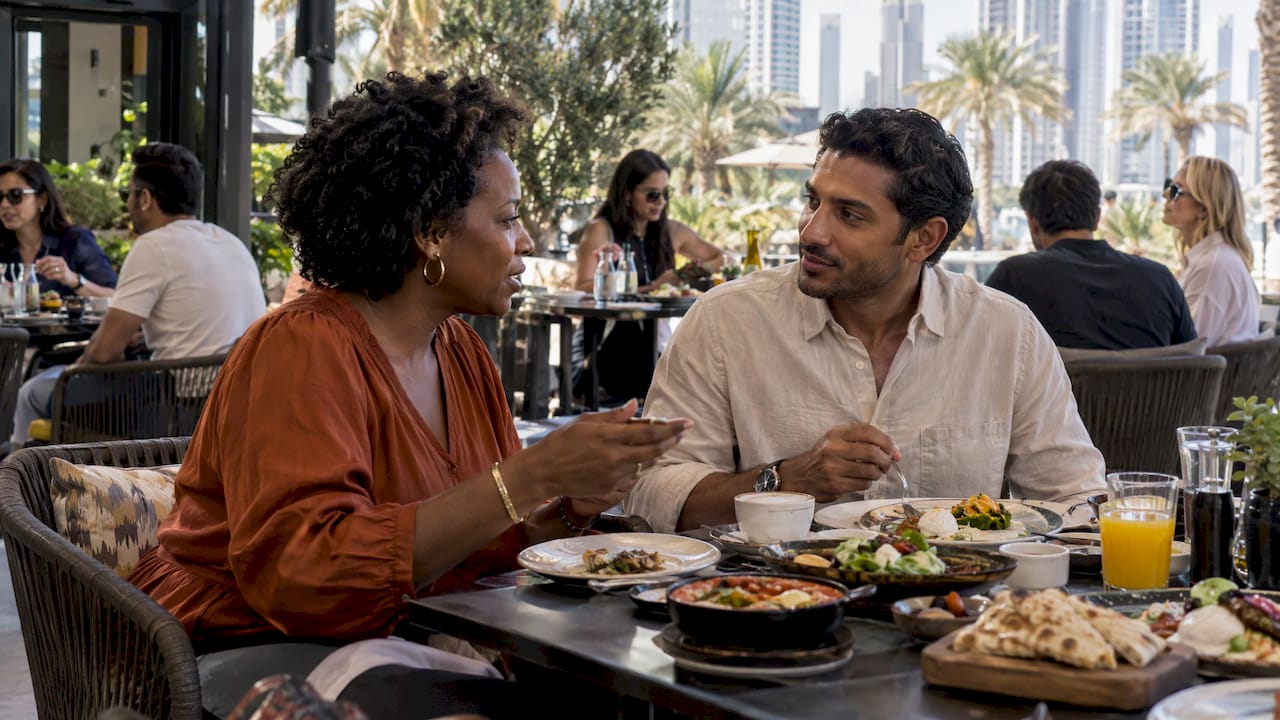
If you are planning a first trip or a first month, two of our guides save the most guesswork: where to eat in Dubai, what it costs and how to book, and how Dubai brunch works and where to start. For a quieter, more creative side of the city, the Dubai Design District guide points you towards cafés and Design Week rather than the mall circuit.
Events, sport and the leisure calendar
Dubai plans its leisure on purpose. Its Quality of Life Strategy 2033 includes more than 1,000 annual sports, community, cultural, arts and entertainment events, and aims to develop the city as a global hub for culture and creativity. For residents that means a year of recurring fixtures: golf and tennis championships, endurance racing, Dubai Design Week, Dubai Restaurant Week and the Dubai Shopping Festival, alongside desert safaris, dune driving and indoor skiing.
The pattern is useful for planning. Most of the big events recur at the same time each year, so check the organisers’ pages for the current dates rather than relying on last year’s calendar. Our Dubai travel guide for South Africans is the place to start if you are building a first itinerary.
The cost of keeping up
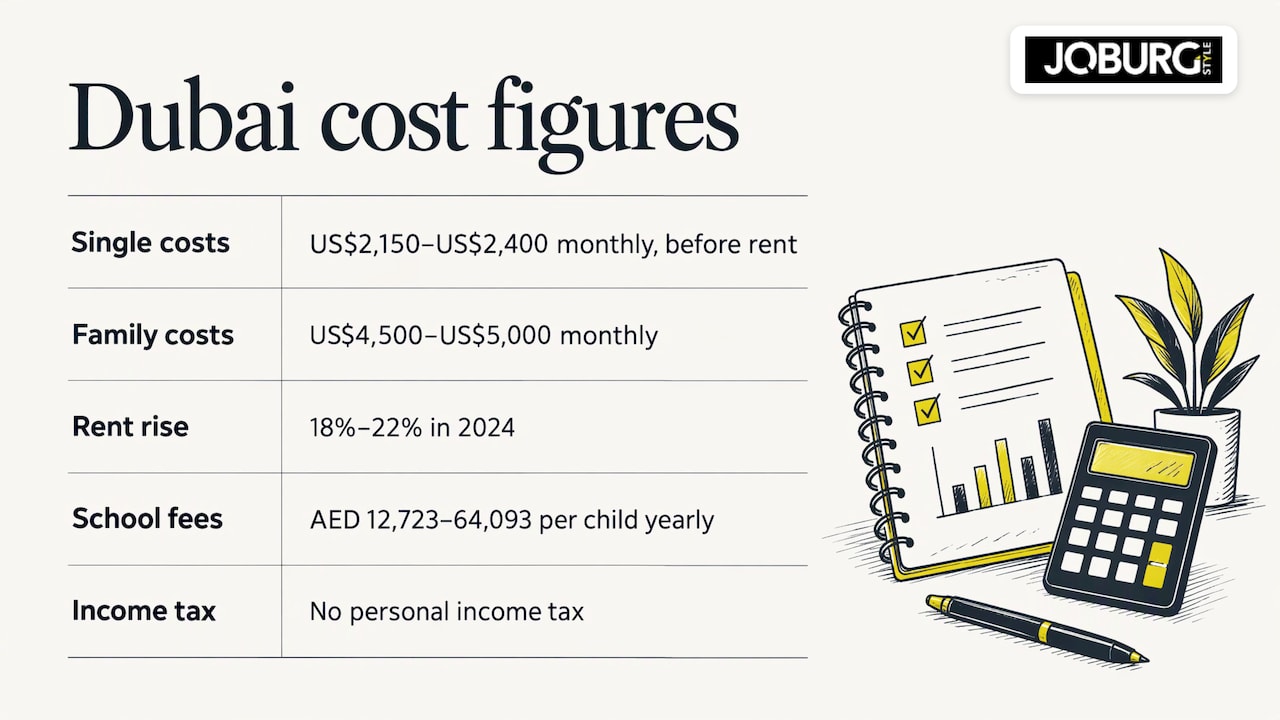
The tax-free headline is the main reason people move. The UAE does not tax personal income, and that is genuinely attractive. What surprises people is how much of that saving the lifestyle absorbs.
A January 2026 cost-of-living analysis by TheSuperPrime, citing Mercer data, puts a comfortable single professional’s monthly expenses at roughly US$2,150 to US$2,400 before rent, and a family of four at US$4,500 to US$5,000. It also reports that rents rose 18% to 22% in 2024, and that international school fees for 2025 to 2026 ranged from AED 12,723 to AED 64,093 per child per year. Those are published figures for their period, and rents and fees move, so treat them as a guide to scale and check current listings.
The same research describes a “lifestyle inflation” effect: a culture of luxury cars, beach clubs and extravagant brunches that creates social pressure to spend. It is easy to see how this happens in a city where every weekend has an event attached. Even personal milestones become occasions for display; the luxury wedding trends emerging in the UAE show how far the expectation of a polished, high-spec celebration has travelled.
The sensible approach is to decide your fixed monthly spending on housing, transport and schooling first, then set a fixed budget for dining and leisure, so that the social calendar works for you rather than the reverse.
Life in Johannesburg: music, art and neighbourhoods
Johannesburg is a different kind of city to live in. Where Dubai is planned and polished, Johannesburg is layered, creative and neighbourhood-driven. English is widely spoken, summers bring warm afternoon thunderstorms and the social life runs through music venues, restaurants, markets and galleries.
The cultural calendar is strong:
- Music. The Standard Bank Joy of Jazz Festival, in its 27th year in 2026, returns to the Sandton International Convention Centre and has grown from 1,800 attendees in 2000 to more than 25,000 festivalgoers annually.
- Digital creativity. Fak’ugesi 2025 ran for six days across the Tshimologong Precinct and Braamfontein, positioning itself as Africa’s premier platform for digital creativity, with full-dome experiences, animation, game jams and industry networking.
- Public art. In October 2025, Gautrain launched its Art in Transit project with the Market Theatre Foundation, turning Sandton Station into a venue for live theatre, performance and photographic exhibitions.
- Galleries. A 2025 guide to the city lists David Krut Projects, Goodman Gallery, SculptX at Melrose Gallery, SMAC Gallery and the Joburg Contemporary Art Foundation, a former tram depot that has hosted Global South exhibitions since 2020.
For evenings, our Johannesburg nightlife guide covers where to go after dark, and for daytime outings with children, our guide to family activities in Johannesburg sets out where to go with kids.
South African lifestyle trends tend to travel from these scenes: local designers, coffee culture, wellness and design-led dining move from Maboneng, Braamfontein, Melville and Sandton into the wider conversation. Following them means following the people who make them, which is what we do in print and online.
Dubai and Johannesburg side by side
| Dubai | Johannesburg | |
|---|---|---|
| Pace | Planned, service-led, car-centred | Layered, neighbourhood-driven |
| Social life | Dining, brunch, beach clubs, organised events | Live music, galleries, restaurants, markets |
| Culture | Emirati traditions in a global city; conservative dress at religious sites | Pan-African creativity, jazz, digital art, theatre |
| Climate | Outdoor life in the cooler months, indoor in summer | Warm, wet summers, dry winters |
| Spending pressure | High, driven by social display | Varies widely by neighbourhood and habit |
| Best for | Efficiency, international dining, events | Creative scenes, cultural discovery, local talent |
The two cities do not compete so much as complement each other. Many of our readers move between them for work, family or holidays, and a good guide to one makes the other easier to enjoy.
Planning around both cities with JoburgStyle
If you promote a hotel, restaurant, designer, event or destination and want to reach readers who follow both Johannesburg and Dubai, our team publishes across a quarterly print magazine, the website, social channels and YouTube. A Sponsored Online Article costs R6,000 one-off, a Social Media Reel costs R7,500 one-off, and an Integrated Media Campaign runs from R15,000 to R25,000 one-off. Print and digital advertising, brand partnerships and events are available on request.
See how we work with brands and venues at joburgstyle.co.za.
Our view on lifestyle journalism
We started covering Dubai because our readers were already living between the two cities: flying out for business, planning a stopover, or choosing where to take the family. A lifestyle story only helps if it is specific, so we write about what a place feels like, what it costs and who it suits.
Dubai and Johannesburg are often compared on rankings. We prefer to compare them on Saturdays: what you would eat, wear, hear and spend. Johannesburg has a depth of local talent, in music, design, art and food, that deserves to be seen alongside the great global destinations, and Dubai rewards visitors who plan ahead.
That is the thinking behind our magazine, our site and our partnerships with hotels, tourism boards and brands: tell the story properly, in the voice of the place, and let readers decide for themselves.
Chad McLintock
FAQ
What is the lifestyle in Dubai like?
It is outdoor, social and international. Dining, beaches, sport and organised events dominate, and the city runs efficiently, with strong online government services and car infrastructure. The cost of keeping up socially is the main thing to budget for.
What should I wear in Dubai?
All attire is generally acceptable, but conservative dress is advised at religious and historical sites, according to Visit Dubai’s 2026 City Guide. Our Dubai dress code guide goes through malls, beaches and restaurants.
How does Johannesburg’s lifestyle differ from Dubai’s?
Johannesburg is more creative and neighbourhood-based, with live jazz, digital arts, theatre and contemporary galleries at the centre. Dubai is more planned, with a large annual events programme and a strong dining and brunch culture.
Is life in Dubai expensive?
It can be. A January 2026 analysis estimates a comfortable single professional’s monthly costs at US$2,150 to US$2,400 before rent, and rents rose sharply in 2024. Fixing housing and schooling costs first makes the rest easier to manage.
Sources
- Expat City Ranking 2022, InterNations
- Dubai City Guide 2026, Visit Dubai
- Social life, the official platform of the UAE Government
- SMCCU Cultural Training booklet
- Dubai Quality of Life Strategy 2033
- Cost of Living Index Dubai 2026, TheSuperPrime
- Luxury Wedding Trends in the UAE 2026
- Joy of Jazz press page
- Fak’ugesi 2025 Report
- The Market Buzz, October edition
- The top things to do in Johannesburg, guide to experiences in Jozi
Recommended
- Dubai Dress Code: What to Wear as a South African Visitor
- Dubai Design District: Skip the Mall for Cafés and Design Week
- Johannesburg Nightlife: Where to Go Out After Dark
- Dubai Brunch Guide: How It Works, What It Costs, Where to Start
JoburgStyle Media House publishes this article for general information and inspiration. Prices, opening hours, availability and booking terms can change. Please confirm the latest details directly with the venue, operator or brand before making plans. We disclose any sponsorship, hosted experience or affiliate relationship in the relevant article. Wellness content is for general information and is not a substitute for professional medical advice.
