

The best time to visit Dubai is November to March, when daytime highs sit in the high 20s to low 30s °C and outdoor plans are comfortable. March, April and November suit beach days best, summer can offer lower rates, and Ramadan offers a night-focused cultural alternative. Dubai recorded 80.7% average hotel occupancy in 2025, so no month is truly empty.
TL;DR:
- January averages about 24°C by day and 16°C overnight, while its higher rainfall makes a light layer useful for evenings and outdoor plans.
- August averages a 41.9°C daily high and 31.5°C overnight low; plan outdoor visits early or after sunset, and spend midday indoors.
- Dubai’s 2025 average daily hotel rate was AED579, but annual citywide figures do not predict summer prices; compare dates, districts, and packages.
- Ramadan brings night markets, iftar events, and community gatherings, but daytime routines and attraction hours change, so verify schedules for your exact dates.
Table of Contents
- Which month fits what you want from Dubai?
- What is the weather in Dubai month by month?
- How do winter, shoulder months and summer differ?
- Which events and festivals shape the calendar?
- Are hotel prices really lower outside peak season?
- What changes during Ramadan?
- When should you book, and how do you save?
- What should you pack and plan for on the ground?
- So when should you actually go?
- Why do we follow Dubai so closely?
- Where can you follow our event and travel coverage?
- FAQ
- Sources
Which month fits what you want from Dubai?
Pick the aim that matters most to you, then check the month-by-month detail further down.
- Best all-round weather: December to February. Sunny, dry and mild, though these months can be popular.
- Beach days: March, April and November. CN Traveller names these the best beach months, with the sea warm and the sun strong.
- Shopping: January, when the Dubai Shopping Festival is listed on the events calendar.
- Families: November or February, for comfortable days.
- Shoulder months: April or October, when mornings and evenings are more pleasant for outdoor plans.
- Potentially lower rates: summer, with the trade-off of intense heat.
Each pick can have a price implication, so compare rates for your dates. The month-by-month snapshot below shows exactly what to expect from each month.
What is the weather in Dubai month by month?
Here is the climate picture, based on the official figures we could verify.
- January: the coolest month, with an average high near 24°C and a low near 16°C. It is also the wettest month in the timeanddate dataset, so pack a light layer.
- February: comfortable and sunny, ideal for sightseeing and desert trips.
- March: a mean daily high of 28.9°C, but March also has a higher rainfall total of about 21.7mm, so keep beach plans flexible.
- April: a mean high of 33.7°C. Warm enough for the beach, hot for midday walking.
- May: the heat builds sharply and outdoor time shifts to early morning and late evening.
- June to August: the hottest stretch. Official normals give mean daily highs of about 40.3°C in June, 41.5°C in July and 41.9°C in August, and midday sightseeing becomes much less comfortable.
- September: still very hot, with a mean high of 39.5°C.
- October: a mean daily high of 35.9°C, a good shoulder month if you stick to mornings and evenings.
- November: a mean high of 30.7°C, one of the sweet spots of the year.
- December: the winter onset. A comfort dataset scores December highest at 91 out of 100, with February also ranking well.
Dubai’s official normals put the August mean daily maximum at 41.9°C, with an average overnight minimum of 31.5°C, so even the nights stay warm.
How do winter, shoulder months and summer differ?
The season you choose changes how you structure each day, not only what you pack.
- Winter (November to March): days are warm and dry, so you can sightsee from morning to evening. This is also when crowds and prices peak, so book popular experiences early.
- Shoulder months (April and October): plan outdoor activities for mornings and evenings, and keep midday for malls, museums or the hotel pool. You trade a little comfort for easier availability.
- Summer (June to September): treat the outdoors as an early-morning and after-sunset activity. Build the middle of the day around indoor attractions such as aquariums, waterparks and malls, and consider a resort with excellent pools.
For travellers who like the idea of Dubai but dislike heat, winter is the only season where you can improvise. In the other two you plan around the sun.
Which events and festivals shape the calendar?
Events can be a reason to go or a reason to pick another month, depending on how you feel about crowds.
- Dubai Shopping Festival: usually January, with promotions across malls and neighbourhoods.
- Ramadan Street Food Festival: the 2026 edition ran from 19 February to 18 March, with night programming and community iftar events.
- Dubai World Cup: typically March, a major draw for racing fans.
- Dubai Summer Surprises: the 2026 edition ran from 2 July to 30 August, promoting family fun and citywide offers during the quietest part of the year.
- Global Village: check the events calendar for its current season dates.
The dates move from year to year, so confirm them against the official 2026 events calendar before you commit to flights. A busy festival week can mean more visitors; check event details for opening hours and offers.
Pro Tip: Build your trip around one anchor event and keep the rest flexible, so a date shift does not force you to rebook everything.
Are hotel prices really lower outside peak season?
Not as dramatically as the “empty summer” myth suggests. Dubai’s 2025 figures show 80.7% average hotel occupancy and an average daily rate of AED579, and these are annual citywide figures, not a promise that every summer hotel is cheaper.
A busy city year-round: Dubai welcomed 19.59 million international overnight visitors in 2025, according to the same release. Compare actual rates for your dates rather than assuming a universal cheap month.
- Summer may bring lower rates, but compare prices for your dates.
- Discounts vary by district and by how far ahead you book.
- Flexible dates, resort packages and summer promotions are the simplest ways to find real savings.
What changes during Ramadan?
Ramadan changes the rhythm of the city rather than switching it off. Visit Dubai frames it as a different pace: daytime restraint, balanced by night markets, iftar and suhoor events and community gatherings.
- Daytime routines shift, so check venue opening hours for your dates.
- Evenings come alive with food, markets and family-friendly festivals.
- Check current local guidance on public behaviour during daylight hours.
- Check attraction opening hours for your exact dates before you plan a day out.
Ramadan dates move each year, so treat it as a deliberate choice rather than a surprise.
When should you book, and how do you save?
- Winter trips: compare flight and hotel options early, as availability and fares vary. Watch for early-bird fares from airlines serving your departure city.
- Summer trips: look at resort and family packages tied to the summer promotions, where meals and activities are often bundled.
- Hot months: schedule sightseeing at opening time or after sunset, and use malls, museums and aquariums as your midday backbone.
Pro Tip: If your dates are flexible, price the same week across two adjacent months. A shift of a few weeks can matter more than any discount code.
What should you pack and plan for on the ground?
- Winter: light layers for cool evenings, sunglasses and sun cream, plus a light jacket for air-conditioned venues.
- Summer: breathable fabrics, a hat, high-SPF sun cream and a refillable water bottle.
- Daily rhythm: beach in the morning or late afternoon, sightseeing early or after dark, indoor attractions at midday in hot months.
- Health: drink water regularly and rest in the shade or indoors during the hottest hours, as heat exposure builds quickly.
Taxis and the metro are easy ways to avoid long walks in the heat.
So when should you actually go?
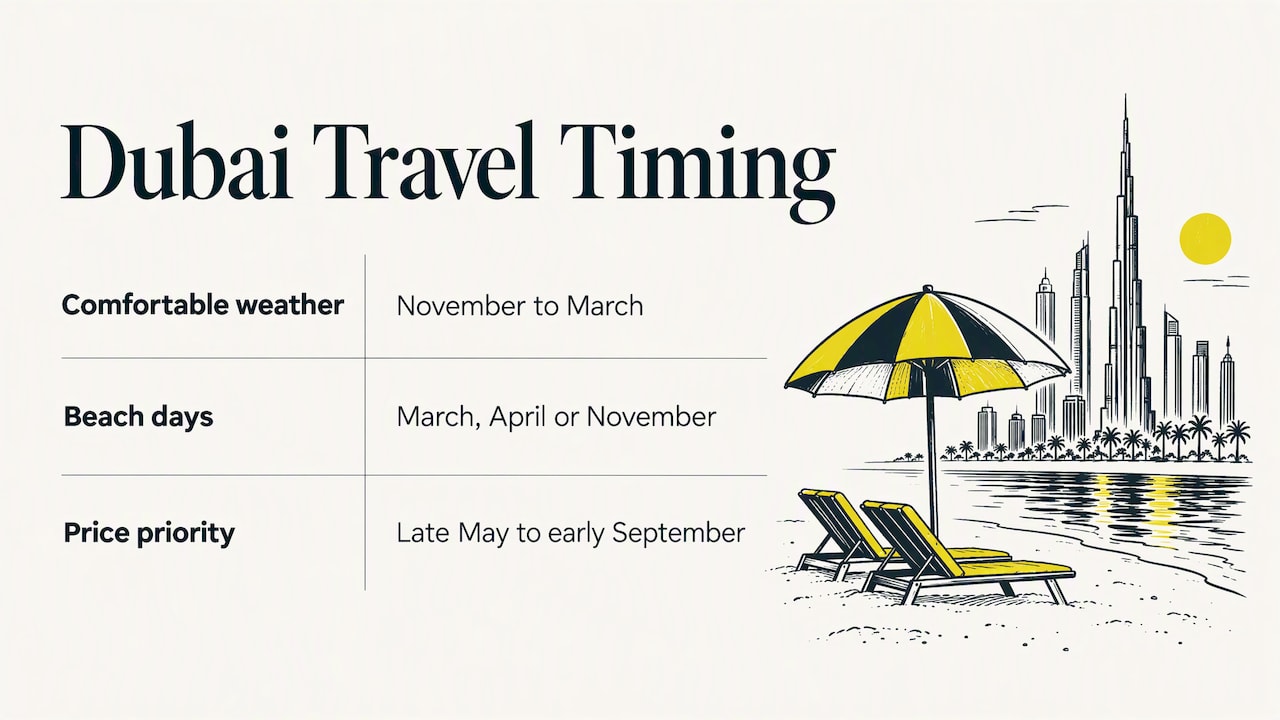
Go between November and March if you want comfortable weather across the board, choose March, April or November for beach days in Dubai, and accept the heat of late May to early September only if price is your priority. Check the events calendar for your dates and book early for winter.
Why do we follow Dubai so closely?
We cover fashion, culture and travel on both sides of the Johannesburg to Dubai connection, so event timing matters to us as much as to you. We track the shows, exhibitions and festivals that change what a visit feels like, and we follow them throughout the year.
— Chad
Where can you follow our event and travel coverage?

We publish event reports, features and travel stories that help you plan around what is happening, from fashion showcases to hotel experiences. If you want to see how we cover hospitality and travel trends, start here:
FAQ
What is the best month to go to Dubai?
December scores highest for comfortable weather, and February also ranks highly. One comfort dataset rates December at 91 out of 100. Overall, November to March is the best window for outdoor plans.
Which month is the cheapest to visit Dubai?
There is no single cheapest month, but summer may bring lower rates because of the heat. Citywide hotel occupancy stayed high in 2025, so compare actual prices for your dates.
What is the hottest month in Dubai?
August has the highest mean daily maximum among the months listed in the official normals, with a mean daily maximum of 41.9°C. July is close behind.
Is Ramadan a good time to visit Dubai?
It can be, if you want night markets, iftar and a cultural focus. Daytime hours are quieter, so check attraction opening hours for your dates.
Sources
- Best time to visit Dubai | CN Traveller
- Visitdubai
- Dubai’s Tourism industry Achieves Third successive Record-breaking Year | Public Debt Management Office
- Ramadan 2026 in Dubai | Visit Dubai
