
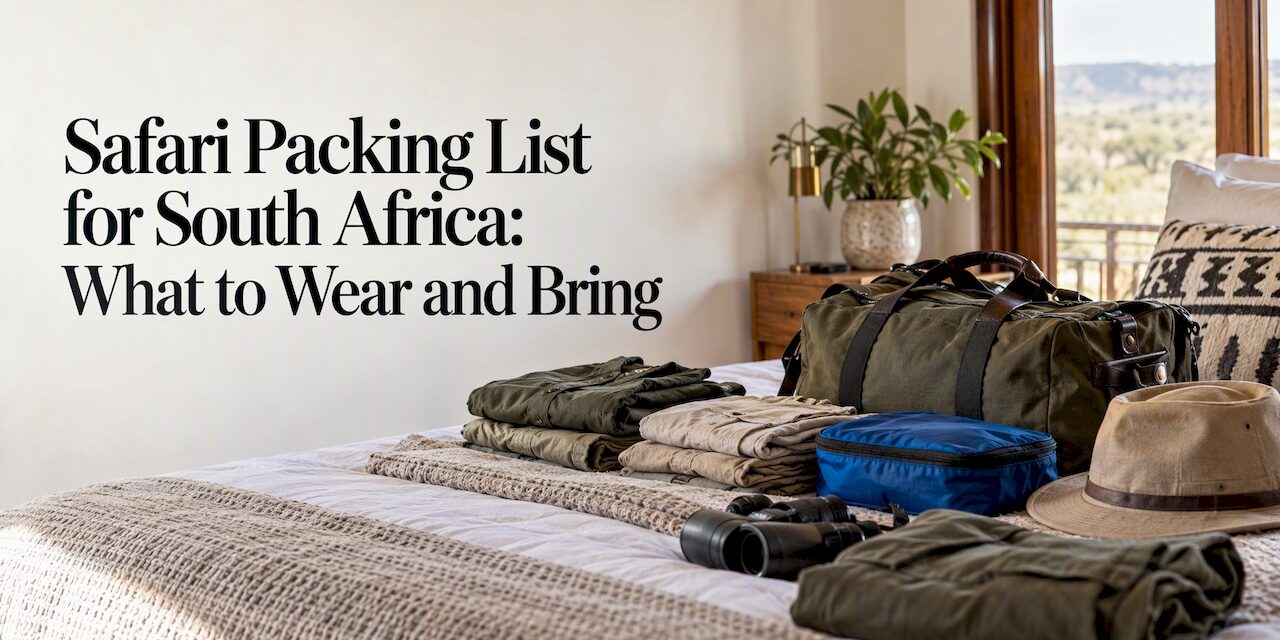
Pack light, soft and neutral: earth-toned layers for cold dawns and hot middays, a wide-brimmed hat, broken-in shoes, serious insect protection, a headlamp and a small daypack for your camera and water. Leave the white shirts, camouflage and hard suitcase at home. Below is the full list, built for a South African trip such as Kruger or a private reserve, with the reasoning behind each item so you can adjust it to your own season, budget and lodge.
TL;DR
- Choose olive, khaki, beige and brown layers in soft fabrics. Skip white, which shows red dust and stands out, and skip camouflage, which is often restricted for civilians.
- Dawn game drives are cold and middays are hot, so pack a fleece or light puffer plus short and long sleeves.
- Kruger is a malaria area: cover up and use DEET repellent from dusk to dawn, and speak to a doctor or travel clinic before you go.
- Use a soft duffel, not a rigid case: small planes to lodges can have tight weight limits.
- Bring a headlamp, a good support bra if it applies to you, and leave drones at home, because they are banned in national parks.
Table of Contents
- How to think about packing for a South African safari
- What to wear on game drives
- Safari outfits for women
- Health, sun and insect protection
- Documents, money and customs
- Gear: cameras, bags and small things that matter
- What not to pack
- Sample lists by trip length
- Park rules that shape what you bring
- Our perspective
- Plan the rest of your trip with Joburgstyle
- FAQ
- Sources
How to think about packing for a South African safari
A safari is not a fashion shoot, and the biggest packing mistakes come from treating it like one. You will spend several hours a day in an open or semi-open vehicle, you will get dusty, and you will move between temperatures that can differ by 20 degrees in a single day.
Three rules cover most decisions.
- Layers beat single heavy items. Early morning drives start in the cool, and the sun climbs fast. You want to peel off and add back without stopping the vehicle.
- Colour matters for practical reasons. Neutral tones keep you less conspicuous and hide dust.
- Weight is a real constraint. Condé Nast Traveler points to roughly 33 pounds (about 15 kg) as a typical allowance on the bush planes that carry guests to lodges, and it can be less. If you are driving yourself from Johannesburg, you have more room, but packing to the smaller number still makes lodge life easier.
If you are still deciding between a drive-yourself trip and a flight, our guide to Johannesburg to Victoria Falls for South Africans compares the options and shows how luggage rules change the choice.
What to wear on game drives
Colours and fabrics
Stick to olive, khaki, beige, tan and brown. White looks tempting in the heat, but it picks up red dust instantly and is highly visible in the bush. SANParks’ visitor information for Kruger is the page to read for park rules before you travel. Camouflage is frequently restricted or forbidden for civilians in South Africa and neighbouring Zimbabwe, so do not pack it, even if it looks the part.
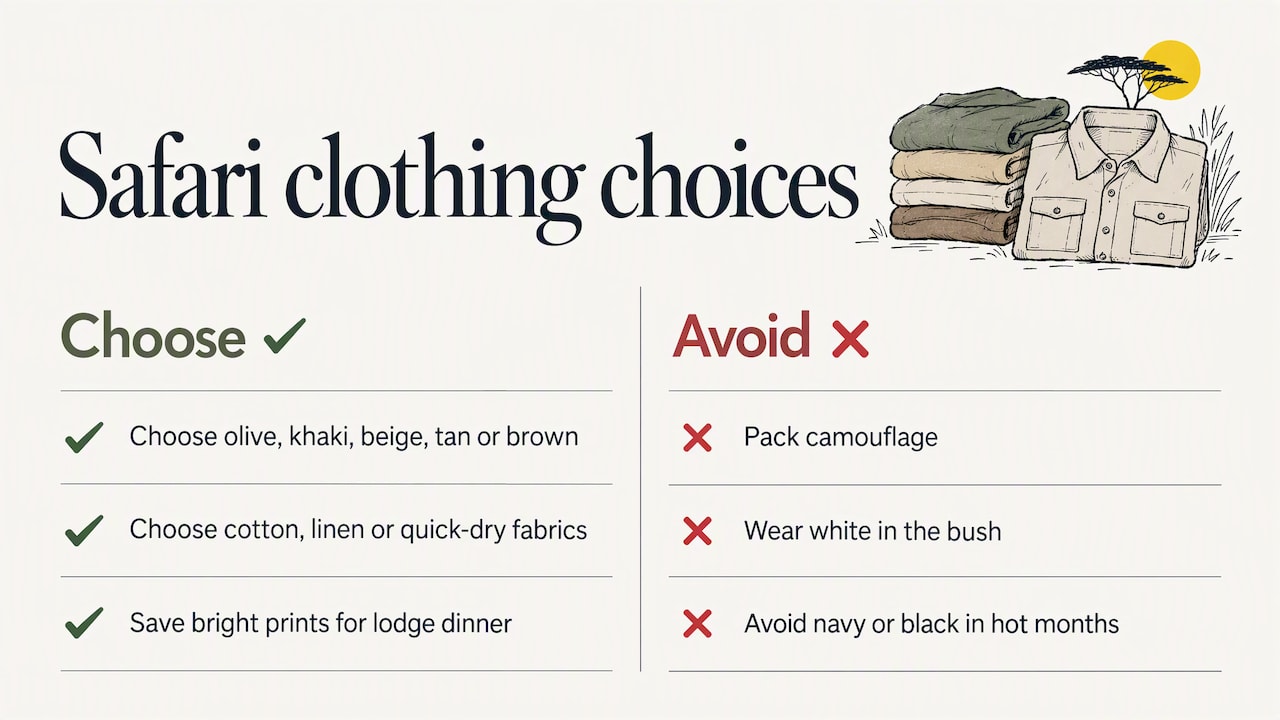
Choose cotton, linen blends or quick-drying technical fabrics. Avoid very dark navy and black in the hot months, which absorb heat, and bright prints, which are better saved for the lodge dinner.
Tops
- 3 short-sleeved T-shirts or lightweight shirts
- 2 or 3 long-sleeved shirts in light cotton or linen. These do double duty against sun and mosquitoes.
- 1 sleeveless top or vest for hot afternoons
- 1 fleece or lightweight puffer for dawn drives
- 1 packable rain jacket, even in the dry season, because summer storms in the Lowveld can be fierce
Bottoms
- 2 pairs of long, lightweight trousers (these also protect your legs from insects in the evening)
- 2 pairs of shorts
- 1 pair of comfortable leggings or joggers for the lodge and for sleeping
Can you wear jeans? You can, and plenty of people do, but they are heavy, slow to dry and hot at midday. Lightweight trousers in a neutral colour are better, and you save luggage weight.
Hats, scarves and sunglasses
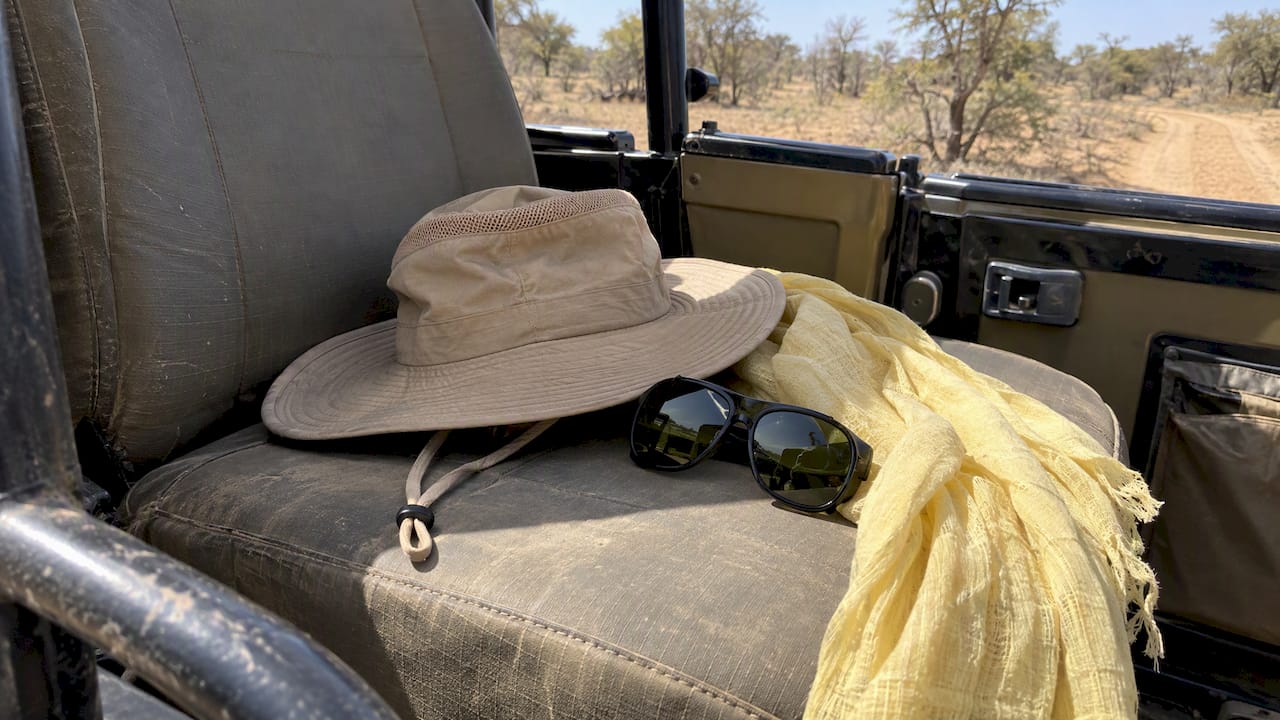
A wide-brimmed hat with a chin strap is worth it, because open vehicles move at a speed that can whip a hat away. Add polarised sunglasses and a light scarf or buff. It works as a dust mask on dirt roads, a neck warmer at dawn and sun protection at noon.
Footwear
You do not need heavy boots unless you are booked on a walking safari. Pack:
- Broken-in trainers or light walking shoes for drives and short walks
- Sandals or flip-flops for the lodge
- 5 or 6 pairs of socks, including a couple of thicker pairs for cold mornings
New shoes are a mistake. Blisters on day one will follow you through the whole trip.
Safari outfits for women
The search for women’s safari outfits is huge, and it is easy to see why: people want to look good in photographs without being impractical. The good news is that the practical choices are also stylish.
- Build a capsule. Two pairs of trousers, one pair of shorts, three tops that mix and match, one lightweight shirt-dress or jumpsuit for the evening, and a fleece or jacket. Everything should go with everything else.
- Wear a supportive sports bra. Safari vehicles are famously bumpy, and high-impact support makes long drives much more comfortable, whatever you normally wear.
- Use accessories for personality. A patterned scarf, good sunglasses, a leather belt and simple jewellery add polish without adding weight. If you like bolder looks for the lodge evening, our guide to African print outfits and how to wear them in South Africa has ideas that suit a warm night on a deck.
- Skip heels and anything delicate. Lodge paths are sandy and uneven, and light is low after dark.
- Tie your hair back. A low ponytail or braid under a hat is the most practical style in a moving vehicle.
For men, the same logic applies: neutral shirts, convertible trousers or shorts and a collared shirt for the lodge evening, if the lodge has any dress sense at all.
Health, sun and insect protection
This is the part of the list where you should not improvise.
Malaria and mosquitoes
The Kruger National Park and other low-lying parts of the country are malaria areas. SANParks explains that mosquitoes bite most often between dusk and dawn, and that you should stay indoors then or cover exposed skin with light clothing and repellent. Pack:
- A repellent containing DEET, applied on exposed skin and ankles
- Long-sleeved, light-coloured shirts and long trousers for the evening
- Any mosquito-related items your lodge does not already provide, such as plug-in repellent
Malaria preventive medicine is a decision for a doctor, not a packing list. Talk to your GP or a travel clinic well before you travel, tell them where and when you are going, and follow their advice on tablets. Government health communication stresses that malaria can become severe if not diagnosed and treated within 24 hours, so if you develop fever, headache, chills or vomiting during or after your trip, see a doctor straight away and say that you have been in a malaria area. Symptoms can appear days or even weeks after a bite.
Sun protection
Bring more sunscreen than you think you need, with a high SPF, plus lip balm with SPF. Reapply at midday even when it feels cool, because the open vehicle and the glare off dry grass catch people out.
Personal medical kit
Keep it small and personal:
- Any prescription medication in original packaging, with a copy of the prescription
- Pain relief, antihistamines and rehydration sachets
- Plasters, blister patches and antiseptic cream
- Hand sanitiser and wet wipes
If you take regular medication, carry a full supply in your hand luggage, not your checked bag.
Documents, money and customs
Keep a plastic sleeve with these in your daypack:
- Passport, with enough validity and blank pages for entry stamps
- Printed lodge and park confirmations, because signal in the bush is patchy
- Driving licence, if you are hiring a car
- Travel insurance details, including emergency numbers
- Yellow fever certificate, if it applies to you
On the yellow fever rule: South Africa’s government states that a certificate is required for travellers over one year old arriving from countries with a risk of yellow fever transmission, or who have been in transit through one for more than 12 hours. The vaccination must be given at least 10 days before travel. That statement dates from 2015, so check the current list of affected countries with your airline, a travel clinic or the Department of Health before you fly, especially if you are connecting through another African country.
If you are coming home with shopping, remember that SARS publishes a duty-free allowance of R5,000 per person for goods brought in as accompanied baggage by international travellers. Keep receipts. SARS also says that cash above $10,000 or its equivalent must be declared on entry or exit, so nobody should be surprised by a customs interview.
Worth knowing: if you plan to shop for modest fashion or designer pieces on a stopover in Dubai, our piece on Dubai modest fashion brands and South Africa’s import costs explains how the import side works for South Africans.
Gear: cameras, bags and small things that matter
Luggage
Use a soft-sided duffel or a backpack of about 40 to 45 litres, plus a daypack. Hard cases do not squeeze into small aircraft holds or vehicle boots. A packing cube or two keeps dust out of clean clothes.
Camera and binoculars
Binoculars are the single best upgrade to your game drive. Even a compact pair of 8×32 transforms birdwatching and distant sightings. For photography, bring:
- A camera with a zoom lens, or a phone with a good telephoto
- Spare batteries and enough memory cards
- A dust-proof pouch or a plastic bag and a lens cloth
- A small beanbag to rest your lens on the vehicle’s window frame, if your guide allows it
Leave the drone at home. Drones are completely prohibited in national parks because they disturb wildlife.
Headlamp and power
Lodge lighting is often minimal after dark, and you will walk between your room and the dining area. A headlamp is far better than a phone light, which can also be unwelcome in quiet areas. Add a power bank, the right plug adaptor (South Africa uses its own three-round-pin type, so check your lodge) and a short charging cable.
Small extras worth their space
- A refillable water bottle
- Earplugs, because the bush is noisy at night
- Wet wipes and a small towel
- A paperback or e-reader for the midday break
- A small notebook for sightings lists
- Zip bags for wet or dusty items
What not to pack
| Leave at home | Why |
|---|---|
| White or very bright clothing | Shows dust and is highly visible in the bush |
| Camouflage | Often restricted or forbidden for civilians |
| Hard suitcases | Do not fit small aircraft or vehicle space |
| Drones | Banned in all national parks |
| Heavy hiking boots | Only needed for walking safaris |
| Strong perfume | Attracts insects and irritates others in a shared vehicle |
| Too much jewellery | Easy to lose, and not needed in the bush |
| Jeans and heavy cotton | Hot, slow to dry and heavy |
Sample lists by trip length
People often ask what to pack for 7 or 10 days. Good news: the list barely grows, because lodges usually offer laundry, and you wear the same neutral pieces repeatedly.
A long weekend (3 nights)
Two tops and one pair of trousers for drives, one pair of shorts, one fleece, one outfit for the evening, sleepwear, and one pair of shoes plus sandals.
A week (7 days)
Three to four tops, two pairs of trousers, two pairs of shorts, one fleece and one light jacket, one evening outfit, and enough underwear and socks for three or four days. Use the lodge laundry for the rest, and check whether it is included, because some charge per item or ask you to avoid delicates.
Ten days or more
Add one extra top and trouser set, a second pair of shoes if you plan hikes, and a small bag of detergent for sink washing. Resist the urge to pack more clothes. Ten days of safari is mostly the same four outfits in rotation.
Park rules that shape what you bring
Park rules are not just for guides. In South African parks, visitors must stay inside their vehicles and keep limbs inside, and feeding animals is strictly prohibited. That is why snacks should be sealed and kept out of sight, and why you should not hang an arm out of the window for a photograph.
SANParks also stresses that good game viewing is about slow travel. The best sightings tend to happen in the cool early mornings and late evenings, so you should pack for an early start: a warm layer on top, a hat in your daypack and your camera charged the night before.
If your plans include East Africa after South Africa, the rules are similar but not identical. This overview of national park rules in Kenya (in Italian) explains how responsible wildlife viewing works there.
Our perspective
We write about Johannesburg and life beyond it, and we get the same question every year from readers heading to the bush: how do I look put together without overpacking? Our answer is always to treat safari as a capsule wardrobe exercise. A few good neutral pieces, one standout accessory and one evening outfit take you through any lodge dinner.
We also see the opposite problem. People spend on an outfit that looks like a film set, then forget a headlamp, a decent hat and a doctor’s appointment. The things that make or break a trip are rarely glamorous. Get the sun, insect and health basics right first, then add the details that make you feel like yourself.
If you are heading out from Gauteng, you have a head start: the bush is a drive or short flight away, which means you can test your shoes and your layers on a weekend trip before the big one.
— Chad
Plan the rest of your trip with Joburgstyle
Joburgstyle covers fashion, travel, family outings and culture from Johannesburg and beyond, so your packing list is only one part of it. If you are travelling with children, read about Kruger Station and what it offers families exploring Kruger. If you want a day out without an overnight trip, our Lion and Safari Park guide covers what to book. More ideas live on the Joburgstyle homepage.
FAQ
What should I wear on a safari in South Africa?
Wear layers in neutral earth tones such as olive, khaki and beige, in cotton, linen or quick-drying fabrics. Pack short and long sleeves, long trousers, a fleece for cold dawns and a wide-brimmed hat. Avoid white, bright colours and camouflage.
Can I wear jeans on safari?
Yes, you can, but they are not the best choice. Jeans are heavy, hot at midday and slow to dry if you are caught in rain or wash them at the lodge. Lightweight trousers in a neutral shade are more comfortable and take up less space.
What should I not pack for a safari?
Leave white and brightly coloured clothes, camouflage, rigid suitcases and heavy hiking boots at home. Do not bring a drone, as they are not allowed in national parks. Strong perfume is also best avoided, because it attracts insects.
What do I need for a 7 or 10 day safari?
You need almost the same as for a long weekend: about three or four tops, two trousers, two shorts, a fleece, a jacket and one evening outfit. Lodge laundry covers the extra days, so check what your lodge offers before you add more clothes.
Do I need malaria tablets for Kruger?
Kruger is a recognised malaria area, but whether you take preventive medicine is a medical decision. See your doctor or a travel clinic before you travel, and use repellent and covered clothing between dusk and dawn either way.
Sources
- SANParks: Vital information for Kruger National Park
- SANParks: Malaria in Kruger National Park
- SAnews: Travellers urged to take malaria precautions
- South African Government: Health reviews yellow fever requirements
- SARS: Duty free allowances for travellers
- SARS: Travellers leaflet
- Condé Nast Traveler: What to pack for safari
