
Start in Rosebank on the Keyes Art Mile, where Goodman and Everard Read anchor the circuit, then add the Johannesburg Art Gallery (JAG) for the city’s main public collection. Most commercial galleries in Rosebank are free to enter, while some institutional and independent spaces ask you to book. Plan a Rosebank circuit plus one studio or JCAF visit.
TL;DR:
- Most Rosebank commercial galleries offer free walk in entry, but JCAF requires online registration, while independent studios such as Asisebenze are best visited by appointment.
- A one day visit can cover six Rosebank galleries before lunch, but reserve the afternoon for one outlying stop requiring a booking or appointment.
- JAG holds around 9,000 to 10,000 works, but only a small share is typically on display, so check current exhibitions before making the trip.
- Keyes Art Night runs on the first Thursday each month with late openings, music, and food; arrive early to see chosen galleries before crowds build.
Table of Contents
- 1. Which Johannesburg art galleries are worth your time?
- 2. How do you make the most of Rosebank and the Keyes Art Mile?
- 3. Which independent and institutional spaces should you add?
- 4. What do you need to know before you go?
- 5. How can you see the highlights in one day?
- 6. How did Johannesburg’s gallery scene develop?
- 7. What kinds of art will you find?
- 8. Which artists are associated with these galleries?
- 9. How do galleries support emerging talent and the community?
- 10. How do you buy art from a Johannesburg gallery?
- 11. Which art fairs and recurring events should you plan around?
- 12. Why we time our gallery visits around openings
- 13. Where can you find current exhibitions and events with Joburg Style?
- FAQ
- Sources
1. Which Johannesburg art galleries are worth your time?
If you want a short list rather than every venue in the city, these are the ones we would put in your diary, grouped by neighbourhood. Entries are brief on purpose: check each gallery’s own page or phone ahead for current hours and shows.
Rosebank and Keyes Art Mile
- Goodman Gallery: Best for international contemporary art and big-name conversations. Standout: a programme that links South African and global artists. Entry is generally free.
- Everard Read: Best for sculpture, architecture and large-scale work. Standout: one of the anchor galleries of the precinct, and a good first stop. Entry is generally free.
- Circa Gallery: Best for visitors who like architecture and contemporary work in the same visit. Standout: a Keyes-area anchor with its own distinct focus. Entry is generally free.
- David Krut Art Gallery: Best for printmaking and works on paper. Standout: its printmaking specialism, which sets it apart from neighbours. Entry is generally free.
- Origin Art: Best for a mix of established and emerging artists. Standout: a more intimate scale than the big names. Hours vary, so confirm before you go.
- Gallery MOMO: Best for a short walk from the main cluster. Standout: rotating exhibitions that change through the year. Entry is generally free.
Inner city and independent
- Johannesburg Art Gallery (JAG): Best for history and scale. Standout: the city’s largest public collection. It is typically open Tuesday to Sunday, 10:00–17:00, but confirm which exhibitions are up.
- Bag Factory and Asisebenze Art Atelier: Best for seeing artists’ working spaces. Details are in section 4.
- Joburg Contemporary Art Foundation (JCAF): Best for museum-quality shows. Booking is required, as explained in section 4.
Time Out’s roundup of museums and galleries shows there are further circuits beyond Rosebank if you want a second visit.
2. How do you make the most of Rosebank and the Keyes Art Mile?
Rosebank is where serious contemporary art clusters, along Jellicoe Avenue, Keyes Avenue and the Jan Smuts corridor. The Keyes Art Mile grew over about a decade into a walkable precinct of galleries, studios and hospitality spaces, so you can park once and walk between most stops.
- Start with the anchors. Everard Read and Circa give you scale, and David Krut and Origin Art add print and emerging work.
- Time your visit. Keyes Art Night, on the first Thursday of the month, brings late openings, music and food to the precinct. Expect more energy and more people than on a quiet weekday.
- Pause for lunch. The area’s food and hospitality options make it easy to split the day in two.
Pro Tip: Arrive early on Keyes Art Night, see the galleries you care most about first, and leave the food stalls and music for the end of the evening.
3. Which independent and institutional spaces should you add?
Commercial galleries show you what is for sale. Artist-run and institutional spaces show you how art gets made and kept.
- Bag Factory: An independent venue with studio space, exhibitions and workshops. It runs residencies and hosts open studios and public events, so check what is on before you go.
- Asisebenze Art Atelier: Artists’ studios and a gallery in central Johannesburg. Visitors are often connected with resident artists through security at the door, and informal studio tours are possible. Arrange your visit by appointment where you can.
- JCAF: Presents museum-quality exhibitions and public programmes, and visitors must register online before attending exhibitions. Its programmes are listed as free, but booking is mandatory.
- Johannesburg Art Gallery: Opened in 1913 and holds around 9,000 to 10,000 works, but exhibitions are curated and rotated, so what you can see varies. Civil society groups have reported that only a small share of the permanent collection is typically on display, so check the current schedule on the ArtThrob listing or the city’s page first.
4. What do you need to know before you go?
A little planning makes the day smoother.
- Entry: Most Rosebank commercial galleries are free to enter because they make their income through art sales. JCAF needs advance online registration, and JAG visits are best confirmed beforehand.
- Hours: Weekday daytime is the safest bet. Saturday mornings are common, and many spaces close on Sundays, so phone ahead.
- Getting there: Rosebank is easiest by car or e-hailing, with the cluster walkable once you arrive. For inner-city spaces such as Asisebenze and JAG, use e-hailing and arrange pick-up in advance.
- Staying safe: Keep valuables out of sight, visit in daylight and stay with the planned route in the inner city.
- Lunch: Pair a morning of galleries with lunch in the precinct and save inner-city visits for the afternoon.
- Current shows: Exhibitions change, so check official gallery pages or call before you set out.
5. How can you see the highlights in one day?
Here is a realistic route using the venues above.
- Morning: Begin at Everard Read and Circa, then walk to David Krut and Origin Art.
- Late morning: Visit Goodman and Gallery MOMO while the precinct is still quiet.
- Lunch: Eat in Rosebank so you stay close to your car.
- Afternoon: Choose one: an appointment at Asisebenze or Bag Factory, a booked JCAF visit, or JAG if its current exhibition suits you.
- Rainy day or late start: Limit yourself to two neighbouring Rosebank galleries and a covered café, and leave the inner city for another day.
6. How did Johannesburg’s gallery scene develop?
Johannesburg’s gallery culture has two strands that still shape your visit. The first is institutional: the Johannesburg Art Gallery opened in 1913 and built a collection of roughly 9,000 to 10,000 works, becoming the city’s main public home for art. Its more recent story is about access and conservation, which is why a visit today depends on what is currently on display.
The second strand is commercial and artist-led. The Keyes Art Mile in Rosebank began around ten years ago and developed into a precinct of galleries, studios and hospitality venues with rotating exhibitions and mixed creative programming. Alongside it, newer organisations such as JCAF, which launched in 2020, add museum-style programming and public talks. Artist-run spaces such as Bag Factory and Asisebenze carry the workshop tradition into the present.
The result is a scene spread across several neighbourhoods rather than concentrated in one. That is why we suggest a Rosebank base and one outlying stop: it shows you both the market and the making.
7. What kinds of art will you find?
The galleries have distinct specialisms, so your taste can guide your route.
- Contemporary and international: Goodman Gallery is known for international contemporary work, which makes it a good place to see how local artists sit alongside global names.
- Sculpture and architecture: Everard Read is associated with architecture and sculpture, while Circa also anchors the precinct with its own focus.
- Printmaking and works on paper: David Krut is where to go if you like prints and editions.
- Mixed established and emerging: Origin Art and the wider Keyes Art Mile show established and emerging artists side by side.
- Studio practice: At Bag Factory and Asisebenze you see work in progress rather than finished, framed pieces, which suits visitors curious about process.
- Public collection: JAG’s holdings give historical depth, though only part of the collection is shown at any one time.
We have not listed traditional or township art as a separate gallery category here, because the sources we rely on do not tie it to specific venues. If that is your interest, ask gallery staff or the resident artists what they currently show.
8. Which artists are associated with these galleries?
We would rather point you to how to find artists than quote a ranking we cannot verify. Each gallery’s own website lists its represented artists and current exhibitions, and that is the most reliable way to see who is showing now.
Some practical routes in:
- Goodman Gallery presents international contemporary artists and is worth a look if you want to see how local practice connects to global trends.
- David Krut is the place to meet printmakers and see editions up close.
- Everard Read shows large-scale sculpture and architectural work.
- Origin Art is useful for discovering names you may not have heard.
- Bag Factory supports artists through residencies and open studios, so you may meet working artists directly.
Our own coverage follows local creatives too. For example, we reported on the Rockets Media Group studio and artist development ecosystem, which is relevant if you are interested in the infrastructure behind artists’ careers.
9. How do galleries support emerging talent and the community?
Support for emerging artists takes several forms, and you can see most of them on a single visit.
Residencies and open studios are the clearest example. Bag Factory runs residencies and hosts open studios and public events, and Asisebenze houses working artists in a shared building where visitors can meet them. JCAF adds a public programme, including the School of the South lecture series and workshops, which brings conversation and learning to a wider audience.
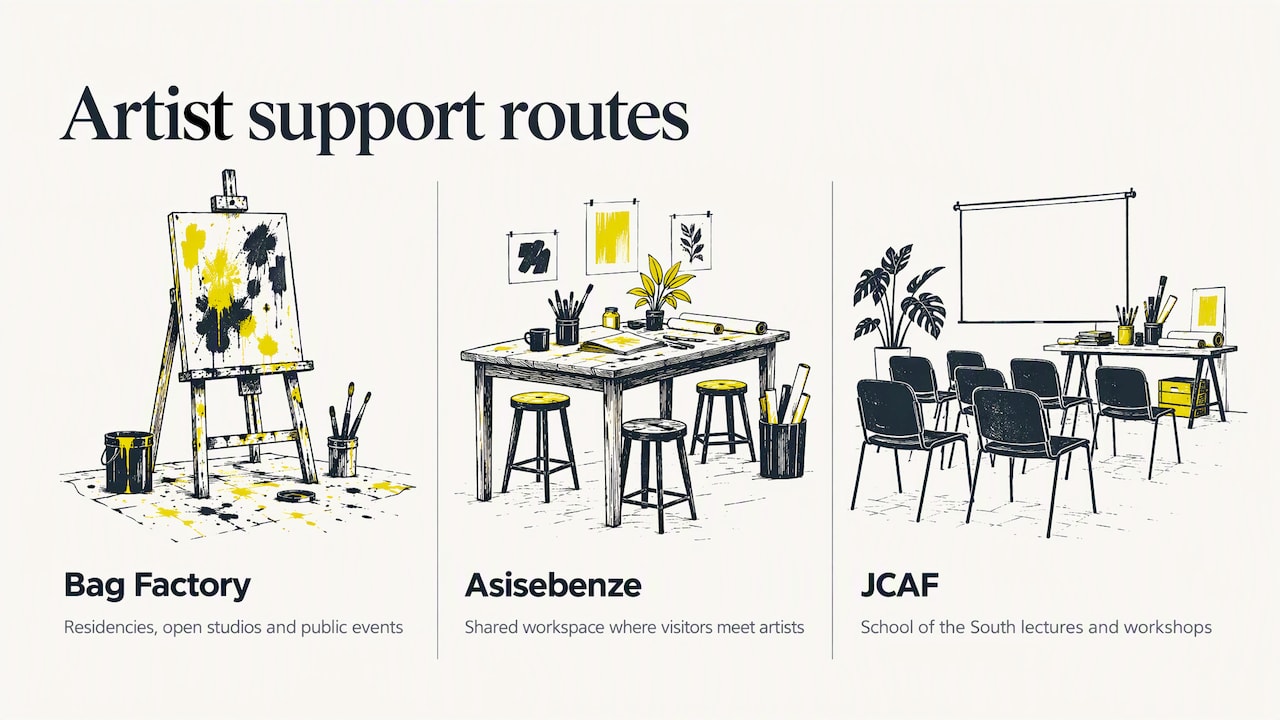
Commercial galleries contribute in a different way. Keyes Art Mile mixes established and emerging artists, so a newcomer’s work can hang near a well-known name. Monthly late openings put that work in front of people who might not otherwise walk into a gallery.
For us at Joburg Style, community engagement is part of the job. We covered the Fringe solo exhibition at Scapegoat Gallery in Hyde Park Corner because showing local work is how a scene grows. If you want to support emerging artists, attend openings, ask about studio visits and tell friends what you saw.
10. How do you buy art from a Johannesburg gallery?
Most Rosebank galleries are free to enter and operate through art sales, so staff expect questions and are used to first-time buyers. You do not need to commit to anything by walking in.
A sensible process looks like this:
- Look first. Visit a few galleries and note which artists and mediums you keep returning to.
- Ask for information. Staff can tell you about an artist’s background, the medium, the edition (for prints) and the price.
- Request documentation. Ask for a certificate or invoice that names the artist, title, medium and year, which is the practical basis for authenticity and for resale or insurance later.
- Discuss commissions. If you want something made, ask whether the artist or gallery takes commissions and how timelines and deposits work.
- Arrange delivery. Ask how the work will be packed and transported.
We cannot give you each gallery’s terms, as they differ and are not published in the sources we use. Ask the gallery directly. Printmaking at David Krut is often a gentler entry point if you are buying for the first time, because editions give you a clearer sense of what you are getting.
11. Which art fairs and recurring events should you plan around?
The most dependable recurring event in this guide is Keyes Art Night, held on the first Thursday of the month, when the Rosebank precinct opens late with music and food. It is the easiest way to see several openings in one evening.
Beyond that, the galleries run rotating exhibitions through the year, and JCAF adds a programme of exhibitions, lectures and workshops. The Keyes Art Mile also hosts rotating exhibitions and mixed creative programming, so a visit a month apart will often show you something new.
We have not confirmed dates for any major annual art fair for this article, and we would rather say so than guess. Before you plan a trip around a specific fair or exhibition, check the organiser’s page or the gallery’s site for current dates and booking rules. For a taste of event coverage, see our report on the Take a Stand exhibition at @Sandton Hotel.
12. Why we time our gallery visits around openings
We cover Johannesburg’s culture, and our advice is simple: go when the doors are open late. Openings are when galleries are at their most generous. Artists are often in the room, the music is on, and you can ask questions without feeling like you are interrupting. A quiet weekday is better for looking carefully, but a first Thursday is better for understanding why the scene matters. Do both if you can.
We also think the best gallery day is a modest one: a few good rooms, a proper lunch and one place that surprises you. Follow our arts coverage for exhibition news and event listings, and tell us what you found.
— Chad
13. Where can you find current exhibitions and events with Joburg Style?
We write about the exhibitions, openings and cultural moments that make Johannesburg worth exploring, so you can plan before you leave the house.

- Read our coverage of the Take a Stand exhibition at @Sandton Hotel for a recent art event worth knowing about.
- Browse our homepage for new exhibition stories, interviews and event reports.
- Pair your gallery day with our savvy traveller tips for planning.
FAQ
Are Johannesburg art galleries free to enter?
Most commercial galleries in Rosebank are free to enter, because they make their money through art sales. Some institutional spaces, such as JCAF, require you to register online first. Confirm current conditions on each gallery’s own page, as the Rosebank guide notes.
When is the best time to visit Rosebank’s galleries?
Weekday daytime is usually the quietest and best for careful looking. For atmosphere, go on Keyes Art Night, the first Thursday of the month, when the precinct stays open late with music and food. Always check ahead, as hours can change.
Do I need to book to visit a gallery in Johannesburg?
For JCAF, yes: visitors must register online before attending exhibitions. Independent spaces such as Asisebenze are best visited by appointment. Most Rosebank commercial galleries allow walk-ins, but a quick call avoids surprises.
Is the Johannesburg Art Gallery worth visiting?
Yes, if you want the city’s main public collection and some history. It is typically open Tuesday to Sunday, but exhibitions rotate, so only part of the collection is shown at once. Check the city’s visiting page before you travel.
Can I buy art directly from these galleries?
Yes. Rosebank galleries sell art, and staff can explain pricing, editions and documentation. Ask for an invoice or certificate naming the artist, title and medium, and ask the gallery about commissions and delivery.
Sources
- Art Galleries in Rosebank: Your Complete Guide
- Joburg’s Keyes Art Mile 2.0: A vision finally takes shape after a decade of dreaming
