

There are luxury hotels. There are destination resorts. And then there is Atlantis Dubai.
I’ve been to Dubai before. More than once. It’s a city that has built much of its reputation on doing what others thought couldn’t – or perhaps shouldn’t – be done. Bigger. Higher. Faster. More ambitious.
Yet returning to Atlantis Dubai reminded me of something quite different. Extraordinary doesn’t always have to be bigger.
Sometimes it’s a child seeing a mermaid through the glass of an aquarium. Sometimes it’s waking up with sharks and an underwater world moving silently beyond your bedroom window. Sometimes it’s the scale of a resort that feels almost impossible to comprehend.
And sometimes it’s a tiny dolphin unexpectedly appearing on your phone-charging cable.
That’s the point. Expect Extraordinary. It is a bold promise to put in front of the world. And Atlantis Dubai knows it.
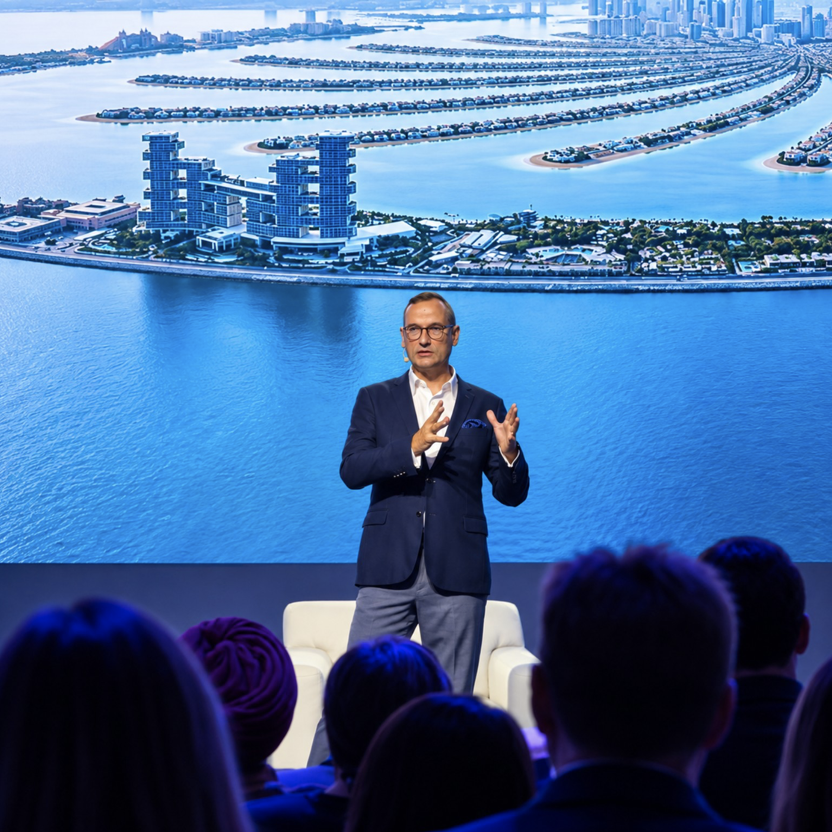
A WORLD AWAY
Atlantis The Palm has long occupied a peculiar position within global hospitality. It isn’t simply somewhere to sleep in Dubai. It is a destination within the destination – a world built around marine life, water, food, entertainment, family, fantasy and the idea that a resort can become part of the reason you travel in the first place.
Then came Atlantis The Royal. If The Palm introduced the world to the Atlantis vision in Dubai, The Royal pushed that vision into another realm of contemporary luxury.
The architecture is unapologetic. The restaurants are destinations in their own right. Pools appear suspended above the city. Water, fire, glass and extraordinary views form part of the theatre.
Yet during an intimate Atlantis Dubai brand weekend in the city, something became increasingly apparent. Atlantis doesn’t want to be remembered simply for what it has built. It wants to be remembered for how it makes people feel.
That distinction matters. Because when you’re already operating at the top end of global hospitality, another beautiful room isn’t enough. Your guests arrive expecting extraordinary before they’ve even walked through the door. So where do you go from there?
EXPECT IT
The answer is perhaps contained in the audacity of the campaign itself. Expect Extraordinary. Not discover extraordinary. Not experience extraordinary if you’re lucky. Expect it.
Atlantis is effectively telling its guests, partners and the wider world to arrive with the bar already raised. During the weekend, that promise was articulated simply: if something isn’t extraordinary, tell us.
That’s confidence. But it’s also pressure. And to explore what happens when expectation and performance collide, Atlantis introduced someone who has spent much of his life living precisely there: Michael Johnson.
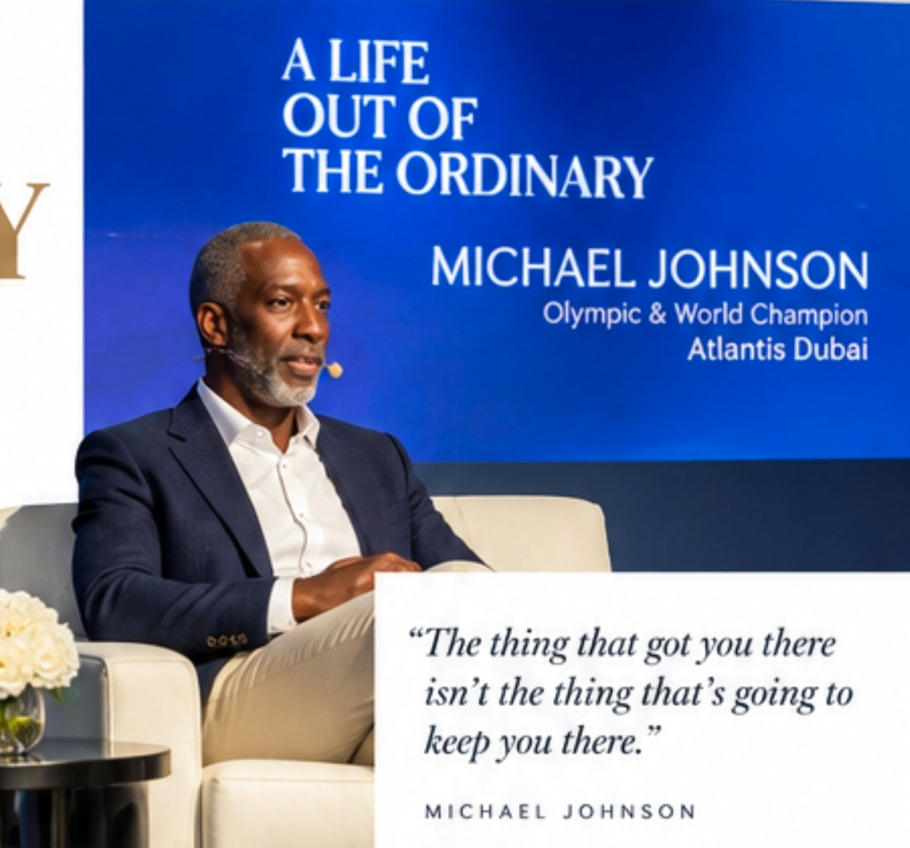
THE MAN IN THE GOLDEN SHOES
Four Olympic gold medals. Eight World Championship gold medals. World records. Olympic records. American records. And one of the most recognisable running styles – and pairs of shoes – in sporting history.
Michael Johnson walked onto the Atlantis stage as the personification of the weekend’s central idea: extraordinary. But what followed wasn’t really a conversation about medals. It was about what happens before them.
Johnson took us back to Atlanta in 1996. Years earlier, he had decided he wanted to attempt something unprecedented: win both the 200 metres and 400 metres at the same Olympic Games.
He didn’t quietly harbour the ambition. He told people. He publicly put pressure on himself to make history. And then he did.
That distinction became particularly relevant sitting inside Atlantis Dubai, beneath a campaign making its own very public promise. Johnson understood exactly what Atlantis was doing. Telling people you’ve achieved something extraordinary is one thing. Telling the world to expect extraordinary from you before you’ve delivered it is something else entirely. It raises the stakes.
THE GOLD SHOES THAT ALMOST WEREN’T GOLD
Johnson’s story about those famous golden Nike spikes provided one of the most revealing moments of the conversation.
The shoes weren’t originally designed around colour. For almost two years, Johnson and Nike worked on creating something technically unusual. He wanted an exceptionally lightweight sprint shoe that was simultaneously incredibly rigid – two requirements that naturally worked against each other.
The focus was performance. When the final prototype arrived shortly before Atlanta, it wasn’t gold. It had an almost mirrored appearance. Johnson loved it. His coach wasn’t convinced.
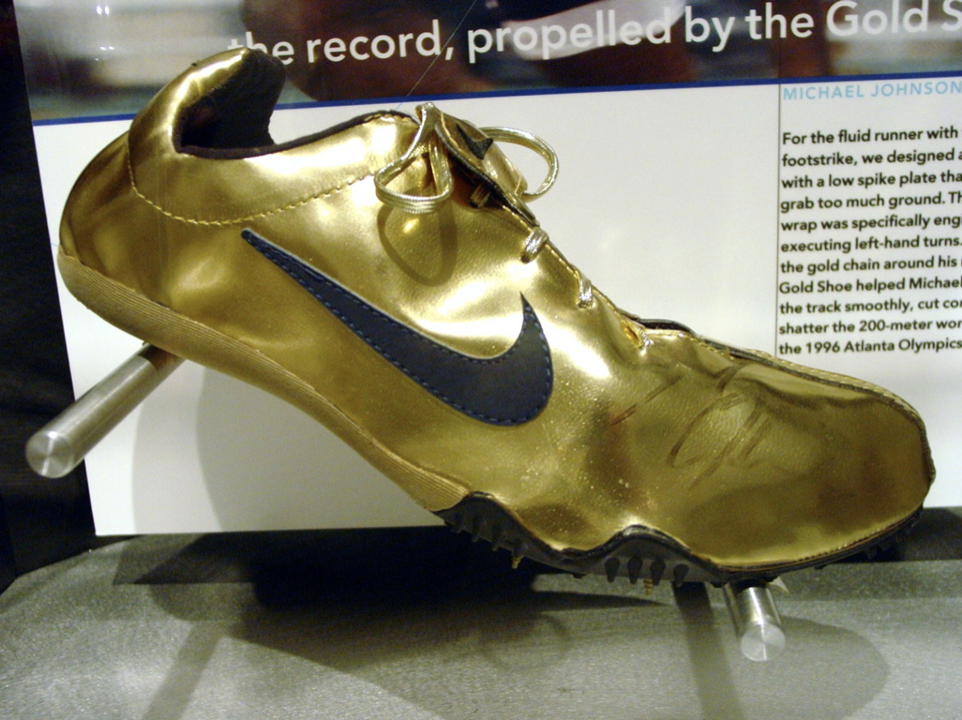
From the stadium or through a television camera, he suggested, the reflective shoe might simply appear grey or silver. Silver. For an athlete thinking about only one colour at Atlanta, that wasn’t going to work.
Johnson’s response was instinctive: could they make it gold? They could. The rest became sporting history.
Years of technology, development, experimentation and partnership went into those shoes. And the world remembers their colour. Of course, there was one rather important condition attached to wearing gold shoes at an Olympic Games. You had better win. Johnson did. Twice.
PARTNERSHIPS CREATE GREATNESS
There was another reason the Nike story mattered. Johnson couldn’t create those shoes himself. Nike couldn’t understand exactly what Johnson needed without listening to him. His coach couldn’t design them. The designer couldn’t run the race. Each person brought something different.
That became one of the strongest parallels with Atlantis. Extraordinary rarely happens alone.
Johnson spoke repeatedly about the team behind what appeared to the outside world to be an individual career – his track coach, strength coach, physiotherapist, manager and agent. Everyone understood their role. More importantly, they trusted one another to perform it.
For a hospitality brand, the principle is identical. The architecture can be extraordinary. The suite can be extraordinary. The restaurant can be extraordinary. But ultimately somebody has to open the door, remember the name, notice the detail, solve the problem or create the unexpected moment that a guest takes home.
Luxury is infrastructure. Hospitality is human.
THE 19 SECONDS THE WORLD SEES
Johnson spoke about standing on an Olympic starting line knowing that approximately 19 seconds later he would either be Olympic champion or he wouldn’t. There is no hiding in that moment. And there is no next week.
The Olympic Games return four years later – if you’re fortunate enough to return with them. So where does confidence come from when the entire world is watching? His answer wasn’t bravado. Preparation.
His confidence came from knowing that, before arriving at that starting line, he had done everything he possibly could. Weeks. Months. Years.
The world sees 19 seconds. The athlete lives everything that came before them. That may be one of the simplest explanations of extraordinary performance I’ve heard. Because extraordinary is rarely created in the moment everybody sees. It’s created during the thousands of moments nobody does.
WHEN EXTRAORDINARY GOES WRONG
Atlanta makes for a wonderful story because Johnson won. Barcelona four years earlier is arguably more revealing because he didn’t.
Johnson arrived at the 1992 Olympics as world champion, undefeated for approximately two years and favourite for the 200 metres. Then, shortly before the Games, he suffered food poisoning. His preparation collapsed. He failed to reach the 200m final.
For someone accustomed to being number one, the experience was devastating. There was no Olympics next year. There were four years to wait.
Johnson allowed himself to be disappointed. He questioned himself. He experienced everything that comes with watching an opportunity you’ve spent years preparing for disappear. Then he looked at the athletes who had won. They were largely the same athletes he’d been beating. The circumstances had changed. His ability hadn’t suddenly disappeared.
That distinction eventually helped him move forward. His philosophy today is remarkably simple: don’t allow victory or defeat to pull you permanently away from reality. Celebrate success. Feel disappointment. Then return to neutral. And concentrate on what comes next.
RESILIENCE IS CLIMBING
The word resilience has become overused. Johnson gave it a wonderfully simple definition.
On the road to success, he explained, sometimes you’re climbing a mountain. Sometimes you fall into a hole. Either way, you still have to climb.
That resonated particularly strongly in a room filled with people from international tourism and hospitality – industries that understand better than most how quickly circumstances outside their control can change.
Resilience isn’t pretending the hole doesn’t exist. It is developing the ability to climb out of it.
Johnson’s broader message was equally important. Knowing yourself means understanding not only what you’re good at, but what frightens you, where you struggle, how you react under pressure and even who you need around you when things go wrong.
For Johnson, sympathy isn’t necessarily what he needs during difficult moments. Someone else may. That’s the point. Self-awareness isn’t about adopting somebody else’s formula. It’s knowing your own.


THE QUESTION I WANTED TO ASK
Sitting there listening to an Olympic champion talk about preparation, resilience, pressure and extraordinary performance, I found myself thinking about something considerably less glamorous. Procrastination.
It’s something entrepreneurs, creatives, executives, athletes – frankly, all of us – encounter. So when the microphone reached me, I asked him. How does Michael Johnson deal with procrastination?
His answer brought almost everything we’d heard back to one place. Preparation.
Johnson acknowledged that procrastination exists for him too. But when something needs to be done, another desire becomes stronger: his desire to be prepared.
He knows how he wants to arrive at the important moment. He wants the confidence of knowing he’s done everything he could beforehand.
As he put it: “My desire to be prepared supersedes the procrastination.” It stayed with me.
Perhaps elite performers don’t live without the things the rest of us struggle with. Perhaps they’ve simply developed something more powerful on the other side.
BELIEF NEEDS EVIDENCE
Johnson returned several times to the idea of belief. We’re constantly told to believe in ourselves. But his question is more interesting: what is that belief based on?
Talent? Preparation? Experience? Work? Because when the pressure becomes real, superficial confidence can disappear very quickly.
Johnson’s belief that he could become Olympic champion wasn’t based simply on repeatedly telling himself that he could. It was grounded in ability and then reinforced by preparation.
Manifestation, in his world, isn’t sitting around imagining the medal. Set the objective. Start behaving as though you’re going to achieve it. Then do the work required to make that belief credible.
THE HUNTER BECOMES THE HUNTED
Perhaps Johnson’s most relevant observation for Atlantis itself came when he discussed sustained success.
The thing that got you there isn’t the thing that’s going to keep you there.
Becoming number one changes everything. When you’re chasing the top, you’re the hunter. Once you’re there, you’re the hunted. Competitors study you. People question your decisions. Simply winning may no longer be news. Losing certainly is.
Johnson realised that the goals that had taken him to the top could no longer motivate him in exactly the same way once he’d arrived. So the objective changed. He no longer wanted simply to win. He wanted to make history.
For Atlantis Dubai, the parallel is difficult to ignore. How does a resort synonymous with spectacle surprise guests who arrive already expecting spectacle? You evolve. You reinvent. You create the next reason to return.
DON’T SHOW US ANOTHER HOTEL ROOM
That philosophy became particularly clear in the closing remarks of the Atlantis brand weekend.
The organisers acknowledged that the partners gathered in Dubai are among the most travelled people in the industry. They’ve seen hotel rooms. They’ve seen suites. They’ve inspected resorts around the world.
So Atlantis deliberately set out to do something else. The weekend was designed to take its partners into experiences and areas they might not previously have encountered. To allow them to see Atlantis like never before.
And there was another reason for bringing everyone together. Atlantis didn’t want to go silent during uncertain times. Instead, it chose engagement. Partnership. Confidence.
Its message to the room was unequivocal: “We can only do that with your support.” These weren’t simply guests. Atlantis described them as trusted partners. And the ambition was that they would leave Dubai as ambassadors for the Atlantis brand.
THE EXTRAORDINARY DETAIL
Which brings us back to that little dolphin.
During the conversation, one guest described returning to his room and noticing a small dolphin had appeared on his phone-charging cable. Nothing enormous. Nothing expensive. Nothing that required extraordinary architecture. He hadn’t expected it. And that’s precisely why he remembered it.
Atlantis apparently has a collection of them. Which means, naturally, he’ll have to return.
It’s a tiny story. But perhaps it explains modern luxury better than another list of thread counts, square metres and restaurant names ever could.
People expect beautiful things from beautiful hotels. The challenge is giving them something they didn’t know they were waiting for.
A CITY THAT CONTINUES TO SURPRISE
Johnson was eventually asked to choose his favourite Olympic city. For a man who competed around the world, his answer was Sydney in 2000.
What made it extraordinary? Interestingly, he didn’t begin with infrastructure. He remembered the welcome. The volunteers. The atmosphere. The feeling that an entire city was genuinely happy to have the world there.
Again, we arrived at hospitality. Because destinations ultimately live in memory not only through what we photograph, but through how they made us feel while we were there.
Dubai understands that remarkably well. Every time I return, something has changed. Something has opened. Something has been imagined. And somehow, even inside a destination I’ve experienced before, Atlantis managed to surprise me again.
EXPECT EXTRAORDINARY
There’s a danger in choosing those two words. Once you tell people to expect extraordinary, good is no longer good enough. Even excellent becomes questionable.
Michael Johnson understood that better than almost anyone in the room. Before Atlanta, he told the world what he intended to do. That created pressure. It also created accountability. Then he stepped onto the track wearing gold shoes and delivered.
Atlantis Dubai has now made its own promise. Expect Extraordinary.
After spending time inside its world, perhaps the most interesting thing isn’t the scale of that promise. It’s the confidence with which they’re prepared to make it.
Because extraordinary isn’t simply about building something enormous. It can be a shark beyond a bedroom window. A child staring at a mermaid. A chef creating something you’ve never tasted. A team member remembering something you mentioned yesterday. A tiny dolphin appearing on a charging cable. Or sitting a few metres from one of your childhood sporting heroes and unexpectedly getting the opportunity to ask him a question you’ve wondered about yourself.
Extraordinary comes in different forms. But the best extraordinary has one thing in common. You remember how it made you feel.
And perhaps that is the real Atlantis promise. Not simply to see extraordinary. Not simply to visit extraordinary. But to leave with extraordinary.
Atlantis Dubai. Expect Extraordinary.
