
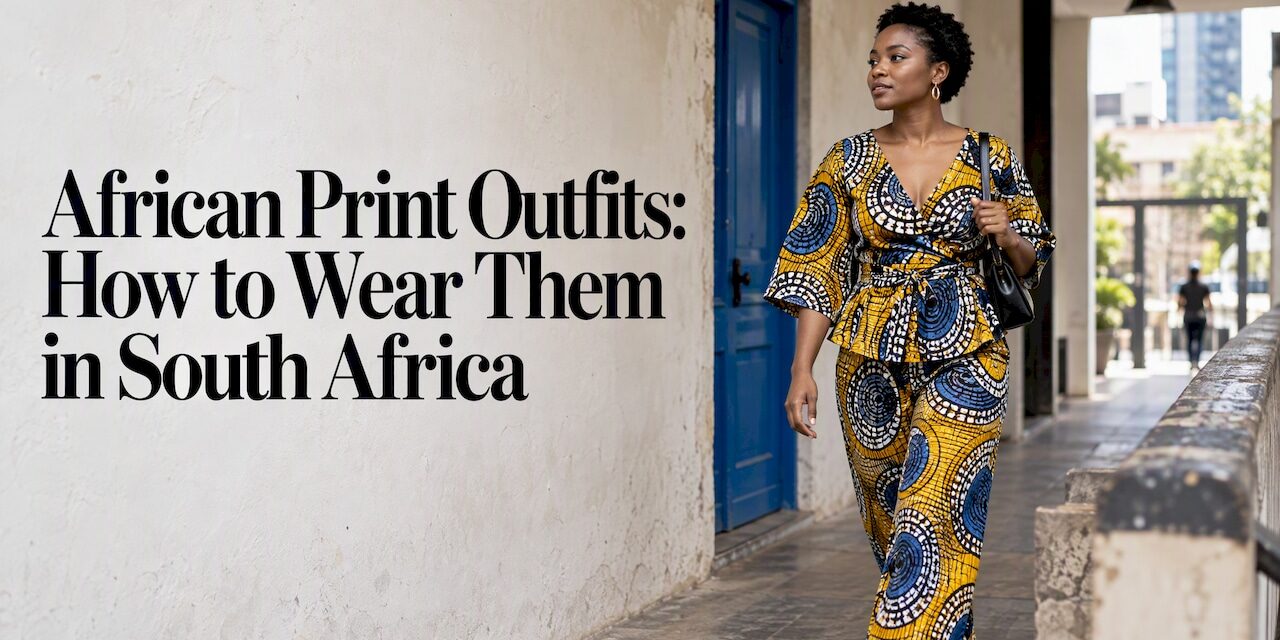
The best African print outfits start with knowing which cloth you are wearing, then letting one printed piece lead and keeping everything else quiet. A shweshwe skirt with a plain tee, an Ankara shirt under a neutral blazer, a wax-print co-ord with clean white sneakers: these work because the print does the talking. Below you will find the fabrics explained, outfit formulas for Johannesburg life, the streetwear angle, and care advice that keeps colour and shape intact.
TL;DR
- “African print” covers several cloths, including Ankara (wax-printed cotton) and shweshwe, which is distinctly South African. Knowing the difference helps you buy well and style well.
- Let one printed piece lead. Pair it with solid neutrals, denim or black, and keep accessories to one statement item.
- Johannesburg style leans bold and oversized, so print works well in streetwear: bucket hats, bomber jackets, wide trousers and chunky sneakers.
- Wash gently in lukewarm water, press on the reverse side, and wash new shweshwe before sewing because it can shrink.
- Buy from local makers and designers where you can: it keeps the craft alive and the pieces are more likely to be one of a kind.
Table of Contents
- What counts as African print?
- How to build an African print outfit that works
- Outfit formulas for Johannesburg life
- African print meets streetwear
- Ankara outfit ideas by piece
- Is it okay to wear African print if you are not African?
- Perspective: why we think print belongs in everyday outfits
- Buying: local, made-to-measure or ready-to-wear
- Caring for your African print clothing
- Photographing your outfit
- Where to see more South African style
- FAQ
- Sources
What counts as African print?
The phrase is a shorthand, and a useful one, but it hides a lot. The V&A describes Africa as home to an abundance of cloth types, made with weaving, dyeing and decorative techniques as varied as the continent itself. When shoppers in South Africa type “African print”, they usually mean one of three things.
Ankara and wax print
Ankara is wax-printed cotton, bold and graphic, often in saturated colour. Its history is more tangled than most people realise: according to the Fashion Institute of Technology’s fashion history database, African prints were initially developed by European manufacturers for the West and Central African textile trade in the late nineteenth century, then became a vital part of local fashion systems over the twentieth. The cloth is European in origin and thoroughly African in meaning, which is exactly why it still invites debate and pride in equal measure.
Shweshwe
Shweshwe is the South African one. Often called the “tartan of South Africa”, authentic shweshwe is, according to Writing Wild’s guide to isiShweshwe, 90 cm wide, carries a Three Cats logo stamp on the reverse and has a distinctive stiffness and slightly oily smell from its starching. The same piece describes its journey from rural work-wear to couture and the world’s catwalks, while staying rooted in tradition.
If you are buying fabric to have something made, the width is a handy check. Imitations are typically 150 cm wide and made of cheaper cotton or polycotton, so a wide bolt sold as “shweshwe” deserves a question.
Heritage-inspired prints
Then there are prints that borrow from heritage without being a traditional cloth: Ndebele-style geometry, animal prints in unexpected colours, and digitally redrawn patterns. Ubuntu Times reports that South African streetwear in 2026 is merging heritage prints like Ndebele motifs with bold jewel tones, neon animal prints and metallic finishes. This is where print meets the street, and it is the most exciting corner of the category right now.
How to build an African print outfit that works
Print-heavy outfits go wrong in one of two ways: too many competing patterns, or a printed piece that is so far from everything else it looks like a costume. These rules avoid both.
- Choose a hero. One printed item per outfit: a skirt, a shirt, a jumpsuit, a jacket. Everything else supports it.
- Pull one colour out. Look at the print and pick the quietest colour in it. Use that for your shoes or bag, or choose a neutral that sits beside it.
- Match the weight. Stiff cloths like shweshwe hold a shape, so they suit A-line skirts, structured dresses and waistcoats. Softer wax prints drape well in wide trousers and shirts.
- Keep the fit deliberate. Either tailored or properly oversized. Half-measures look accidental.
- Limit accessories. Bold print plus bold jewellery plus bold bag is too much. Pick one.
What to wear with an African print skirt
This is one of the questions readers ask most. A printed skirt is easiest with a plain, well-fitting top in white, black, cream or denim blue. For a casual day, add a fitted tee and white sneakers. For work, try a crisp shirt tucked in with loafers or low block heels. For the evening, a black bodysuit or silk-feel camisole and gold jewellery turns the same skirt into something dressier.
If the skirt has a busy pattern, keep the top fitted and the neckline simple. If the skirt is a calmer geometric, you can afford a statement top in a solid, saturated colour.
What to wear with African print trousers
Wide-leg wax-print trousers pair well with a plain cropped tee or a fitted knit and a lightweight blazer in a neutral tone. In cooler months, add a long camel or black coat and ankle boots. The print then reads as a deliberate choice rather than a holiday souvenir.
Dresses and jumpsuits
A printed dress or jumpsuit is a one-piece solution, so the work is in the layers. A denim jacket makes it casual. A tailored blazer makes it office-ready. A long black cardigan makes it winter-friendly. Keep shoes simple: tan sandals, white sneakers or black ankle boots.
Outfit formulas for Johannesburg life
Johannesburg is a city of mixed dress codes: a morning meeting in Sandton, lunch in Maboneng, a gallery opening, a family gathering on Sunday. Print travels across all of them if you adjust the supporting cast.
| Occasion | Hero piece | Supporting pieces | Finishing touch |
|---|---|---|---|
| Office or meeting | Shweshwe A-line skirt or shift dress | Plain shirt or fine knit, blazer | Leather loafers, small structured bag |
| Weekend brunch | Wax-print wide trousers | White tee, light jacket | Sneakers, sunglasses |
| Gallery or event | Printed co-ord or jumpsuit | Minimal gold jewellery | Block heels or clean boots |
| Street style day | Ankara bomber or shirt | Black or washed denim, oversized tee | Chunky sneakers, bucket hat |
| Family gathering | Matching or complementary prints | Neutral shoes | One statement earring or watch |
Print at events and runway-inspired looks
If you want to see how designers push the form, look at how local labels are shown. Our coverage of David Tlale celebrating 20 years in the industry and of the FIASA Awards 2024 shows how South African designers handle silhouette, colour and cloth. You do not need to copy a runway look, but one idea taken from it, such as a sharp shoulder or an unexpected colour pairing, can lift an everyday outfit.
African print meets streetwear
This is where the keyword gets a modern twist. According to Ubuntu Times’ 2026 trends piece, the Durban July 2026 showcase highlighted how streetwear remains the cultural backbone of South African fashion, and the same publication notes that regional style differs: Johannesburg leans towards bold, oversized silhouettes and high-impact graphic accessories, while Cape Town favours more understated, coastal-inspired neutrals and layers.
That tells you how to wear print in Jozi. Think volume and confidence.
Joburg street fashion formulas
- The print bomber. Wear an Ankara or shweshwe-trim bomber over a plain black tee and wide dark trousers. Add chunky sneakers.
- The oversized shirt. A boxy wax-print shirt, worn open over a white tee, with straight-leg jeans. Add a cap in a solid colour pulled from the print.
- Print accessories only. Not ready for a full printed piece? Try a bucket hat, bag, headwrap or bandana in print and keep the rest monochrome.
- Mixed-texture layering. A printed skirt worn with a hoodie and sneakers. The contrast between soft jersey and structured cloth is what makes it look current.
South African streetwear brands to know
The streetwear scene is full of local names. IOL’s Sunday Tribune has highlighted local streetwear labels such as Seen Pha, Chepa Streetwear, Boys Of Soweto and Pieces Of Me (POM) Jeans, which show how local brands are building pieces that respect culture without sacrificing quality. Browse them for fit and silhouette ideas, then bring in your own printed piece to make the outfit yours.
For a designer who sits at the heritage end of the spectrum, read our feature on Thebe Magugu and the preservation of African narratives through fashion. Livingetc’s report on the Thebe Magugu Suite at Cape Town’s Mount Nelson is a good reminder that his pattern-led language now travels into interiors, too.
Ankara outfit ideas by piece
If you are scrolling for Ankara outfit ideas, these are the pieces that earn their place in a real wardrobe.
- Peplum top. Structured and flattering. Wear with black tailored trousers or a slim denim skirt.
- Wrap dress. Easy to dress up or down, and forgiving on fit. Add a belt in a solid colour from the print.
- Co-ord set. Matching top and skirt or trousers. Wear together for impact or split them up: the top with jeans, the skirt with a white tee.
- Kimono or duster jacket. The simplest way to introduce print. Wear open over a plain dress or jumpsuit.
- Men’s short-sleeve shirt. A mixed-print button-down worn untucked with chinos or jeans is a fast route to a good outfit. Retailers sell these in sizes and cuts for different builds, so check the measurements before buying.
Is it okay to wear African print if you are not African?
People ask this often, and it deserves a straight answer. Print is worn widely, and the history above shows it has always been traded, adapted and reinterpreted across borders. What matters is how you wear it. Buy from African makers and designers where you can, learn the name and story of the cloth, and avoid treating sacred or ceremonial garments as costume. If a cloth is tied to a specific ceremony or community, wear it with that awareness.
The V&A’s account of African fashion stresses that these prints are constantly reinvented and evolving, not museum pieces. Wearing them with thought is part of that evolution.
Perspective: why we think print belongs in everyday outfits
We cover fashion in Johannesburg, and we see the same pattern at runway shows, charity events and street corners: the outfits people remember are rarely the most expensive. They are the ones with a clear idea. A printed piece does that work for you, because it tells people where you come from, what you value or simply what you like.
We also believe that print is best discovered locally. Our focus is on promoting local talent, and that is not just a slogan: designers who work with shweshwe, Ankara and heritage-inspired patterns are shaping the city’s style, and readers benefit when they can see the person behind the garment. Because we work across Johannesburg and Dubai, we also see how a South African print reads in a different climate and a different crowd. It travels well when the styling is clean.
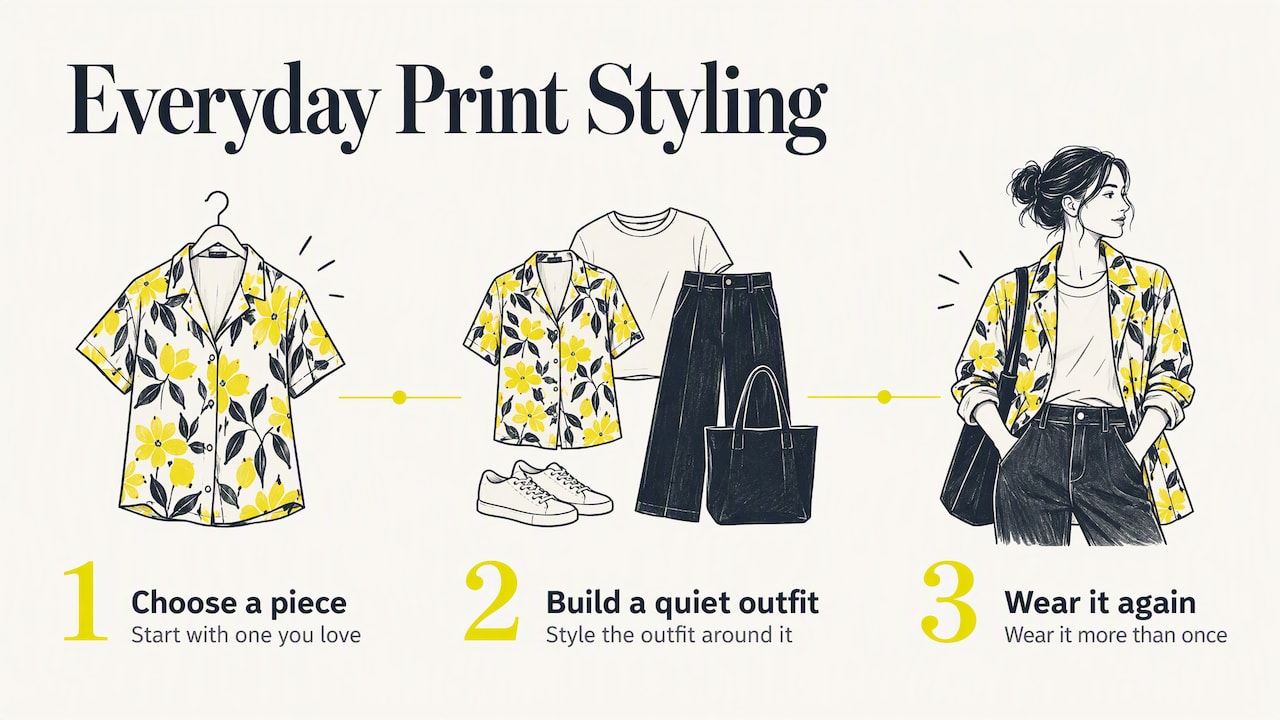
Our advice is simple. Start with one piece you love, build a quiet outfit around it, and wear it more than once. Sustainability in fashion is less about buying the “right” thing and more about wearing what you have bought until it earns its keep. If you want to see that idea in action, read our piece on upcycling with purpose at Tendalo Trading and our look at how Generation Z is turning pre-owned luxury into the new fashion frontier.
— Chad
Buying: local, made-to-measure or ready-to-wear
You have three realistic routes, each with trade-offs.
| Route | Best for | Watch out for |
|---|---|---|
| Buy fabric and have it made | A perfect fit and a one-off piece | Fabric shrinkage, tailor lead times, checking that the cloth is authentic |
| Ready-to-wear from local designers | Convenience and a considered cut | Limited sizes and small production runs |
| Streetwear and high-street pieces with print details | Trying the trend cheaply | Prints that look flat or will fade quickly |
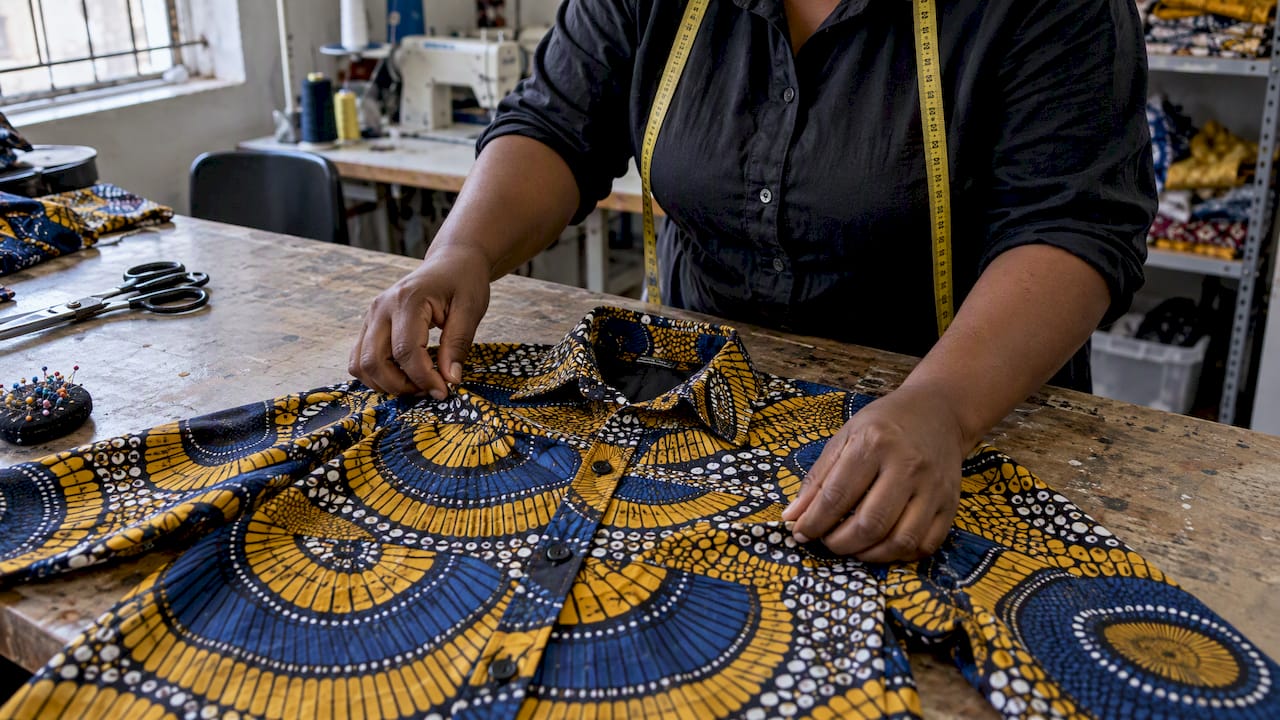
On made-to-measure: Writing Wild’s guide advises that shweshwe must be washed before sewing because it can shrink by up to 8%, and the starch has to come out. Tell your tailor you have pre-washed it, or ask them to do it before cutting.
If you are buying from overseas, remember that import costs add up. Our guide to Dubai modest fashion brands and South Africa’s import costs explains what to expect before you click “buy”.
A note on irregular print placement
Wax-print garments never look identical. One retailer’s care notes explain that pattern placement is rarely uniform, an inherent trait of the manufacturing process, so two shirts from the same bolt will differ slightly. That is part of the charm, but it matters if you are buying a matching set: check how the pattern falls at the seams and across the chest.
Caring for your African print clothing
Good care is what separates a piece you wear for years from one that fades after three washes.
- Wash gently. The same retailer recommends hand-washing in lukewarm water or professional dry cleaning to keep the fabric vibrant.
- Wash new shweshwe first. Starch and processing residue need to come out, and the cloth can shrink.
- Press on the reverse side. This protects the surface detail of the print.
- Dry in the shade. Strong sun fades saturated colours. This is practical common sense rather than a rule from a single source, but it is worth following in a Highveld summer.
- Wash dark and bright prints separately for the first few washes to avoid colour transfer.
Photographing your outfit
If you run a style blog, a small label or a social account, good images make print look the way it should: true colour, sharp pattern detail, natural light. Hiring verified photographers in South Africa is a straightforward way to get a lookbook or a set of outfit shots without guessing at quality. Brief them on the colours in your print so they expose for them properly.
Where to see more South African style
We publish coverage of fashion shows, designers and lifestyle events from Johannesburg and beyond. If you want ideas for how local labels style colour and cloth, start with our report on the Fashion Week Studio runway show at Hôtel Le Marois and the Trenton spring/summer launch. For the full picture of what we cover, from fashion to travel and culture, visit Joburgstyle. If you are a designer, venue or brand with a collection or an event to share, that is also where to reach us about features and collaborations.
FAQ
What are African print clothes?
They are garments made from printed or dyed cloths associated with Africa, such as Ankara wax prints and South African shweshwe. The V&A notes that the continent’s cloth traditions are extremely varied, so the term is a broad label rather than one fabric. Check the cloth name when you buy.
What is the difference between Ankara and shweshwe?
Ankara is wax-printed cotton, while shweshwe is a starch-stiffened South African cotton known as the “tartan of South Africa”. Authentic shweshwe is 90 cm wide with a Three Cats stamp on the reverse, according to Writing Wild. Ankara tends to be bolder and more graphic, shweshwe more structured and often smaller in pattern scale.
How do I style African print for streetwear?
Let one printed piece lead, such as a bomber, an oversized shirt or a bucket hat, and keep the rest in black, white or denim. Johannesburg style is described as leaning towards bold, oversized silhouettes, so volume suits the city. Finish with chunky sneakers.
How do I wash African print fabric?
Hand-wash in lukewarm water or use professional dry cleaning, and press on the reverse side. New shweshwe should be washed before sewing, as it can shrink. Always check the care label on a finished garment first.
Can I wear African print to work?
Yes. Choose a structured cloth like shweshwe in an A-line skirt or shift dress, and pair it with a plain shirt or knit and a neutral blazer. Keep accessories minimal so the print looks polished rather than loud.
Sources
- Africa fashion: cloth of a continent, V&A
- isiShweshwe: the fabric of life, Writing Wild
- African-Print Fashion Now! A Story of Taste, Globalization, and Style, Fashion History Timeline
- Streetwear Evolution in South Africa: Heritage Prints Meet Digital Culture, Ubuntu Times
- South Africa’s 2026 Fashion Trends, Ubuntu Times
- Local streetwear brands that are currently in the spotlight, IOL
- Thebe Magugu Made Mount Nelson Into an Artsy Kaleidoscope, Livingetc
- African Print Short Sleeve Shirt for Men, product and care notes
