
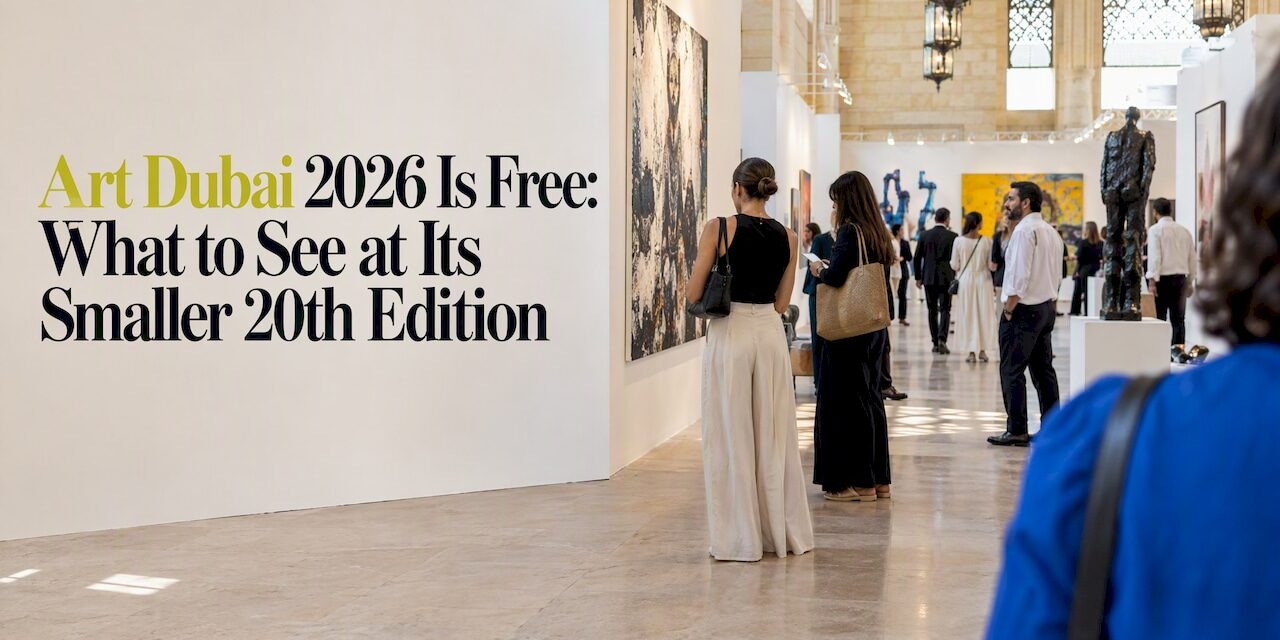
Art Dubai 2026 takes place at Madinat Jumeirah from 15 to 17 May, with an invitation-only VIP preview on 14 May. The fair’s 20th edition was rescheduled and condensed into a tighter, partnership-driven programme, and public entry carried no ticket price. For anyone weighing up whether this is the year to visit Dubai’s art week, the short answer is yes, and it costs nothing to walk in.
TL;DR:
- Friday public hours run from 4 PM to 9 PM, Saturday from 2 PM to 9 PM, and Sunday from noon to 6 PM.
- Performances and talks run at set times and do not repeat, so check the entrance desk schedule first and plan your route around them.
- With half a day, prioritize the Dubai Collection and Global Art Forum, then visit two or three gallery rows before catching a performance.
- Taxis and ride hailing offer the simplest arrival because Madinat Jumeirah sits far from the metro; parking fills quickly on Friday and Saturday evenings.
Table of Contents
- Art Dubai 2026 dates, venue and opening hours
- What to prioritise in the Art Dubai 2026 programme
- Why the exhibitor list looks different this year
- Getting to Madinat Jumeirah and making the most of your visit
- Inside the fair’s curated sections
- What the VIP preview includes and whether it’s worth seeking out
- Why Art Dubai’s 20th edition matters beyond the fair itself
- Fashion and lifestyle crossovers at Art Dubai 2026
- Talks, workshops and ways to meet people at the fair
- Artists and galleries worth seeking out
- African representation across the 2026 programme
- What makes the 20th edition different from previous years
- A smaller fair, a sharper visit
- More Art Dubai coverage and culture features from our platform
- FAQ
- Sources
Art Dubai 2026 dates, venue and opening hours
The fair runs across four days in total. The VIP preview takes place on 14 May, open to collectors, press and invited guests only, while the public days follow on 15, 16 and 17 May. Opening hours differ by day, so it’s worth checking the schedule before you plan transport or a hotel stay around the event.
Public hours for 2026, as reported ahead of the fair, were:
- Friday 15 May: 4pm to 9pm
- Saturday 16 May: 2pm to 9pm
- Sunday 17 May: 12pm to 6pm
The venue, Madinat Jumeirah, is a sprawling resort complex on Dubai’s coast, and the fair occupies its conference and exhibition halls rather than the hotel wings themselves. For 2026, press coverage described the fair as concentrated within the main conference area, a deliberate contraction from the sprawling, multi-tent layout of previous years. That makes the 2026 edition easier to navigate in a single visit: fewer long walks between sections, and a layout that rewards arriving with a shortlist rather than trying to see everything.
Entry points sit near the hotel’s main lobby and conference centre, with signage directing visitors from the Madinat Jumeirah entrance through to the exhibition halls.
What to prioritise in the Art Dubai 2026 programme
The programme for 2026 leans heavily on institutional partnerships rather than sheer exhibitor volume, and that shift shapes what’s worth your time.
- Global Art Forum: the fair’s long-running talks programme returns with its usual mix of artists, curators and cultural thinkers in conversation, held in the main auditorium space.
- Dubai Collection: a public-facing presentation under the banner “Made Forward”, bringing together works from the city’s growing civic art collection alongside institutional loans.
- Institutional presentations: Barjeel Art Foundation and Sharjah Art Foundation both contributed curated displays, giving visitors access to significant regional holdings that rarely travel.
- Performance and moving image: a programme of live performances and screenings runs through the public days, scheduled around the main booth hours.
- Art Dubai Digital: a dedicated section for new-media and digital commissions, distinct from the gallery booths.
If you only have half a day, start with the Dubai Collection presentation and the Global Art Forum stage, then work through two or three gallery rows before the performance slot. With a full day, add Art Dubai Digital and the Barjeel and Sharjah Art Foundation rooms, which tend to be quieter earlier in the afternoon.
Pro Tip: Check the daily performance and talks schedule at the entrance desk first; slots are timed and don’t repeat, so building your route around them saves backtracking.
Why the exhibitor list looks different this year
Art Dubai 2026 opened with a noticeably smaller footprint than organisers originally planned. The edition was rescheduled and contracted substantially because of regional tensions, with the number of participating galleries dropping substantially from originally planned figures down to a much smaller number. The fair ultimately ran with an estimated 45 to 75 presentations across its sections.
Organisers used the eight weeks before opening to rebuild the programme around institutional partners rather than trying to replace every withdrawn gallery, which explains the heavier presence of Dubai Collection, Barjeel and Sharjah Art Foundation content this year.
Alongside the smaller exhibitor count, Art Dubai changed how it charges galleries to participate:
- Fixed stand fees were waived for 2026.
- Exhibitors instead pay a percentage commission on sales made during the fair, capped at the equivalent of the old stand fee.
- The model shares financial risk between the fair and its galleries rather than asking galleries to pay upfront regardless of results.
For visitors and collectors, the practical effect is a tighter, more curated selection. Fewer booths means less duplication and a programme weighted towards galleries and institutions with strong existing ties to the region.
Getting to Madinat Jumeirah and making the most of your visit
Madinat Jumeirah sits on Dubai’s Jumeirah coastal strip, near Burj Al Arab, and is well served by taxis and ride-hailing apps, which remain the simplest way to arrive given the venue’s distance from the metro network. Driving is straightforward too, with on-site parking available for public visitors, though weekend evening slots can fill up during peak hours.
A few practical points worth knowing before you go:
- Ride-hailing apps and taxis drop off near the main conference entrance, close to the fair’s signage.
- On-site parking exists but fills quickly on Friday and Saturday evenings, the busiest public hours.
- Signage inside the main conference area is clear, though the condensed 2026 layout means less walking between sections than in previous editions.
- Arriving within the first hour of each day’s opening tends to mean shorter queues at the entrance desk.
Pro Tip: If you’re visiting on Saturday, the longest public day, arrive by 2pm sharp. The talks and performance slots fill the auditorium quickly, and arriving early secures a seat without missing gallery time.
Hotels along the Jumeirah coastal strip, including those within and near Madinat Jumeirah itself, put you within walking distance of the venue, which is worth factoring in if you’re planning multiple visits across the three public days.
Inside the fair’s curated sections
Beyond the main gallery rows, several curated sections give the 2026 edition its shape and are worth building a route around.
- Bawwaba typically spotlights solo or two-artist presentations commissioned specifically for the fair, offering a more focused viewing experience than a standard booth.
- Zamaniyyat centres on modern and historical works, often from artists working across the Middle East, North Africa and South Asia, giving the section a stronger art-historical weight than the contemporary-leaning main halls.
- Art Dubai Digital showcases new-media and digital commissions, a section that has grown in prominence as digital and screen-based practice gains ground in gallery programming more broadly.
- Partner presentations from Alserkal Avenue, Barjeel Art Foundation and Sharjah Art Foundation bring institutional depth to the fair, pairing commercial booths with curated, non-commercial displays drawn from established regional collections.
Each section rewards a slightly different kind of attention: Bawwaba for focused, single-artist viewing, Zamaniyyat for historical context, and the institutional partner rooms for depth you won’t find on the commercial floor.
What the VIP preview includes and whether it’s worth seeking out
The 14 May preview day is reserved for collectors, press and invited guests, and typically includes curator-led tours, private visits to notable collections around the city, and informal programming beyond the fair itself. It’s the quietest day to see the booths without public crowds, and galleries tend to prioritise serious conversations with visiting collectors during these hours.
For most art enthusiasts, the three public days from 15 to 17 May give full access to the booths, talks and curated sections without needing an invitation. VIP access generally requires an application through the fair or a sponsoring gallery or institution, and is aimed at active collectors and professionals rather than general visitors. Unless you have a specific collecting interest or a professional reason to attend, the public days offer the same core programme at no cost.
Why Art Dubai’s 20th edition matters beyond the fair itself
Art Dubai doesn’t operate in isolation. It sits alongside permanent fixtures like Alserkal Avenue’s gallery cluster, the Jameel Arts Centre and the SIKKA Art Fair, all part of a cultural infrastructure that runs year-round rather than for one week in May. Analysis of the city’s cultural economy treats this kind of infrastructure as a genuine input into relocation and investment decisions, not simply a backdrop for tourism.
That framing matters for understanding why 2026’s free, condensed edition reads differently from a typical art fair. Rather than functioning purely as a trade market for galleries, the anniversary edition leaned into its civic role: free entry, institutional partnerships prioritized over sheer exhibitor count, and programming built to draw in residents and visitors who might never buy a single work. Dubai’s creative economy ambitions, including residency routes aimed at creative professionals, sit in the background of that choice.
Coverage from The National and other outlets framed the 2026 edition as a demonstration of resilience under difficult circumstances, built around partnership rather than scale.
Fashion and lifestyle crossovers at Art Dubai 2026
Art fairs rarely stay confined to gallery walls, and Art Dubai’s anniversary edition leaned further into lifestyle programming than previous years. Expect pop-up presentations and events that pair visual art with fashion, design and hospitality, reflecting Dubai’s broader positioning as a city where fashion weeks, design fairs and art events increasingly share an audience.
For readers who follow fashion and culture crossovers, this is where Art Dubai gets genuinely interesting. Collector purchasing habits are shifting too: coverage of the 2026 edition noted that buying increasingly reflects personal narrative and identity rather than pure speculation, a pattern that mirrors how fashion consumers now choose designers and labels for what they say about identity rather than status alone.
Expect to see installations and activations near the main conference area that draw explicitly on fashion and lifestyle references, from material experimentation to presentation formats borrowed from runway shows. These crossovers tend to cluster around the public evening hours on Friday and Saturday, when foot traffic is highest and the atmosphere shifts from quiet viewing to something closer to an event.
If fashion-meets-art programming is what draws you to Dubai’s art week, build your Saturday evening around these activations rather than the quieter morning gallery rows, which suit focused viewing but less spectacle.
Talks, workshops and ways to meet people at the fair
Beyond the Global Art Forum’s main stage, Art Dubai 2026’s public days carry a steady run of smaller talks, artist walkthroughs and informal gatherings that reward visitors who linger rather than rush through.
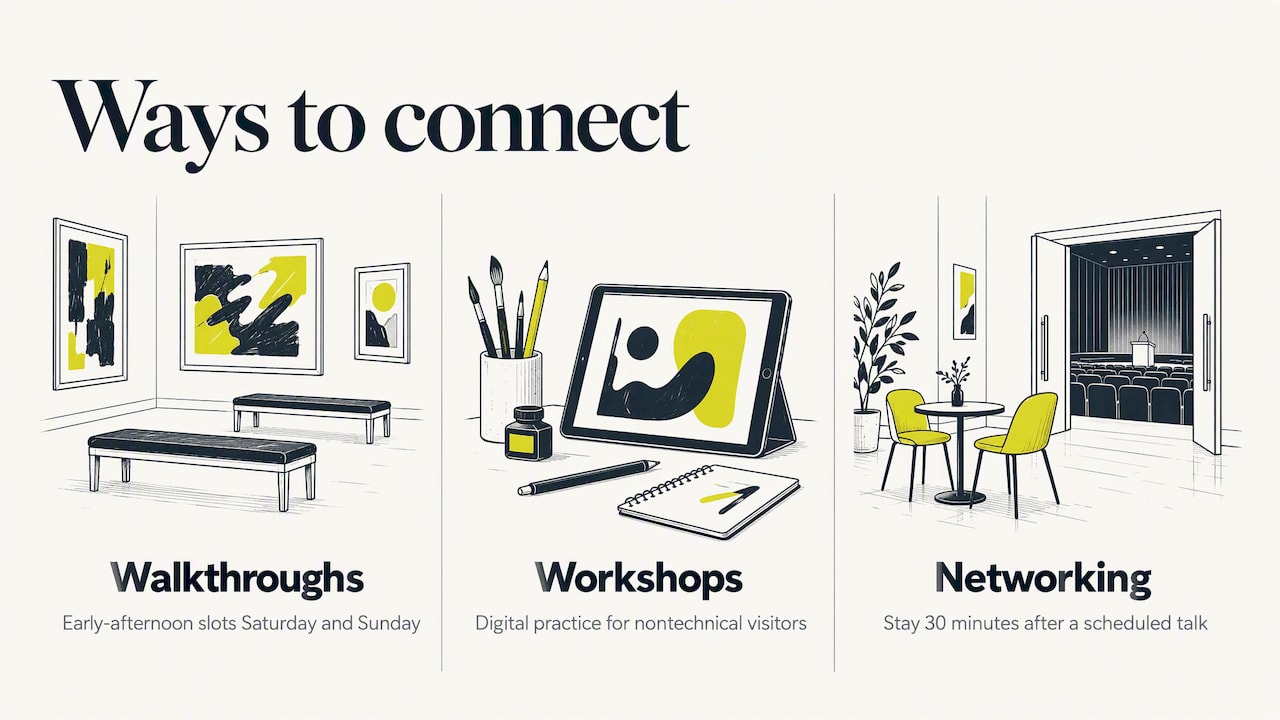
Galleries and institutional partners frequently schedule short, informal walkthroughs of their presentations, typically timed around the quieter early afternoon slots on Saturday and Sunday. These aren’t always listed prominently, so checking noticeboards or asking at individual booths tends to surface more than the printed schedule shows.
Workshops connected to the Art Dubai Digital section have become a regular fixture, often aimed at demystifying new-media and digital practice for visitors without a technical background. These sit well alongside the Bawwaba and Zamaniyyat sections if you’re building a day around close looking rather than big-name talks.
Networking tends to happen informally around the Global Art Forum auditorium and the main café areas within the conference centre, where panellists, gallerists and visitors mix between sessions. If meeting people working in the regional art world is part of your goal, timing a visit around a scheduled talk and staying for the thirty minutes afterwards usually works better than trying to approach people on the gallery floor.
Artists and galleries worth seeking out
With the exhibitor list contracted to roughly 50 participating galleries for 2026, the presentations that remain carry more weight individually than in a typical, larger edition. The Bawwaba section, built around solo and two-artist commissions, is the most reliable place to encounter a focused new body of work rather than a sampler booth.
Institutional rooms from Barjeel Art Foundation and Sharjah Art Foundation offer a different kind of discovery: historical and modern works from artists working across the Middle East, North Africa and South Asia, often shown alongside loans that rarely travel outside their home institutions. These rooms suit visitors who want context and depth over a quick browse.
Zamaniyyat, with its modern and historical focus, is worth a slower pass if you’re interested in how contemporary regional practice connects to earlier movements. Pair it with a stop at the Art Dubai Digital commissions for a sense of where new-media practice is heading, a section that’s grown steadily in prominence across recent editions.
Rather than naming a fixed shortlist, the most useful approach for 2026 is sectional: treat Bawwaba as your discovery stop, the institutional rooms as your context stop, and the main gallery rows as where established names show newer work.
African representation across the 2026 programme
Institutional partnerships are where African and wider regional representation shows up most clearly in the 2026 edition. Barjeel Art Foundation’s presentation draws on a collection built around modern and contemporary Arab art, while Sharjah Art Foundation’s contribution reflects its long-running commitment to artists working across the Middle East and North Africa.
The Zamaniyyat section, focused on modern and historical works from across the Middle East, North Africa and South Asia, is where African art-historical connections surface most directly within the fair’s curated programming, alongside pieces that speak to shared colonial and postcolonial histories across the wider region.
For visitors specifically tracking African representation within the gallery rows themselves, the contracted 2026 exhibitor list makes it worth checking the final programme closer to the fair, since participation shifted considerably from the fair’s original plans. The institutional and curated sections remain the most dependable route to seeing work connected to the continent’s artistic histories, given how heavily this year’s programming leans on partnership presentations over commercial booth volume.
What makes the 20th edition different from previous years
Beyond the condensed layout and free entry, 2026 carries a handful of programming choices unique to its anniversary status. The Dubai Collection’s “Made Forward” presentation, built around the city’s civic art holdings, is a new addition rather than a returning fixture, and gives public visitors access to works that don’t typically sit in a commercial fair context.
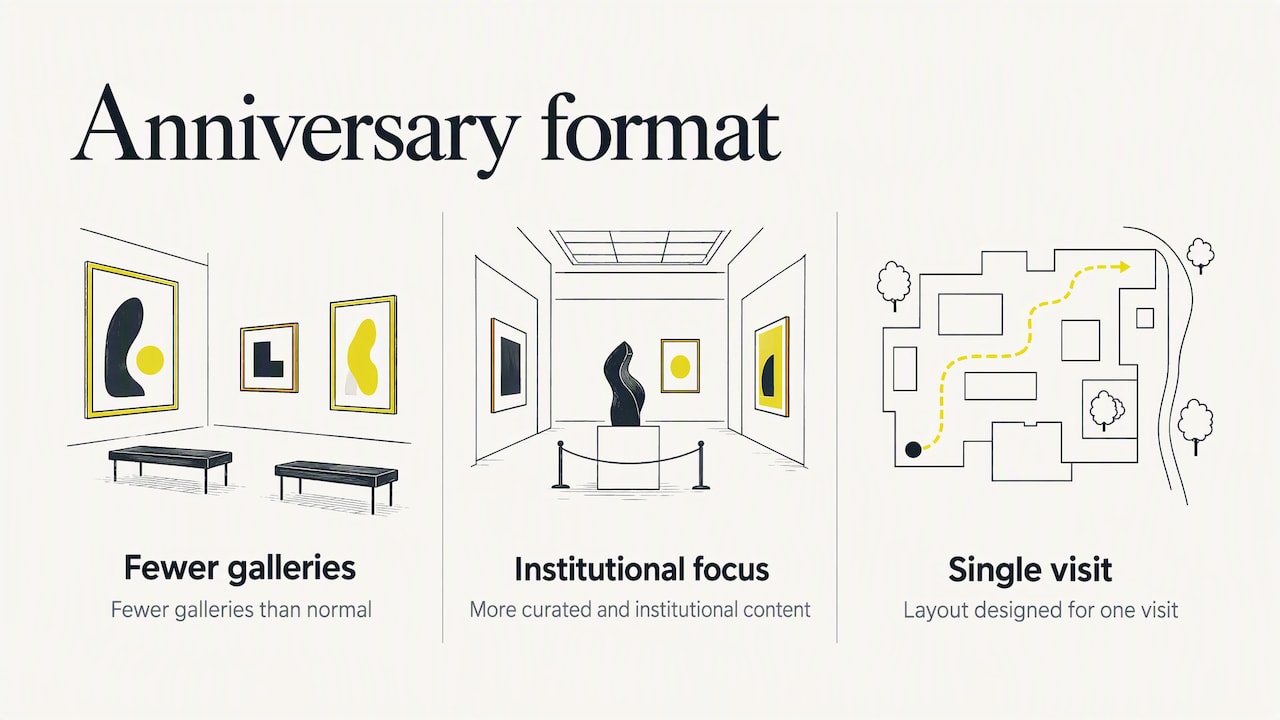
The heavier reliance on institutional partners, rather than a simple return to the previous scale of exhibitors, is itself a structural choice unique to this edition. Rather than padding the floor with additional commercial booths, organisers built the anniversary programme around depth: fewer galleries, more curated and institutional content, and a layout designed to be walked in a single visit rather than requiring a full weekend.
The revised exhibitor fee model, waiving fixed stand costs in favour of a capped percentage commission, is also specific to this edition’s circumstances rather than an established policy, making 2026 a genuine departure from how the fair has operated in previous years. Taken together, these choices make the anniversary edition feel less like a scaled-down version of a normal year and more like a distinct, one-off format worth experiencing on its own terms.
A smaller fair, a sharper visit
What struck me most about this year’s edition isn’t what’s missing, it’s what the contraction forced into focus. A fair with 50 galleries instead of 120 can’t rely on volume to impress you, so it leans on the strength of individual presentations instead. That’s a better visit for anyone who finds big fairs exhausting rather than exciting.
We’ve covered plenty of exhibitions and gallery openings closer to home, and the same principle holds: a tighter show often tells you more than a sprawling one. If you’re curious how that translates locally, our coverage of a solo exhibition at Scapegoat Gallery follows the same thread: fewer works, more weight each.
— Chad
More Art Dubai coverage and culture features from our platform
We cover art fairs and cultural events because they tell you something about where a city is heading, and Dubai’s anniversary edition is a genuinely good example of that. If you enjoyed this breakdown, a related feature on the Take a Stand exhibition at Sandton gives a sense of the photo-essay style brought to events like this.
For readers tracking how arts funding and talent development work across the region, a piece on the ACT Nyoloha Scholarship Programme finalists is worth a read, and a travel planning guide is a useful companion if you’re building a trip around the fair’s public days. Following arts and culture coverage can provide more on Art Dubai as details for future editions emerge.
FAQ
Where are the art galleries in Dubai?
Dubai’s commercial gallery scene is concentrated mainly in Alserkal Avenue, a warehouse district that hosts year-round exhibitions alongside the annual Art Dubai fair at Madinat Jumeirah. Several galleries also maintain spaces in the DIFC and Al Quoz districts, which sit close to Alserkal Avenue and often coordinate opening nights during Dubai’s art week.
Is art a good investment in 2026?
Art carries no guaranteed return, and collecting purely for investment is widely considered riskier than other asset classes because value depends heavily on taste, timing and provenance. Coverage of Art Dubai 2026 noted that buying increasingly reflects personal narrative and identity rather than pure speculation, which suggests many collectors now treat the decision as cultural rather than purely financial.
What are the 7 types of arts?
Definitions vary, but a commonly cited list includes painting, sculpture, architecture, literature, music, performing arts (theatre and dance) and film. Some versions swap film for photography or add a seventh category for digital and new-media art, which has grown significantly as a standalone practice.
What are the upcoming expos in Dubai in 2026?
Dubai’s cultural calendar in 2026 includes Art Dubai at Madinat Jumeirah from 15 to 17 May, alongside year-round programming at Alserkal Avenue and institutional partners such as the Jameel Arts Centre. Specific dates for other expos and trade events vary by sector, so checking each organiser’s own listings closer to the date is the most reliable way to confirm scheduling.
Do I need a ticket to visit Art Dubai 2026?
No, public entry for the three public days from 15 to 17 May was reported as free, with no advance registration required. The 14 May preview day remains invitation-only for VIPs, collectors and press.
Sources
- Art Dubai 2026 rescheduled as curated cultural gathering
- Reflection of resilience: Art Dubai’s postponed edition opens to healthy sales
- Art Dubai 2026 first look: What to expect at the 20th fair
- Dubai’s art season: Art Dubai at twenty, and the economics of a creative city
