


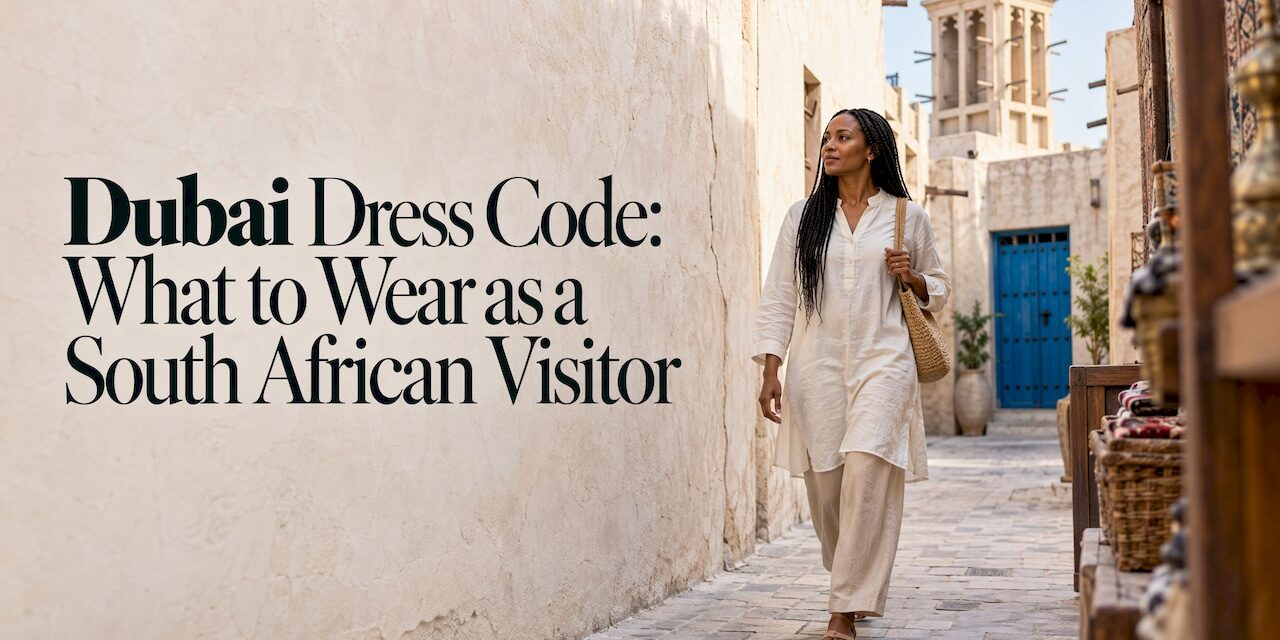
Dubai has no strict dress code for tourists. What it has is a public-decency standard and a few venue rules: cover up in malls, souks and mosques, wear swimwear only at the beach, pool and spa, and pack closed shoes and layers for the desert. Dubai’s own tourism authority says almost all attire is accepted, but modest, loose clothing is what keeps you comfortable and respected. Here is what that means for a Joburg or Cape Town wardrobe, place by place.
TL;DR
- No law tells tourists to wear an abaya or a headscarf. Women only cover their hair when entering a mosque.
- In malls, souks and heritage areas, shoulders and knees covered is the safe default for men and women. Malls are also freezing inside, so carry a light layer.
- Swimwear belongs at the beach, pool, waterpark and spa. Put a cover-up on before you walk into a hotel lobby or a mall.
- On a desert safari, wear loose cotton or linen, closed shoes and a scarf, and add a warm layer in winter.
- Public indecency is a legal matter in the UAE, so skip see-through clothing and offensive slogans.
Table of Contents
- What the Dubai dress code actually says
- What to wear in malls, souks and the street
- Beach, pool and hotel dress code
- What to wear on a Dubai desert safari
- Mosques and places of worship
- Evenings, restaurants and nightlife
- What to avoid, and what is a myth
- Packing for Dubai from South Africa
- Perspective
- Dress for your next trip with Joburgstyle
- FAQ
- Sources
What the Dubai dress code actually says
The first thing to understand is that the “rules” you read about are mostly guidance. The National, one of the UAE’s main English-language newspapers, notes that the country does not enforce rigid public dress codes and that there are no fines for uncovered shoulders or short skirts in most spaces. It also warns that many visitors take this to mean there are no boundaries at all.
The boundaries that do exist come from two places.
The public-decency standard. The Dubai Code of Conduct, issued by the Executive Council of the Government of Dubai in 2009 and reproduced online, says that in public places such as streets, shopping malls and restaurants, shorts and skirts should be of appropriate length. Clothing should not expose parts of the body indecently, be transparent, or carry obscene or offensive pictures and slogans. The same document says swimwear should not be worn away from the beach.
Venue rules. Mosques publish explicit garment requirements. Malls, hotels, clubs and attractions set their own standards, usually through signage and staff who will politely ask you to cover up.
In plain terms: nobody expects you to dress like a local, but everybody expects you to dress as though you are in a busy, family-oriented city. If you stay inside the comfort zone of the people around you, you will be fine nearly everywhere.
Why the advice sounds contradictory
You will see blogs insisting that women must cover their hair and arms, and others saying anything goes. Neither is accurate for tourists. The UAE government’s guidance for visitors leans towards loose clothing covering shoulders, arms and legs, and explicitly says women are not expected to cover their heads except in mosques, according to a summary of the federal portal’s guidance. Dubai’s tourism authority takes the relaxed view that almost everything is acceptable. The sensible reading is to treat “shoulders and knees covered” as a courtesy standard for public and traditional places, and relax it at the beach, in your hotel and in licensed venues.
What to wear in malls, souks and the street
Dubai’s malls are among the most visited places in the city, and they are where tourists most often get dress wrong. They are not beaches. Dubai’s tourism authority says swimwear is not considered appropriate in business districts and shopping malls, and the same line appears in the Dubai City Guide 2025.
A practical mall outfit:
- Women: a midi skirt or dress, linen trousers, or knee-length shorts with a top that covers the shoulders. A sleeveless top is fine if you carry a shawl or cardigan.
- Men: shorts to the knee or mid-thigh, or lightweight chinos, with a T-shirt or shirt. Vests and bare chests are out.
- Both: comfortable closed or flat sandals. You will walk a lot.
Malls are heavily air-conditioned, often around 20°C inside according to one local guide, so a light cardigan, scarf or overshirt is not just modest but practical. If you are used to Sandton City or Mall of Africa, think of the same polite smart-casual, but with shoulders and knees in mind.
Souks and old Dubai
Deira, Bur Dubai and Al Fahidi, including the spice and gold souks, are more traditional than Marina or Downtown. The same guide says that covering shoulders and knees there is respectful and also makes narrow, crowded alleys more comfortable. Dubai’s City Guide advises conservative dressing in historical areas and cultural sites. Wear breathable layers: loose cotton shirts, long skirts, light trousers and shoes you can walk in on uneven ground.
If you are planning a design-led day rather than a mall day, our guide to the Dubai Design District and its cafés is a more relaxed setting, though the same modest-casual rule keeps you comfortable.
Beach, pool and hotel dress code
This is where the rules are most relaxed, and where South Africans, who are used to Clifton and Umhlanga, can pack as they normally would. Swimwear is permissible at beaches, waterparks, public pools and spa areas. The Code of Conduct asks for conservative swimwear that suits Dubai’s culture, so thongs and very skimpy cuts are best left at home.
Three habits make the difference:
- Cover up when you leave the water. Swimwear should stay at the beach or pool, so carry a sarong, kaftan or shirt for the walk to the car, the lobby or a beachside café.
- Pick practical swimwear. One-pieces, sporty two-pieces, rash vests and board shorts all work. If you will be swimming with children or surfing the wake of a jet ski, you will be glad of the coverage.
- Keep topless sunbathing off the list. That falls under public indecency, which the next section covers.
For men, a good pair of beach shorts that can double as casual shorts for lunch on the sand saves you a change, as long as they are a sensible length and dry by the time you head indoors.
Hotel pools and private beach clubs are usually relaxed, but the same cover-up rule applies in restaurants and lobbies. If your trip includes the Jumeirah coast, our piece on the new era at Jumeirah Beach Hotel gives you a sense of the resort setting.

What to wear on a Dubai desert safari
The desert is not about modesty rules so much as sun, sand and temperature swings. Lonely Planet’s safari guide recommends loose-fitting clothing, a scarf for sun, sand and wind, and sandals from May to October, with closed shoes recommended from November to April, plus warm layers for cold winter nights in the open desert.
A simple formula:
- Top: a loose, long-sleeved cotton or linen shirt. Tight fabric traps heat and sand.
- Bottom: light trousers or a long skirt. If you are doing dune bashing or sandboarding, trousers are more comfortable than shorts.
- Feet: closed trainers you do not mind filling with sand. Sandals slip off on the dunes.
- Head and eyes: a cotton scarf, cap or hat, and sunglasses.
- Winter extras: a fleece or light jacket for the evening camp. January nights in Dubai can drop to around 15°C, and the open desert feels colder after dark, according to one seasonal guide.
If you have already done a Kruger or Pilanesberg game drive, you know the drill: neutral colours, layers, closed shoes. Our safari packing list for South Africa translates well to a Dubai dune evening, apart from the camouflage-adjacent greens, which are not needed here.
Safari tips beyond clothing:
- Bring a small pouch or zip bag for your phone to keep sand out.
- Skip heavy perfume and dangling jewellery, which snag and annoy in a bumpy vehicle.
- Travel sickness is common on dune drives, so go light on a heavy lunch beforehand.
- If you are pregnant, have a back or neck condition or travel with a baby, ask your doctor before booking dune bashing.
Mosques and places of worship
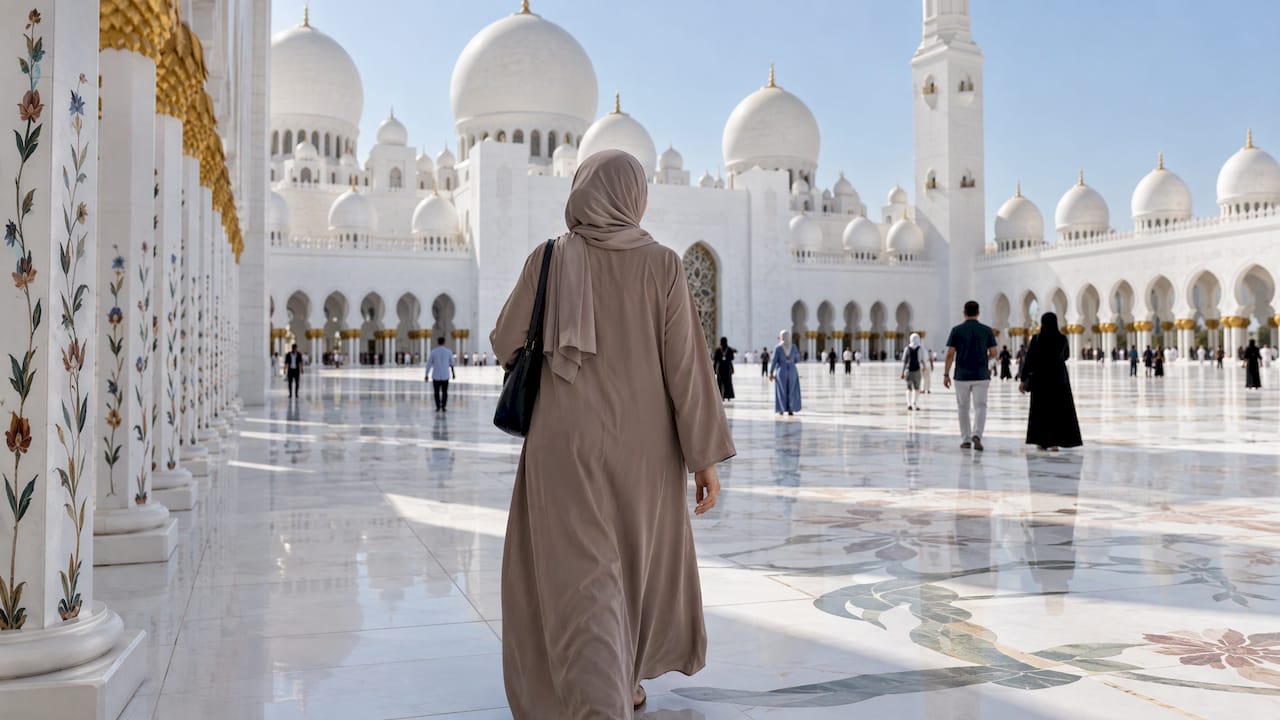
This is the one place where the dress code is explicit and non-negotiable. The Sheikh Zayed Grand Mosque in Abu Dhabi, a popular day trip from Dubai, publishes its requirements: women wear loose-fitting attire to the ankles, sleeves to the wrists and full hair coverage, and men wear clothing that covers the whole leg. Both should avoid transparent, tight-fitting or revealing clothing, sleeveless shirts for men, vibrant colours, heavy makeup, excessive jewellery and clothing with slogans or inappropriate drawings.
On the practical side, bring a large scarf for your hair and shoulders, and wear long, loose trousers or a long skirt. Local guidance notes that an abaya and head covering are usually provided on site if you arrive underdressed, but arriving prepared is quicker and more comfortable. Check each mosque’s official page for current visiting hours, as these vary around prayer times and religious periods.
Evenings, restaurants and nightlife
Dubai evenings run from relaxed beachfront dinners to polished rooftop bars. Smart-casual covers most restaurants: a dress or tailored trousers, a collared shirt or a neat top. Many upmarket venues, hotel bars and clubs set their own standards, and these are typically stricter on footwear and neatness than on skirt length. Gym wear, flip-flops and swimwear are the usual rejects.
Brunch is a Dubai institution, and it has its own dressing habits. Our Dubai brunch guide covers how it works and what it costs. For theatre and opera, check the venue’s own page for its current guidance before you go, and when in doubt, dress smart.
If you want clothes that suit Dubai’s modest-chic mood, read about Dubai modest fashion brands and what South Africans pay in import costs before you shop.
What to avoid, and what is a myth
Myth: tourists must wear an abaya or kandura. They do not. Emirati dress is an important part of local culture, but it is not mandatory for visitors, and shorts are generally acceptable in tourist areas when they are knee-length or mid-thigh.
Myth: you will be fined for bare shoulders. In most spaces, no. The National reports that there are no fines for uncovered shoulders or short skirts in most places. Typically a staff member offers a polite reminder or a cover-up.
Reality: public indecency is a legal matter. UAE law criminalises indecent acts in public, and it applies to tourists as well as residents. Authorities have discretion over what counts, which is why the practical advice is to avoid anything transparent, very revealing or carrying offensive slogans. Arrests of tourists for clothing alone are reported to be very rare, but there is no upside to testing it.
Skip these:
- Swimwear anywhere away from the beach, pool or spa
- Sheer fabrics, crop tops with very short shorts, and visible underwear
- T-shirts with offensive slogans or images
- Topless or nude sunbathing
- Bare shoulders and legs in mosques and heritage sites
Packing for Dubai from South Africa
The weather decides most of your wardrobe. Visit between November and March for more pleasant temperatures of roughly 25 to 30°C, while summer can top 40°C. Our guide on the best time to visit Dubai for South Africans weighs temperatures against flight costs.
A compact capsule for a week:
| Item | Why |
|---|---|
| 3 to 4 loose cotton or linen tops with sleeves | Heat, sun and modest coverage |
| 2 to 3 knee-length or longer bottoms | Malls, souks and the safari |
| 1 long skirt or loose trousers | Mosque visits |
| Large scarf or shawl | Hair covering, shoulders, freezing malls |
| Swimwear and a cover-up | Beach and pool, plus the walk back |
| Closed trainers and comfortable sandals | Safari, malls and walking |
| Light jacket or fleece | Winter desert nights and cold air-conditioning |
| Sunglasses, hat, high-SPF sunscreen | Midday sun |
The outfit that works from breakfast to dinner is a lightweight linen shirt-dress or loose trousers with a breathable top, trainers or flat sandals, and a scarf in your bag. If you like your holiday wardrobe to feel current, our look at global fashion trends for 2026 shows what is shaping what people wear right now, and a lot of it, from relaxed tailoring to flowing silhouettes, suits Dubai’s climate and manners well.
Perspective
Dubai is a city we love writing about, partly because it is so close to home for our readers. Joburg and Dubai share a love of style, and we cover both from the inside. Having been part of that conversation, we can tell you that the best-dressed visitors are not the most covered or the most daring. They are the ones who read the room.
Our view is simple. Dress for the place, not for the rulebook. Linen and cotton, good shoes, a scarf that does three jobs, and an eye for who is around you will carry you from the souk to the safari to a rooftop dinner. Fashion in the Gulf has a long tradition of elegant modesty, and plenty of local and regional designers are doing exciting work with it. It is a good reason to treat the dress code as an invitation to dress thoughtfully rather than a restriction.
We bring that same lens to everything we publish, from Johannesburg’s emerging designers to the fashion and travel scenes across Africa and Dubai.
Chad
Dress for your next trip with Joburgstyle
Joburgstyle covers fashion, travel, hotels and culture in Johannesburg, across South Africa and in Dubai, with a focus on local talent and what is worth your time. If you are planning a trip or building a travel wardrobe, start with our global fashion trends for 2026.

You can also browse everything from event coverage to destination stories on the Joburgstyle homepage.
FAQ
Is there a dress code for tourists in Dubai?
There is no strict legal dress code for tourists, and Dubai’s tourism authority says almost all attire is accepted. The expectation is modest, non-transparent clothing in public places, with shoulders and knees covered in malls, souks and heritage areas as the safe default. Mosques have explicit rules.
Can I wear shorts and sleeveless tops in Dubai?
Yes, in most tourist areas, particularly if shorts are knee-length or mid-thigh. Sleeveless tops are common, though many visitors carry a shawl or cardigan for malls and traditional areas. Avoid very short shorts, and cover shoulders and legs fully for mosques.
What is the beach dress code in Dubai?
Swimwear is fine at beaches, waterparks, public pools and spa areas, but not in malls or business districts. Choose conservative swimwear, avoid topless sunbathing, and wear a cover-up when you leave the beach or pool.
What should I wear on a Dubai desert safari?
Loose cotton or linen with long sleeves, light trousers, closed trainers, a scarf, sunglasses and a hat. From November to March, add a warm layer, because nights in the open desert get cold.
Do women need to cover their hair in Dubai?
No, not in public places, according to the UAE government’s guidance as summarised by a local guide. Women need to cover their hair only when visiting mosques, where an abaya and head covering are required and often provided.
Sources
- Essential Travel Tips for Dubai, Visit Dubai
- Dubai City Guide 2025, Visit Dubai
- There’s no dress code in the UAE but how appropriate is it, The National
- The Dubai Code of Conduct
- Dress Code in Dubai: Rules for Tourists and Residents 2026
- Dubai Desert Safaris: Everything You Need to Know, Lonely Planet
- What to Wear on a Desert Safari in Dubai, by Season
- Mosque Manners, Sheikh Zayed Grand Mosque Centre
- Dubai Dress Code Myths: What Tourists Really Need to Know
- Dubai Travel Tips and Advice, Holiday Extras
