
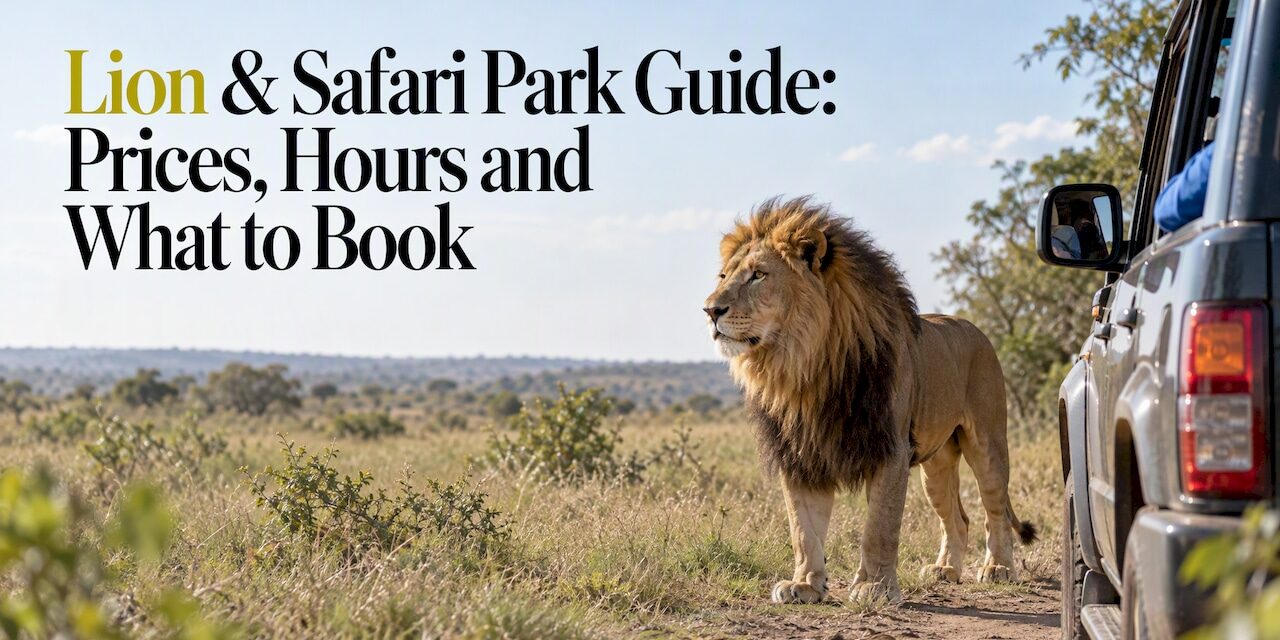
The Lion & Safari Park sits in the Cradle of Humankind, about 45 minutes from Johannesburg, and it is open every day of the year. Entry to the park and restaurant is free. You pay only for the activity you choose, from a R400 self-drive to a guided or sunset safari. This guide tells you what each option costs, which one suits you, when to arrive and how to behave around the predators.
TL;DR
- Entry is free. Self-drive costs R400 per adult, a one-hour guided safari R575 and a two-hour guided safari R705, all including the conservation fee.
- Gates are open 08:00 to 17:00 daily. Sunset safaris (R785 per adult) run only on Saturdays, Sundays and public holidays.
- First-timers get the most from a guided drive. Keen self-drivers can do an early self-drive, then a guided one.
- Keep windows shut in every predator camp and stick to 35 km/h.
- Rates change without notice, so check the official rates page before you leave.
Table of Contents
- What the Lion & Safari Park is
- Opening hours and how to get there
- What it costs: a plain-language price guide
- Self-drive or guided: how to choose
- The best time to go
- A plan for a half-day outing
- Safety rules that matter
- Photography tips
- Perspective: why we would book a guide first
- Thinking about other wildlife trips
- Follow Joburgstyle for your next outing
- Before you go: a quick checklist
- FAQ
- Sources
What the Lion & Safari Park is
The park is a roughly 600-hectare habitat on the R512 (Lanseria road), near Broederstroom and the Hartbeespoort area. It is not a reserve where animals roam freely among your car. Predators live in large enclosures that you drive through, while antelope and other species share a bigger open area.
It also plays a conservation role. According to Visit Gauteng, the park was previously the Lion Park in Lanseria, moved in 2016 to the Cradle of Humankind, and shelters threatened species such as the Cape wild dog, cheetah and rare white lions. Wikipedia’s entry on the park lists lions, cheetahs, hyenas, wild dogs and various antelope.
For a Johannesburg resident, it is one of the easiest half-day wildlife outings in Gauteng. For a visitor with a short stopover, it is a practical way to see big cats without the multi-day commitment of a Lowveld trip.
Opening hours and how to get there
As of October 2026, the park is open from 08:00 to 17:00 every day, including weekends and public holidays. There are no timed entry slots, so you can arrive when it suits you, but the later you come, the less time you have for the drive you chose.
The address is R512, Lanseria Road, Broederstroom, 0240. Listings such as Wetu’s location page give the same address. The park says it is 13 km from Lanseria Airport, which makes it handy if you are flying in or out of that airport. If you are travelling through Lanseria, our report on the Tap and Fly automated boarding gates is worth a look before you go.
Two timing points matter:
- The restaurant and curio shops close at 18:00, so eat or shop before a late-afternoon or sunset drive, not after it.
- Gates close at 17:00 for arrivals, so a sunset safari is the only activity that stretches past that hour. Book it ahead and arrive early.
What it costs: a plain-language price guide
All prices below are the park’s published rates as of October 2026, per adult, and include the conservation fee. They come from the official rates page. The park can change them without notice.
| Activity | Adult price | Senior (60+) | Children under 12 |
|---|---|---|---|
| Self-drive safari | R400 | R215 | One free per paying adult |
| 1-hour guided safari | R575 | R300 | One free per paying adult |
| 2-hour guided safari | R705 | R380 | One free per paying adult |
| 2-hour sunset safari (weekends and holidays) | R785 | R355 | One free per paying adult |
The park also lists longer or more specialised experiences. A 1-hour quad experience is R1280 per adult (16 and older), a 1.5-hour horseback safari is R760 (maximum weight 85 kg), and a safari and boat cruise adventure is R1395. The elephant sanctuary package, which combines an elephant tour, a monkey sanctuary tour and a guided safari, is R2345 per adult and R950 for children aged 4 to 14.
A worked example for a family of four
Take two adults and two children under 12 on a one-hour guided safari. Because one child is free per paying adult, both children ride free, so you pay for two adults: 2 × R575 = R1150. On the same day, a self-drive would cost 2 × R400 = R800. The R350 difference buys you a guide, who is usually the better value for children who tire of searching for animals.
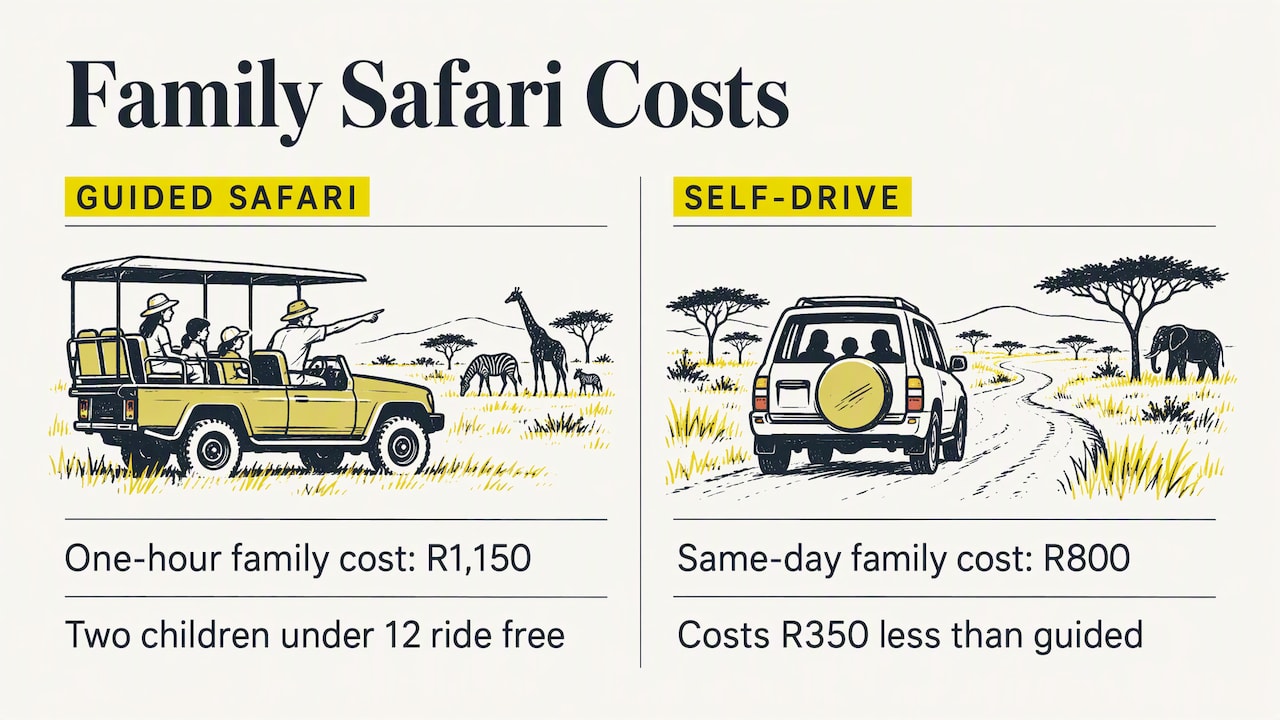
That rule has conditions. Check the current terms on the rates page, because some specials exclude certain offers.
Combos and specials
The park’s specials page, last updated in May 2026, listed a self-drive safari with a smash burger at R420 per adult, with one child under 12 free per paying adult (some exclusions apply). If you plan to eat there anyway, a combo is usually cheaper than buying each item separately. Specials change, so confirm what is running on the day.
Self-drive or guided: how to choose
Choose a self-drive if
- You have your own car and want to go at your own pace.
- You are comfortable scanning for animals in a large habitat.
- You want to repeat the loop, or you are travelling on a tight budget.
The self-drive takes you through the lion, wild dog and cheetah enclosures, then on to an extended drive among antelope and hyena. The park’s own tips say success relies on patience: drive slowly, scan waterholes and trees, and use binoculars or a zoom lens, because animals in the 600-hectare habitat are often well camouflaged.
Choose a guided safari if
- It is your first visit.
- You are bringing children or visitors from abroad.
- You want to know why the animals behave as they do.
Travel writers consistently recommend the guided drive because a guide knows animal behaviour and where the pride tends to be, which raises your chances of good sightings and adds context. Self-driving relies more on luck.
One hour covers the main predator camps. Two hours gives you a calmer pace and more time at each stop, which matters when you want photographs.
The split visit
The best balance, according to the same guide, is an early self-drive followed by a guided drive. You get flexibility first, then expert positioning when you want to fill the gaps. Because entry is free and you pay per activity, this costs R400 plus R575 per adult for the one-hour version, so budget accordingly.
The best time to go
Wildlife is most active in the early morning and late afternoon, and the park itself recommends those windows for viewing. Midday sun sends cats into shade, and photos suffer.
The daily lion feeding is typically around 12:00. For the best view, arrive 10 to 15 minutes before feeding time to secure a position. That means a morning drive and a midday feeding can be combined in a single outing without a rush.
Sunset safaris, which include a lion feeding, run only on Saturdays, Sundays and public holidays at R785 per adult. They are the most atmospheric option, but they are also the busiest days. If you prefer fewer vehicles, a weekday morning is calmer.
Winter mornings on the Highveld are cold, so dress in layers even in an enclosed vehicle. In summer, afternoon thunderstorms are common, so check the forecast.
A plan for a half-day outing
Here is a simple schedule that works for most visitors:
- 08:00 to 08:30: arrive at the gate, go through the vehicle check and book your drive.
- 08:30 to 10:30: self-drive or two-hour guided safari while the animals are active.
- 11:30 to 12:15: be in position for the lion feeding, arriving 10 to 15 minutes early.
- 12:30 to 14:00: lunch at the restaurant, entry to which is free, then browse the curio shops.
- Optional late afternoon: a second drive, or a sunset safari on weekends and holidays. Finish eating and shopping before 18:00.
Prefer a Sunday at the markets afterwards? Our guide to Johannesburg Sunday markets explains how to find local makers and avoid wrong dates, and our food markets guide helps when you want a meal in town on another day.
Safety rules that matter
These are not suggestions. The park’s own guidance says to:
- Keep windows closed in every predator enclosure: lion, wild dog, cheetah and hyena.
- Never leave your vehicle outside designated safe zones.
- Remember that calm-looking animals are wild and unpredictable.
- Keep to the 35 km/h speed limit and stay on the designated roads.
- Expect routine vehicle checks by security at entry to ensure no prohibited items come in.
All of this comes from the park’s self-drive guidance. If you have a convertible or a vehicle with a window that does not fully close, ask staff at the gate whether a guided vehicle is a better fit before you enter the predator camps. With young children, agree on the window rule before you start so nobody opens one for a photograph.
Photography tips
A phone is fine for the close cats, but animals in the open areas are far off. A zoom lens or binoculars help, as the park advises. A few practical points:
- Switch off your flash. It adds nothing through glass and can startle animals.
- Shoot from the window, not from a hand held out of it. Windows stay closed in predator camps, so clean your windscreen and side windows beforehand to avoid glare.
- Stay still for a minute at each stop. Cheetahs and wild dogs often move after a pause.
- Ask your guide where the sun will fall. Early or late light flatters the animals.
Perspective: why we would book a guide first
We cover Johannesburg’s lifestyle, culture and travel scene, and day trips like this are what readers ask us for most when visitors land. Our view is simple. The park is at its best when you treat it as a short, well-run introduction to African wildlife and to the conservation work behind it, not as a replacement for a game reserve.
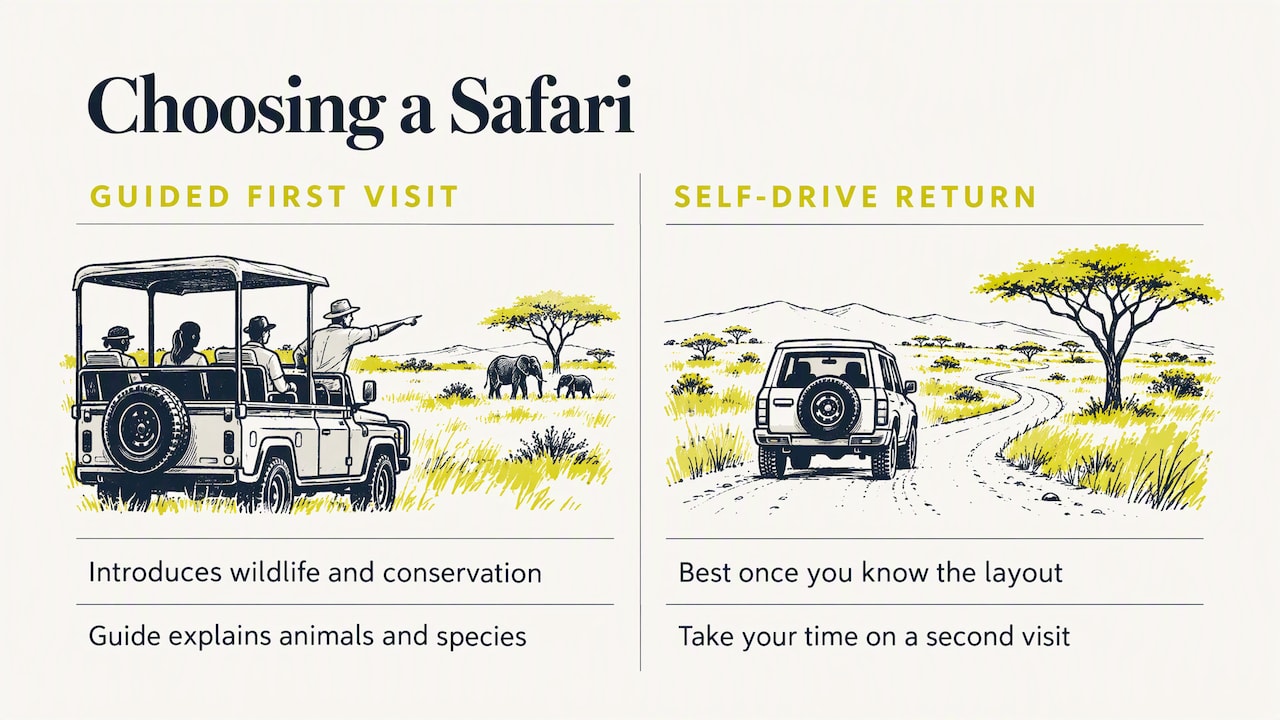
That is why we lean towards a guided drive for a first visit. A guide turns a loop of enclosures into a story: who the animals are, what the park is protecting, and why the species matter. Self-drive is a good second visit, once you know the layout and want to take your time. We also like that entry is free, because it lets you add a meal or a market stop without turning the outing into a big-ticket day.
If you are building a longer Gauteng weekend, pair the park with city culture. Our one-day Johannesburg loop and museums guide cover the Apartheid Museum, Maboneng and free-entry options, and our Rosebank art galleries day suits a slower afternoon.
— Chad
Thinking about other wildlife trips
A day at a park like this often sparks the bigger question: where next? Our feature on Kruger Station for families is a good starting point for the Kruger National Park.
If your travels go further afield, animal encounters are a big draw in many countries, for example elephant sanctuary tours in Phuket. Whatever the country, ask how many guests the operator allows, how animals are looked after, and whether the activity puts visitors in direct contact with wild animals.
Follow Joburgstyle for your next outing
Joburgstyle is an online platform covering fashion, lifestyle, arts, culture, travel and fine dining in Johannesburg, South Africa and Dubai. If you are planning a weekend that mixes wildlife with city style, start on the Joburgstyle homepage for our latest travel features, event coverage and local picks. Hotels, venues and tourism bodies that want to reach our readers can also work with us on sponsored features and event coverage.
Before you go: a quick checklist
- Check the official rates page for current prices and any specials.
- Decide on self-drive or guided, and book the sunset safari ahead if you are going on a weekend or public holiday.
- Pack binoculars or a zoom lens, water, sunscreen and warm layers.
- Arrive at least 10 to 15 minutes before the 12:00 feeding if you want to see it.
- Close all windows in the predator camps and keep to 35 km/h.
- Eat and shop before 18:00.
FAQ
How much is the entry fee at the Lion & Safari Park?
There is none. Entry to the park and restaurant is free, and you pay only for the activity you choose. As of October 2026 the self-drive is R400 per adult and guided safaris start at R575 per adult.
What is the best time to visit?
Early morning and late afternoon, when animals are most active. The daily lion feeding is typically around 12:00, so arrive 10 to 15 minutes early. On weekends and public holidays, a sunset safari at R785 per adult also includes a lion feeding.
What is there to do at the park?
You can self-drive, take a one- or two-hour guided safari or join a sunset drive. The park also lists quad, horseback, boat cruise and elephant sanctuary experiences, plus a restaurant and curio shops. Prices for those are on the rates page.
Can children come along?
Yes. One child under 12 is free per paying adult on the self-drive and guided safaris. Some activities, such as horseback safaris, have weight limits, and quad prices differ for passengers, so check each activity before booking.
Sources
- Rates and activities, Lion & Safari Park
- Specials, Lion & Safari Park
- Lion & Safari Park homepage
- Make the most of your self-drive safari experience, Lion & Safari Park
- Lion & Safari Park Johannesburg: prices, hours, game drive, Johannesburg Travel Guide
- Lion and Safari Park, Visit Gauteng
- Lion & Safari Park, Wikipedia
- Lion & Safari Park Self Drive location, Wetu
