
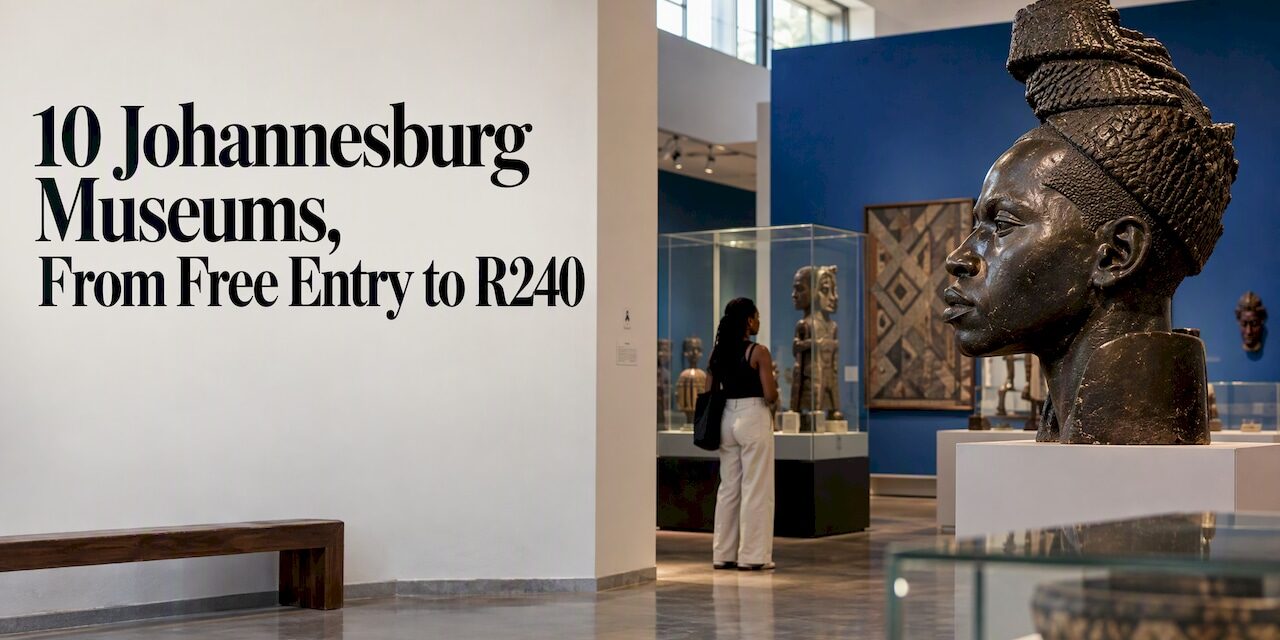
Start with the Apartheid Museum for modern South African history, Museum Africa for the story of the city itself, and Constitution Hill for a living heritage precinct. Add the Johannesburg Art Gallery and Wits Art Museum for art, the Origins Centre for deep human history, and Sci‑Bono for hands-on science. Most are paid or donation-based, and JCAF needs advance registration.
TL;DR:
- The Apartheid Museum charges South African adults R170 with ID and international adults R240, closes Mondays, and merits about two hours.
- Museum Africa is free, and James Hall Museum of Transport accepts donations, but check access before traveling to its La Rochelle site.
- JCAF requires advance registration, while museum hours and booking rules vary, so confirm both directly before setting out for your visit.
- Visit Sci‑Bono on a weekday outside school group hours to avoid its busiest crowds, and note that it opens Saturdays too.
Table of Contents
- 1. Which museums in Johannesburg should you visit first?
- 2. What should you know before you go?
- 3. How do you build a half-day or full-day museum itinerary?
- 4. Why do museums matter to Johannesburg’s cultural life?
- 5. Where can you keep track of new exhibitions and openings?
- FAQ
- Sources
- Where can you check official visitor information and ticketing?
1. Which museums in Johannesburg should you visit first?
Each of these places does something different, so pick by interest rather than trying to see everything.
- Apartheid Museum: The country’s modern history told through film, photographs and documents. Per the official visitor information, international adults pay R240 (audio tour included) and South African adults pay R170 with ID. Concessions run from R120 to R190, and guided tours cost extra. Allow enough time to explore, and note that it is closed on Mondays.
- Museum Africa: Johannesburg’s social and cultural history in Newtown, with permanent displays plus rotating photography and geology exhibits. Entry is free, and it opens Tuesday to Sunday, 09h00 to 17h00. It sits close enough to other Newtown sites to combine in one outing.
- Constitution Hill: A living museum and heritage precinct with guided experiences through former prison cells and fort areas. It is open daily and home to the Constitutional Court.
- Johannesburg Art Gallery (JAG): Housed in Joubert Park and established in 1910, it holds a collection of thousands of artworks and runs rotating exhibitions. Confirm opening times before you go.
- Wits Art Museum (WAM): A university museum devoted to African art, holding more than 18 000 artworks. It opens Tuesday to Saturday, 10:00 to 16:00.
- Origins Centre: Human origins exhibits, run as part of the university heritage network. A visit takes roughly 60 to 90 minutes, and the Wits museums pair scientific collections with public and school education resources.
- James Hall Museum of Transport: Vintage vehicles and transport history across themed halls, with more than 2 500 items. Entry is donation-based, and the city-managed site is worth checking before you travel.
- Sci‑Bono Discovery Centre: Southern Africa’s largest science centre, with hands-on exhibits, school programmes and holiday activities. It suits families, and it opens weekdays and Saturdays from 09h00 to 16h30.
- Joburg Contemporary Art Foundation (JCAF): Contemporary art from the Global South, with education programmes and events. You should contact or register in advance before visiting.
- Wits University Zoology Museum: A specialist natural-history collection with more than 60 000 specimens. It opens on weekdays, with guided tours by appointment, and suits school groups.
2. What should you know before you go?
A few habits save the most time and money.
- Check the day. The Apartheid Museum is closed on Mondays, and some institutions want online pre-registration while others accept walk-ins. Confirm current hours before you travel.
- Carry ID. South African rates at the Apartheid Museum apply to citizens with ID, and a valid student card unlocks concession pricing.
- Budget your time. Plan about two hours for the Apartheid Museum and 60 to 90 minutes for most art museums.
- Plan your transport. James Hall in La Rochelle is often tricky to reach, so use secure, reliable transport if you do not know the route. Inner-city sites in Newtown and Constitution Hill are easier to link on foot.
- Book ahead where needed. Register with JCAF before visiting, and consider guided tours for added context at Constitution Hill and the Apartheid Museum.
Pro Tip: Visit Sci‑Bono on a weekday outside school-group hours to avoid the busiest crowds.
3. How do you build a half-day or full-day museum itinerary?
Both plans work best when you start early and keep the transport simple.
- Half-day, Newtown and Constitution Hill: Start at Museum Africa when it opens at 09h00, spend about 90 minutes there, then head to Constitution Hill for a guided walk through the precinct. Use a secure ride between the two if you are unsure of the walking route.
- Full day, Apartheid Museum plus a heritage site: Allow time for the Apartheid Museum in the morning, then add a Soweto visit or a second heritage stop in the afternoon. Tour operators on platforms such as Viator and GetYourGuide often package these, so check what is on offer.
- Tickets: The Apartheid Museum sells tickets on site, but sites such as JCAF need pre-registration, so book those first.
- Lunch: Fit it between the morning and afternoon stops, ideally near the cultural precinct where you finish your first visit.
4. Why do museums matter to Johannesburg’s cultural life?
We see these museums as part of the city’s living cultural scene, not as relics. The galleries, heritage sites and science centres sit alongside the designers, artists and events we cover. Follow our exhibition previews, interviews and event coverage and you will spot the shows worth planning around, many of them shaped by local talent and creative communities across the city.
— Chad
5. Where can you keep track of new exhibitions and openings?
We cover exhibition previews and event roundups, which makes us a handy starting point for temporary shows and openings that never reach a museum’s permanent listing. Our feature on Art Meets Elegance at the Sandton Hotel shows the kind of exhibition coverage we publish.

- Browse our recent exhibition features for current shows
- Check our events pages for upcoming openings
- Read our Heritage Month coverage for themed programming
FAQ
Is the Apartheid Museum worth visiting?
Yes, it offers an introduction to modern South African history in Johannesburg. Allow time to explore, and note that the official visitor information lists South African adult entry at R170 with ID. It is closed on Mondays.
Is there an entrance fee for the James Hall Museum of Transport?
Entry works on a donation basis rather than a fixed ticket price, according to a travel listing. Because the museum is city-managed, confirm current access before you travel.
Which museums in Johannesburg are free?
Museum Africa offers free entry, and the James Hall Museum of Transport works on donations. Sites like the Apartheid Museum charge, with rates that differ for South African and international visitors.
What types of museums can you find in Johannesburg?
The city covers history and heritage, art, science, transport and natural history. Examples include the Apartheid Museum, Wits Art Museum, Sci‑Bono, James Hall Museum of Transport and the Wits University Zoology Museum.
Sources
- Visitor Information – Apartheid Museum
- Museum Africa
- Constitution Hill
- WHO WE ARE
- Wits Art Museum – Wits University
Where can you check official visitor information and ticketing?
Always confirm hours, prices and temporary closures on the official page before you set out. Start with the Apartheid Museum visitor page, the Constitution Hill site, and Sci‑Bono’s operating times. For Wits collections, use the university pages linked above. Ask about exhibition-specific booking rules when you check, since temporary shows can change the entry requirements.
